Tantaquidgeon Museum (1931)

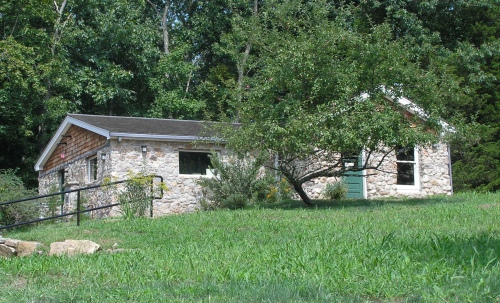
The Tantaquidgeon Museum, on the Norwich-New London Turnpike in Uncasville (in Montville), is the oldest Native American owned and operated Indian museum in America. The Museum‘s stone building was built in 1931 by three members of the Mohegan Tribe: John Tantaquidgeon, who was blind in one eye and on crutches, with his son, Chief Harold Tantaquidgeon, and daughter Gladys Tantaquidgeon. Dr. Gladys Iola Tantaquidgeon (1899-2005) was a Mohegan Medicine Woman who wrote A Study of Delaware Indian Medicine Practice and Folk Beliefs (1942), later reprinted as Folk Medicine of the Delaware and Related Algonkian Indians. She also did social and economic development work with the Bureau of Indian Affairs and the Indian Arts and Crafts Board. The Tantaquidgeon House and the Museum building were recently acquired by the Mohegan Tribe. In 2008, the Museum, which contains objects made by Mohegans and members of other Native American tribes, was reopened after renovations.

Heublein Building, Hartford (1896)

Adjacent on the north of the old Charter Oak Bank Building, on Trumbull Street in Hartford, is the Heublein Building, built in 1896. It was originally the home of G.F. Heublein and Brothers, a liquor and wine company which created the world’s first bottled cocktails in 1892 and began making A1 Steak Sauce in 1895. G.F. Heublein later built the Heublein Tower. The building in Hartford was constructed on the site of the eighteenth-century house of Dr. Norman Morrison, which was demolished to make way for the new building. Dr. Morrison (1690-1761), who was born in Scotland, settled in Hartford around 1740. He is credited with being the first man to separate the practice of medicine from pharmacy.

St. Anne’s Church, Waterbury (1906)

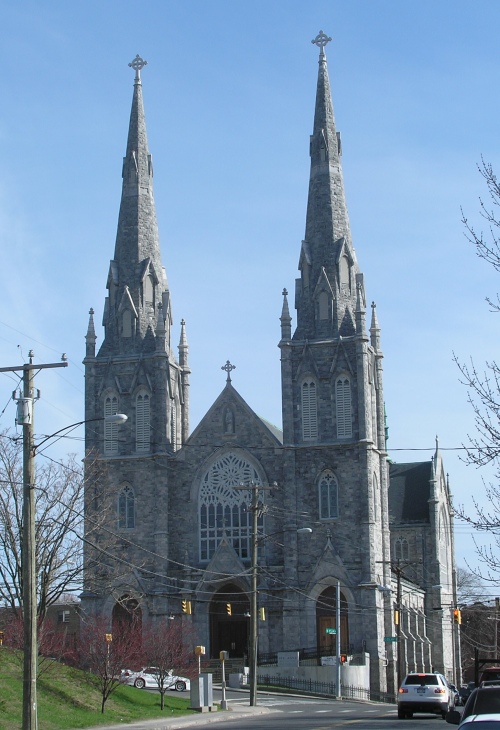
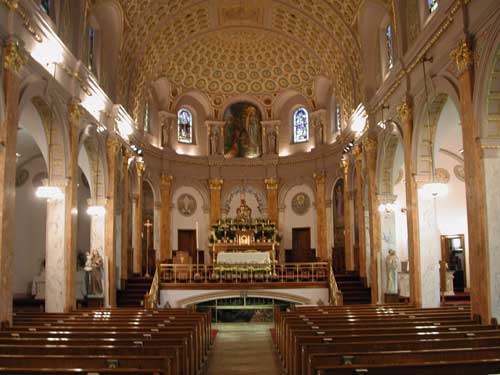
St. Anne’s Parish in Waterbury was organized in 1886 to serve the city’s French and French-Canadian Catholics. The parish’s first church was built in 1888-1889 on Dover Street. In 1906, work began on a much larger church, with the exterior being completed in one year. In 1912, the basement was finished and used for services while the rest of the interior was being worked on. It took several years to accumulate the necessary funds and there was also a delay due to the First World War, but the finished church was dedicated in 1922. The Gothic-style church has a structure of steel and brick with an exterior of granite and Vermont blue marble. The church survived fires in 1971 and 1978 and work was also undertaken in 1979 to repair the two great spires and dome. These signature features continue to impress motorists traveling through Waterbury on I-84.

UPDATE: Sadly, the condition of the two towering spires continued to deteriorate and they were removed in August, 2019.

Our Lady of Lourdes Church, Waterbury (1909)

As described in the first volume of the History of Waterbury and the Naugatuck Valley (1918), “In the year 1899 the Italian Catholics of Waterbury were organized into Our Lady of Lourdes Parish by the Rev. Father Michael A. Karam, the first pastor, at the request of the Right Rev. Bishop Tierney.” The parish’s first chapel was later replaced with the current Our Lady of Lourdes Church on South Main Street, begun in 1903 and completed in 1909. It was modeled after the Roman church of Santa Francesca Romana. According to the History quoted above:

The church has a frontage of 70 feet on South Main Street and is 127 feet in depth. The height of the nave or body of the church is 55 feet, and the campanile or bell tower is 100 feet in height. The basement was first completed and roofed over, and used for a number of years for church services, and was occupied also while the super-structure was being built. The general plan consists of a high nave, lighted by clerestory windows, with two aisles. Each aisle terminates in a semi-circular apse in which the side altars are placed. The main altar is also placed in a large semi-circular apse, surrounded by an entablature and columns in which are arches and niches for the numerous statues with which the interior is adorned. The exterior of the church is built of gray pressed brick and trimmed with Indiana limestone and terra cotta. The main roofs are of slate. The campanile, which was afterwards destroyed, was built near the rear after the manner of Italian churches.

Nuttinghame (1740)

Wallace Nutting (1861 – 1941), a former minister, became a leading antiquarian, entrepreneur and a major figure of the Colonial Revival movement in the early twentieth century. He authored books, reproduced antique American furniture and opened colonial houses as museums, including the Webb House in Wethersfield. He is most well-known for his photographs of country landscapes and the interiors of colonial houses, which were hand colored by women who worked for him and sold through a catalog. In 1906, Nutting had moved to a farm in Southbury, where he soon established a studio in a new barn he built on the property. He restored the old farmhouse, built in the 1740s, and named it “Nuttinghame.” Quite a few Nutting pictures feature Nuttinghame and the landscape that surrounds it. One notable image is titled “Nuttinghame Blossoms.” A particular parlor in the house was featured in many Nutting pictures, including: “A Bit Of Sewing,” “A Sip Of Tea” and “An Afternoon Tea.”

As Nutting‘s business prospered, he decided to move his operation to Framingham, Massachusetts in 1912, where he bought an Italianate house he called “Nuttingholm.” The Framingham house was later demolished, but his earlier house in Southbury still exists. In 1953, the farm was purchased by the comedic pianist Victor Borge. In the mid-1960s, Borge sold the property to a development company, which built a retirement community called Heritage Village. The Nutting/Borge house is now called the Meeting House and has executive offices, meeting rooms and a kitchen for use by community residents.