Shoor Building (1909)

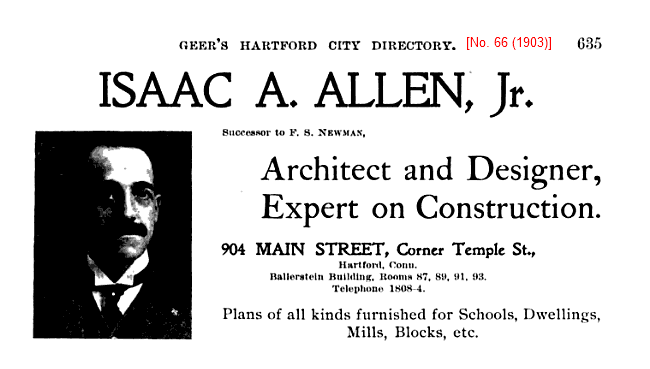
The Federal-style Corning House once stood at 150 Trumbull Street in Hartford, just north of the old Hall of Records building. In 1909, it was replaced with what later became known as the Shoor Brothers Furniture Company building. Shoor Brothers did not move in until 1955. The original stores to occupy the building in 1909 were the Flint-Bruce Company furniture store and the Luke Horsfall Company clothing store. The building was designed by Isaac A. Allen, Jr, who also designed the similar Dillon and Sage-Allen buildings in Hartford. Among the businesses now occupying the Shoor Building today is Trumbull Kitchen. A modern addition now adjoins the building where the Hall of Records once stood.

Sharpenhoe (1922)

Sharpenhoe is the name of a house at 132 Red Stone Hill in Plainville. This Colonial Revival home was built in 1921-1922 for Charles Hotchkiss Norton (1851-1942), a mechanical engineer and designer of machine tools. In the 1890s, Norton invented a heavy-duty cylindrical grinding machine capable of supplying machine parts for automobiles. The Charles H. Norton House was designed by Isaac A. Allen, Jr. of Hartford. As described in Modern Connecticut Homes and Homecrafts (1921): “this dwelling of red brick with garage attached is an exceptionally happy conception of the hip roof type of Colonial house with dormer windows. The design everywhere evidences a refinement of taste in the choice of its carefully considered decorative details.” Norton’s family continued to live in the house until about 1958.

Windsorville United Methodist Church (1877)


According to Vol. 2 of The Memorial History of Hartford County (1886):

The Rev. William H. Turkington, who occupied the pulpit of the Methodist Church at Windsorville [now Windsorville United Methodist Church] in 1882, has kindly furnished the following brief record of its history : —

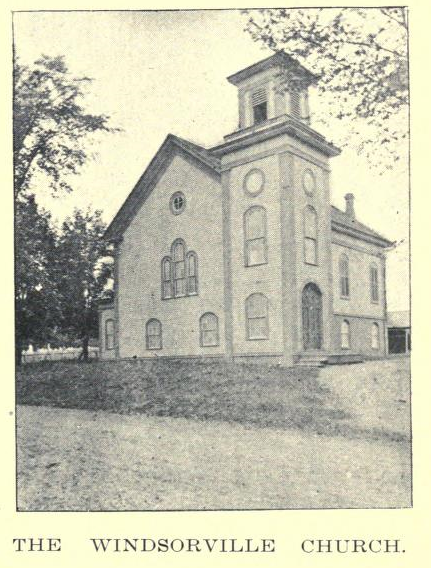
“The following sketch concerning the church in this place is taken from the minutes of the Methodist Episcopal Conference. The church was built in 1829 [at Thrall and Clark roads, moved to Windsorville Road in 1858]; the name of East Windsor first appears in 1829 ; the name of Ketch Mills in 1839; the name of Windsorville, in 1850. In 1876 the church was destroyed by fire. In 1878 [1877, according to the Souvenir History of the New England Southern Conference (1897)] the present church edifice was dedicated.”

A complete list of the men who in rotation have filled the pulpit of this church since its foundation in 1829 includes more than forty names. The present pastor [1886] is the Rev. H. M. Cole.

Oldfield (1818)

Between 1818 and 1822, John Moseley built a house on what is now Main Street North in Southbury. The lumber for the house was said to have been personally selected by Moseley in Maine. After Moseley died in 1876 at the age of one hundred, the house passed through several owners, including Albert and Ruth Aston, who donated the land that became the First Church Green. In 1902, a building across the street, which had once served as an inn or store, was moved and attached to the rear of the house and raised from one to two stories. The house’s interior was also featured in photographs taken by Wallace Nutting during the period when he lived in Southbury. Known as Oldfield, the house has been a bed & breakfast, called Cornucopia at Oldfield, since 1997.

Southworth-Williams House (1802)

Alpheus S. Williams was a Union general in the Civil War. He was born in 1810 in Saybrook (now called Deep River). [see General Alpheus S. Williams (1911), by Joseph Greusel and Memorial Addresses on the Life and Character of Alpheus S. Williams (1880)] In 1817, his father, Ezra Williams, bought the house at the corner of Main and Elm Streets in Deep River. It had been built in 1802 by Jabez Southworth, Sr. The year before, Ezra Williams had partnered with George Read, Phineas Pratt and others to form Ezra Williams & Company to manufacture ivory combs.

Mohegan Congregational Church (1831)

On Church Lane in Uncasville near the Tantaquidgeon Museum is the Mohegan Congregational Church. In 1827, land for the church was deeded to the Mohegan Tribe by Lucy Occom Tantaquidgeon, her daughter Lucy Tantaquidgeon Teecomwas, and her granddaughter Cynthia Teecomas Hoscoat. Their friend, missionary Sarah Huntington of Norwich, raised funds and opposed the relocation of the Mohegans during the era of Indian Removal, inspiring her relative, Congressman Jabez W. Huntington, to support the Tribe’s right to remain in Connecticut. The completion in 1831 of a Christian church played an important role at the time in preventing the removal of the Mohegans from their traditional lands. More recently, proof that the church property was the only plot of land that remained continuously owned by the Tribe was a critical factor in the reinstatement of federal recognition in 1994. With new funds, the Mohegan Tribe has restored the church, which has been for so long been a center of tribal political, social, and cultural life.