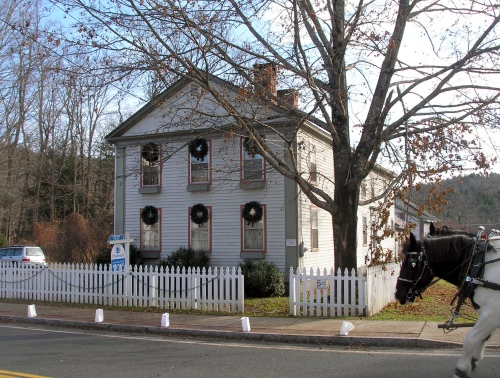
Elisha Steel House (1720)

The house at 64 Tolland Green in Tolland was built around 1720. From 1765, the residence was home to Elisha Steel. As described in Waldo’s Early History of Tolland (1861)

Elisha Steel, the son of Rev. Stephen Steel, married Sarah Wolcott, of Windsor, April 26, 1758. He graduated at Yale College in 1750, was educated for the bar, located in the town of Tolland, and engaged in the practice of his profession. He was chosen a representative in the General Assembly in 1761, and was reelected five times. He was one of the two Justices of the Peace from 1761 to 1766 inclusive. He was the first lawyer ever located in the town of Tolland, and the only one while he lived. He died August 17, 1773.

South College, Wesleyan University (1825)

When Wesleyan University was founded in 1831, it took over a campus on which two buildings, North College and South College, had already been built in 1825. They were originally constructed by the City of Middletown for use by Captain Partridge’s American Literary, Scientific and Military Academy. In 1829, after the Connecticut legislature declined it a charter to grant college degrees, Capt. Alden Partridge moved his Academy to Rutland, Vermont. The Academy later became Norwich University and the Middletown buildings were acquired by Wesleyan. The book, Norwich University, 1819-1911, Vol. I (1911), provides the following description of South College (originally called the Lyceum) and North College (called the Barracks):

These buildings were constructed of brown sandstone from the quarries in Portland. The “Barracks” was four stories high, 150 feet long and 52 feet wide, with a large attic and basement. Halls extended the full length of the building. The “Lyceum” was located 20 feet south of the Barracks, was three stories high, with a basement partly above the ground. At the front of the building was a tower 14×16 feet and 73 feet high. The basement floor was used for an arsenal and laboratory and the first and second floors for class rooms; the third floor called the “Hall of the Lyceum” was used as a chapel, drill room, and for public services.

The original North College was destroyed in a fire in 1906, but South College survived, being converted into offices that same year. The cupola and the belfry, which contains the Wesleyan Carillon, was designed by Henry Bacon and was added in 1916.

Alfred Alford House (1838)

The Alfred Alford House is a brick Greek Revival-style residence, built c. 1834-1838 and located at 3 Main Street in RivertonAlfred Alford was the brother of Abra Alford, who was the partner of famous chairmaker Lambert Hitchcock, and of Eunice Alford, who married Hitchcock.  The Alford brothers continued the manufacture of chairs in Riverton after Hitchcock moved to Unionville in 1842.  Alfred Alford’s company also produced wood planes.

First Congregational Church of Meriden (1879)

The First Congregational Church of Meriden had its origins in the 1720s, when people in the northern section of Wallingford began holding services in their homes during the winters. As related in the History of New Haven County, Vol. I (1892):

On the 9th of May, 1728, the inhabitants living in the above sections petitioned the governor and the general court to be established as a village or a parish, which prayer was granted and the new parish called Meriden. The new society flourished and having a successful ecclesiastical government soon longed for its own civil administration. This privilege, however, was not granted until 1806

The first meeting house had already been constructed in 1727 at the corner of Ann Street and Dryden Drive. This was followed by a new meeting house, built on Broad Street in 1755. This was in turn replaced, at the same location, by a larger one in 1830. A split occurred in 1848, as described in A Modern History of New Haven and Eastern New Haven County, Volume 1 (1918):

Prosperity and population had come to Meriden in the period just before that, and the church had so increased its membership that it felt the need of a new and larger building. This was erected, in 1846, on Colony Street, half a mile from the old site. But something arose which caused a difference of opinion among the members. Most likely the then familiar question of the abolition of slavery had something to do with it. At any rate, something like half a hundred members withdrew and formed the Center Church. The old building on Broad Street was vacant, and they secured possession of it. There they have remained and worshipped ever since—they and the new worshippers who have come in the changing process of seven decades.

The 1846 building continued in use by the First Congregational Church. It was replaced by the current one, at 62 Colony Street, in 1879. The church was renovated in the 1950s, when the south-side portico was removed. Although there were plans to erect a steeple, it was never built.

164 Oxford Street, Hartford (1915)

One of the houses that will be featured in tomorrow’s Mark Twain House & Museum Holiday House Tour is located at 164 Oxford Street in Hartford. It was built for an Allen of Sage Allen Department Stores in 1915. Augusta R. Roemer, a resident of the house, was a department president in the Woman’s Relief Corps in 1940-1941. Its present owners are known for their elaborate Christmas decorations, including over 60 themed Christmas trees.

191 Terry Road, Hartford (1923)

This coming Sunday, December 4, will be the 31st Annual Mark Twain House & Museum Holiday House Tour, presented by the Friends of the Mark Twain House & Museum. One of the houses that will be featured on the tour is a brick Georgian Colonial at 191 Terry Road in Hartford. Built in 1923, it was designed by William T. Marchant, who was also the architect of many other Colonial Revival buildings in the area, including the Alfred C. Fuller and Wallace Stevens Houses in Hartford, the Wood Memorial Library in South Windsor and the old Hall High School, now the Town Hall, in West Hartford.