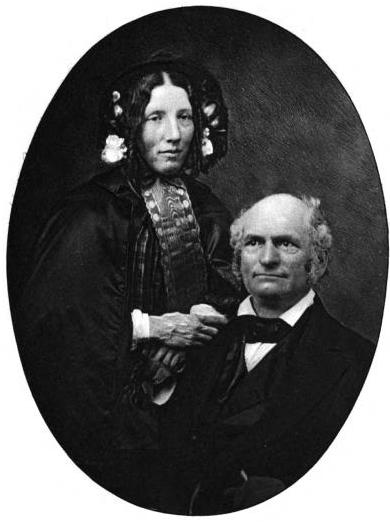
Hattie & Eliza Stowe House (1891)

Author Harriet Beecher Stowe (1811-1896) and her husband, Calvin Stowe (1802-1886), had twin daughters named Harriet (Hattie) Beecher (1836-1907) and Eliza Tyler (1836-1912) Stowe. Neither twin married, but they lived with their parents, traveling with their mother and managing the family’s households in Hartford and in Mandarin, Florida. After their mother’s death in 1896, the twins settled in Simsbury, where their brother, Charles E. Stowe, was the minister at the First Church of Christ. According to the new Images of America series book on Simsbury, their former house at 965 Hopmeadow Street was provided for them by their brother when he became minister in 1891. They wouldn’t have moved there until their mother died, so perhaps the house was built in 1891? Today, the house is used for offices.

Update 4/5/12: There’s a new article about the Stowe family’s connections with Simsbury. Check it out!

Squire’s Tavern (1796)

In 1796, Daniel Bennett of Weston built the house in Barkhamsted that would later be called Squire’s Tavern. From 1801 to 1821, it was operated as a tavern by Saul Upson, who then sold it to Bela Squire. The property had a farm, tavern, and blacksmith’s shop. The house had other owners after 1871, including Johann Ullmann, a German immigrant farmer. In 1929, the former Tavern was donated to the state and housed park rangers as part of People’s State Forest. By the 1990s, the building was unoccupied. It has since been restored and opened as a museum by the Barkhamsted Historical Society.

Wallingford First National Bank (1921)

Incorporated in 1881, the First National Bank in Wallingford was originally located in an 1882 Renaissance Revival building at 35 South Main Street. In 1921, the bank moved to a new Beaux-Arts building at 9 North Main Street. This building was bought by the town in 1960 and was the location of the town’s electric division payment office and tax collector’s office until 1989. It has since housed a drug store, bookstore and now a restaurant.

Eugene L. Cushman House (1920)

Another house in West Hartford’s West Hill Historic District is the house built in 1920 for Eugene L. Cushman. Located at 14 West Hill, it was designed by Cortland F. Luce in the Tudor Revival style. As reported in The Iron Age, Vol. 104, No. 26, December 25, 1919:

Eugene L. Cushman died at his home in West Hartford, Conn., Dec. 18, aged 65 years. Mr. Cushman was chairman of the board of directors of the Cushman Chuck Co., Hartford, Conn., having formerly been president of that organization.

Could this be the father of the house’s first occupant, or did Cushman die before it was completed?

Center Congregational Church, Torrington (1867)

Center Congregational Church, at 155 Main Street in Torrington, was originally known as the Third Congregational Church of Torrington. It was established in what was then known as Wolcottville, a village that later became the center of Torrington. As related in The Torrington Register Souvenir Edition. An Illustrated and Descriptive Exposition of Torrington, Connecticut, 1897:

The Third Congregational Church is so named, not as many strangers suppose because there are two others in the borough, but because it is the third Congregational church formed in the town, the one in West Torrington being the oldest and the one in Torringford being the next in age. The Torringford church was formed because of the deep swamp which its people had to traverse to get to the First Church. The third came into being in later times because the petitioners alleged that they must either ascend a hill of 630 feet to go to Torringford, or one-half as high to go to the First Church. The building of the First Church was then up on the hills toward Goshen. A debt of gratitude is due to Capt. Uri Taylor, who gave the land and built thereon a Congregational meeting-house before the church was organized. Later on, he added to his gift a parsonage and lot. The ecclesiastical society was formed Dec. 3, 1829, and the Church was organized July 11, 1832, with twenty-nine members. This was at a time when the population of the village numbered about 500. The meeting-house built in 1828 was remodeled in 1844, by running a floor under the gallery. The present building of stone was erected in 1866[-1867] at the cost of great sacrifice on the part of the members. The Chapel was built in 1880.

The church was expanded to its present size in 1900 and was renamed Center Congregational Church. The church was burned by arsonists in January 1979. The interior was destroyed, but the granite walls survived. The church was restored and reopened in October 1980.

Alexander T. Pattison House (1896)

At 750 Hopmeadow Street in Simsbury is a distinctive house constructed in 1896 for Alexander T. Pattison. The following biographical entry is from Taylor’s Legislative History and Souvenir of Connecticut for 1903-1904:

Hon. Alexander T. Pattison of Simsbury, Republican Senator from the Third District, is the son of Joseph and Delia (Sceery) Pattison. He was born in East Weatogue, town of Simsbury, March 26, 1861, and received his education in the public schools of the town, Granby Academy and Prof. McLean’s School, Simsbury. He began his business career as clerk in the general store of Judson Wilcox, which was established in 1851. Since January, 1886, he has successfully managed the business. He married, October 7, 1885, Miss Ella Ruth Wilcox, daughter of Judson and Nancy S. (Chapman) Wilcox of Simsbury. They have had four daughters: Lucy W., born October 14, 1886; Stella C, born September 1, 1888, died Dec. 26, 1888, Julia E., born August 26, 1890, and Ruth Frances, born June 8, 1902. He has been secretary and treasurer of the Simsbury Cemetery Association since 1888, and is a director and secretary of the Simsbury Electric Co. He was a valuable member of the House in 1897. This session he was Senate chairman of the Committee on Appropriations and plainly showed that he was the “right man in the right place.” He was also chairman of the Committee on Engrossed Bills. Senator Pattison’s influence is ever felt for the good of the community in which he resides.

Horace R. Grant House (1923)

One of the houses in West Hartford’s West Hill development of the 1920s is the Horace R. Grant House, designed by Cortland Luce and built in 1923. Horace R. Grant, President of the Allen Manufacturing Company, is credited with conceiving the idea for the development. He planned it with Stanley K. Dimock, who had inherited the land from his father, Ira Dimock, a silk manufacturer. Ira Dimock had purchased the former Vanderbilt Mansion on the property, which was later demolished to make way for the new houses. The Grant House has a rear addition, dating to 1937 and designed by William T. Marchant.