
The first Masonic Lodge in Meridan was established on January 1, 1851. The current Masonic Temple, at 112 East Main Street, was built in 1927. The Neo-Classical building features two Egyptian-style columns at the front entrance.
The first Masonic Lodge in Meridan was established on January 1, 1851. The current Masonic Temple, at 112 East Main Street, was built in 1927. The Neo-Classical building features two Egyptian-style columns at the front entrance.

At 76 Prospect Street in Rockville (Vernon) is the 1893 mansion built for George Sykes. It was the first in a series of Queen Anne-style homes built for the owners of Rockville‘s textile mills. George Sykes came to America from Britain as a boy and from early on worked his way up in the textile industry. In 1866, at the age of 26, he came to Rockville to manage Hockanum Company mill, of which he was later president.

John Allen (1763-1812), originally from Great Barrington, Mass., attended the Litchfield Law School from 1784 to 1786. He set up practice in Litchfield and became active in politics, serving as in the Connecticut House of Representatives (1793-1796) and the U.S. House (1797-1799). He was later a member of the State council and of the Supreme Court of Errors from 1800 to 1806. The John Allen House, at 91 North Street in Litchfield, was built around 1799. The Federal-style house was expanded and altered in the Italianate style around 1865.

The house at 127 Oxford Street in Hartford was built in 1894 for James B. Cone, a Director of the Hartford Carpet Comany and of the Aetna National Bank. The house, designed by Frederick Royal Comstock, was featured in an article, titled “A New England Residence,” in the October 1897 issue of Carpentry and Building. According to the article:
The treatment of the exterior is such as to give a rich and harmonious effect to the design, while the rooms are arranged with a view to the convenience and comfort of the occupants. A feature which will strike many as all essential in a building of this character is a broad piazza extending across the front of the house.
Some of the house’s exterior decoration has been altered over the years, while inside some of the rooms have been combined to create larger spaces. The house was also later expanded with an addition to the south with a corresponding extension of the front piazza. The house will be part of this year’s Mark Twain House & Museum Annual Holiday House Tour, on Sunday, December 4th, 2011.

The church at the corner of Barnum and Noble avenues (235 Barnum Avenue) in Bridgeport was built in 1883 as the Washington Park Methodist Episcopal Church. The brick Gothic church with elaborate terra cotta trim was designed by Lawrence B. Valk of New York. Organized in 1853, Park Church was the first church in East Bridgeport. Today, the building is Protection of the Blessed Virgin Mary Ukrainian Catholic Church. This parish was founded in 1950 and, the following year, acquired a church building and rectory on Grant Street. An adjoining building was purchased in 1958 to become the parish school, but in 1966, the parish was notified by the state that their property was required for the building of a hospital. In 1970, therefore, the parishioners voted to purchase the former Methodist church on Barnum Avenue to become their new home.

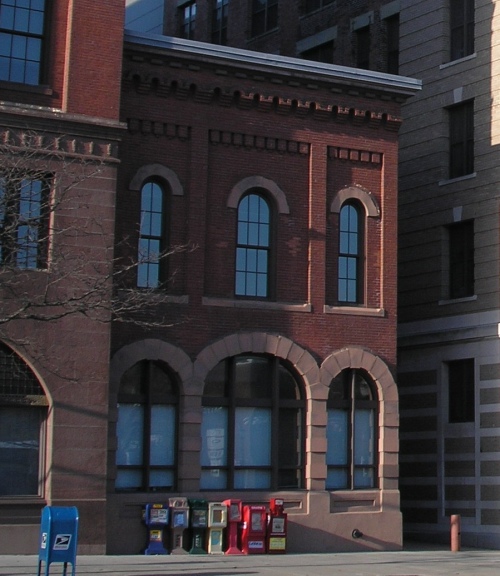
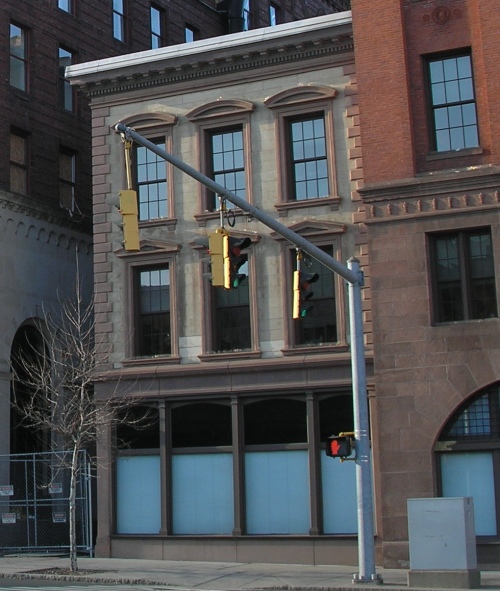
The building which is today New Britain’s City Hall was first opened in 1886 as the Hotel Russwin. Financed by Henry E. Russell and Cornelius B. Erwin, it mainly served the numerous salesmen and clients of the Russell and Erwin Manufacturing Company, makers of architectural hardware. The Italian Renaissance Revival design was created by Joseph Merrill Wells of McKim, Meade & White (Wells was Stanford White’s principal assistant). Wells was a pioneer in the use of terra cotta detailing, as displayed on the Russwin Building. The same firm was hired in 1907 for the building‘s conversion into City Hall that took place in 1908-1909. An addition to the building was completed in 1992. On either side of the Russwin are two other nineteenth-century buildings that were later incorporated into the City Hall. The building on the right/west side was built c. 1860 as the New Britain National Bank (the Bank later moved to a new building next door). The building on the left/east side was built c. 1870 as a U.S. Post Office and served until a new one was built in 1911. (more…)

The Thomas Clarkson House, at 212 Huntington Street in Shelton, is a later Greek Revival house, built c. 1830-1850. According to the National Register of Historic Places Registration Form for the Huntington Center Historic District, the Clarkson House is essentially a Colonial half-house form with a shallow hipped roof. In addition, the doorway probably once had a traditional Greek Revival-style wide frieze and cornice, but this part of the entablature was later removed.

You must be logged in to post a comment.