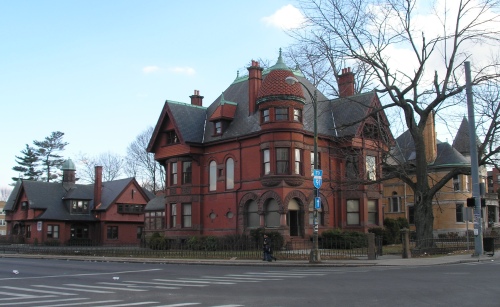
Silas Webster Robbins, a partner in the seed business, Johnson, Robbins and Co., built an impressive Second Empire style mansion on Broad Street Green in Wethersfield in 1873. Damaged by fire in 1996, the home was purchased in 2001 by new owners, who have restored it. The Silas W. Robbins House will open as a bed-and-breakfast on November 1, and a number of gala events are planned for this month, including daily house tours, Oct. 6-Oct. 14, to benefit the Keane Foundation.
John Millard House (1790)
In 1858, John Millard bought a brick Federal-style house on South Main Street in West Hartford. The date of the house’s construction is not known, but land records indicate a sale of this land in 1790 with a house and barn in existence. Part of the property was purchased in 1821 by James Hurlbut. John Millard, like his relative Samuel Millard, had a farm along South Main Street. Millard and then his daughter lived in the house until 1921, when it was bought by the current owner’s grandparents.
Capt. John Bulkeley House (1820)

Built in 1820, on Main Street in Wethersfield, for Capt. John Bulkeley, who had commanded a schooner during the American Revolution. It was later owned by Dr. Abner Warner, a surgeon who served in the 16th Connecticut Volunteer Regiment during the Civil War. The house is transitional between the Federal and Greek Revival styles.
(more…)Museum on the Green (1840)
Located on the Green in Glastonbury, the town’s first secular Town Hall was built between 1839 and 1840 by Parley Bidwell, who probably also designed it. Glastonbury’s first Meeting House of 1693 had stood nearby. The 1840 building served as the Town House for a century, and is now the Museum on the Green, operated by the Historical Society of Glastonbury.
Rev. William Thompson House (1847)
Built in 1847, on Main Street in East Windsor Hill, by the Theological Institute of Connecticut as a residence for its Chair of Biblical Literature, Rev. William Thompson. The Institute sold the home to Rev. Thompson when it moved to Hartford in 1865 (it is now known as the Hartford Theological Seminary). Rev. Thompson came from Goshen and, according to Williston Walker’s A History of the Congregational Churches in the United States (1894), his “connection with the seminary lasted till his death, in 1889, and to his wisdom, patience, self-denial, and teaching skill, whatever success the institution has had is chiefly due.”
The John Gaylord House (1772)
Located on Palisado Avenue in Windsor, the John Gaylord House was built in 1772. John Gaylord‘s ancestors were French Huguenots who had emigrated to England in the 1550s. The Gaylord family was one of the first to settle in Windsor.
Travelers Insurance Company (1928) and Hartford-Connecticut Trust Company (1920)

Two 1920s Colonial Revival skyscrapers, on Central Row in Hartford, across from the Old State House, exemplify an architectural style based on the classical column, with the upper stories corresponding to a column’s capital. The classical detailing on both buildings link them stylistically to the nearby Old State House.
The Hartford-Connecticut Trust Company Building (on the Right), designed by the firm of Morris & O’Connor, was built in 1920. The company was created in 1919 as a merger of the Connecticut Trust and Safe Deposit Company and the Hartford Trust Company. In 1954, it merged with Phoenix Bank to become Connecticut Bank and Trust Company. The structure on the roof, which looks like a classical building itself, once contained a restaurant. The Travelers Insurance Company Building (on the Left) was built in 1928 along similar lines.

You must be logged in to post a comment.