Capt. John Appleman House (1837)

Capt. John Appleman was a Mystic sea captain who commanded the Naptune and the Hero. His Greek Revival home was built in 1837 and is on Gravel Street in Mystic. The original pedimented entryway to the house was destroyed in the Hurricane of 1938. In 1958, the house was purchased by Capt. Edward L. Beach. He commanded the nuclear submarine, USS Triton, in 1960, when it became the first vessel to execute a submerged circumnavigation of the Earth. Capt. Beach was also a bestselling author of the World War II submarine novel, Run Silent Run Deep (1955).

James Plumb House (1804)

jacob-pledger-house.jpg

The house traditionally known as the Jacob Pledger House, at the northeast corner of Westfield and East Streets in Middletown, was actually built by a prosperous farmer, named James Plumb, in 1804. The attached kitchen wing may have been Plumb’s original dwelling (built in 1740), before he built his early Federal-style mansion house. The house remained in the Plumb and Barry families until 1888 and is still a private residence.

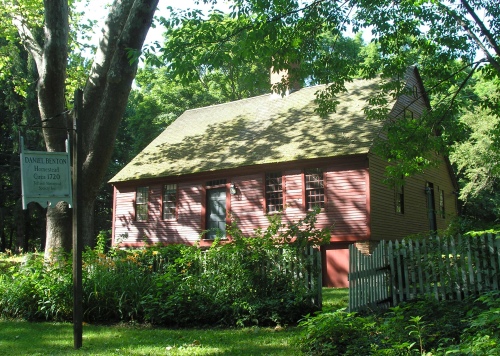
Daniel Benton Homestead (1720)

daniel-benton-homestead.jpg

The Daniel Benton Homestead in Tolland was built in 1720 and was home to members of the Benton family until 1932. In 1777, during the Revolutionary War, twenty-four Hessian officers, who had surrendered after the British defeat at Saratoga, were quartered in the house on their journey to Boston, from where they would be shipped back to Germany. Daniel Benton had three grandsons who fought in the war: two died as a result of imprisonment by the British while the third, Elisha Benton, returned home in late 1776, after his confinement on a prison ship, where he had contracted smallpox. Back home, he was nursed by Jemima Barrows, whom he had courted before the war. He died after a few weeks, and she followed shortly after, having contracted the disease during their time together. They were both buried on the property, but were not buried next to each other, as they had not married. The Daniel Benton Homestead is famous as a haunted house and numerous articles with ghost stories about the house have been written on many sites. The house was purchased in 1932 by Florrie Bishop Bowering, a WTIC radio personality, who lived there until she died in 1968. The next owners, Charles B. Goodstein and William A Shocket, donated the house the following year to the Tolland Historical Society to open as a museum.

Riley-Gridley House (1780)

Riley-Gridley House

The Riley-Gridley House was probably built around 1780 by Julius Riley, in Cromwell, at a time when it was a part of Middletown known as “Upper Houses.” Riley sold his house in 1784 to Isaac Gridley, with the stipulation that his two unmarried sisters could live in the house until they married; they never did and remained in the house, both living to be over 100 years old. Isaac Gridley was a graduate of the Yale Class of 1773 and had been a roommate there of Nathan Hale. He bought the house in Cromwell the same year he married Elizabeth, the daughter of Capt. John Smith. From 1855 to 1880, the house was owned by Elizabeth Crocker, the widow of Zebulon Crocker, the former minister at the First Congregational Church of Cromwell. (more…)

Bishop Abraham Jarvis House (1799)

bishop-abraham-jarvis-house.jpg

The 1799 home of Bishop Abraham Jarvis is considered to be Cheshire’s best example of Federal-style architecture. Abraham Jarvis was consecrated second bishop of Connecticut in 1797, succeeding Samuel Seabury, and two years later he moved from Middletown to Cheshire. In 1803, he moved to New Haven, where he died in 1813, and his remains are interred under the high altar at Trinity Episcopal Church. Jarvis was one of the trustees of the new Episcopal Academy (now Cheshire Academy), where his son attended school. The house passed through other owners and in recent years was in an endangered condition, but it has since been restored.