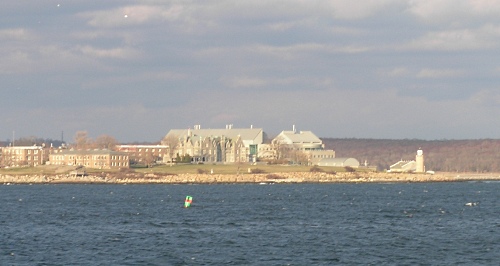
Branford House (1903)

avery-point.jpg

Morton Freeman Plant, son of the railroad and steamboat magnate Henry Bradley Plant, was a very wealthy businessman who was also known to live a playboy lifestyle He built the mansion known as Branford House on Avery Point in Groton. Instead of building his expensive summer home in Newport, Plant, who had a great interest in agriculture, chose the less crowded Groton, where there was greater space to build extensive gardens, greenhouses and farms. The 31-room Tudor Revival mansion was built in 1903 and named Branford House, after the town where Plant had been born. It was designed by Plant’s wife, Nellie, with English architect Robert W. Gibson carrying out her plans. The granite used in the construction was quarried from the surrounding grounds. After Plant died in 1918, the estate passed to his son and then his daughter-in-law. The house was eventually sold at auction in 1939 and later became the property of the United States Coast Guard, with the house being used as offices and quarters for the families of the station’s commanding and executive officers. Much of the grounds were bulldozed during this period and the adjacent Avery Point Lighthouse was built in 1942. In the 1960s, the Coast Guard station moved and the land reverted to the State. It was then given to the University of Connecticut and is now UCONN’s Avery Point branch campus. The mansion was refurbished in 2001 and is available for rental.

Amos Morris Hathaway House (1889)

191-prospect-street.jpg

The Amos Morris Hathaway House, at 191 Prospect Street in Willimantic, is a Queen Anne house built in 1889. Hathaway was an executive with the Willimantic Linen Company, which later became American Thread Company. In 1957, Hathaway’s surviving daughters, Kate and Marion, deeded the house to the city to become a children’s library: the Taylor-Hathaway Memorial Library. It was named in honor of Dr. Daniel Taylor, Kate’s late husband, and her brother Edgar, who had been an office manager at American Thread. Dr. Taylor was a dentist and expert on telescopes who practiced in New York City and Willimantic and who also owned a home in Noank. The house served as a library for ten years, when the children’s collection was moved to the new library on Main Street.

John A. Conant House (1894)

john-a-conant-house.jpg

Located on the steepest part of Chestnut Street in Willimantic, the John A. Conant House has a basement at street level. John Ashbel Conant, who had the house built in 1894, was superintendent of the Holland Silk Company. The Holland brothers had built a steam powered mill on Valley Street in 1865 and Conant became their overseer the following year. Holland Silk Co. became a leading manufacturer of dress silk thread and, by the time Conant built his house, he had become the company’s managing director, a position he held until he retired in 1906. Conant was also involved in the temperance movement and at the American Prohibition National Convention of 1884 in Chicago, he was nominated as the Prohibitionists candidate for vice-president.

David Nevins House (1746)

Recent (2024) photo of the house taken by the current owner.

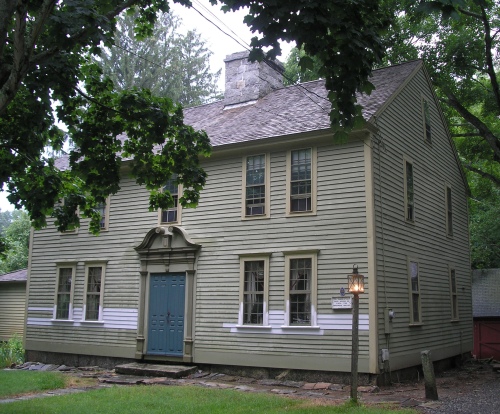
The 1746 house of David Nevins, a merchant originally from Nova Scotia who settled in Canterbury, is located across from the Canterbury Green in the Canterbury Center Historic District. The house was built the same year that Nevins married Mary Lathrop, the daughter of Col. Simon Lathrop of Norwich. Nevins died in 1758, in circumstances described in the History of Norwich (1866), by Frances Manwaring Caulkins:

It was while engaged in repairing a bridge over the Quinebaug, between Canterbury and Plainfield, which had been partially destroyed in a severe freshet, that the first David Nevins of Connecticut lost his life. He was standing on one of the cross beams of the bridge, giving directions to the workmen, and had his watch in his hand, which he had just taken out to see the time, when, losing his balance, he fell into the swollen stream, was swept down by the current, and drowned before he could be rescued.

Nevins’ son, also named David, fought in the Revolutionary War. At different times, between 1842 and 1975, the house was used as a Parsonage for the nearby First Congregational Church. In the twentieth century, the house has undergone restoration, including the restoration of the chimney using stones found in the basement of the house.

This is an earlier photo of the house that initially appeared at the top of this post.