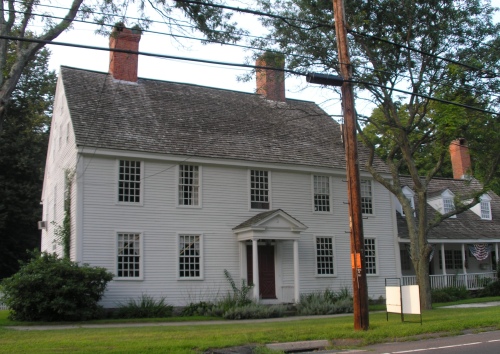
John B. Chittenden House (1814)

john-b-chittenden.jpg

Possibly built earlier, the house of John Baldwin Chittenden, on Boston Street in Guilford, was updated with Federal-style additions, including a tripartite window (similar to that on the Deming-Standish House in Wethersfield) in 1814. In 1831-1832, Chittenden and his family, along with others from Guilford, moved to Illinois and settled near what is now Mendon in Adams County. Chittenden was a deacon in the Congregational Church and in 1833, in his new home in Illinois, the first Congregational Church in the state was organized. In 1834, Chittenden laid out the village of Guilford, now Mendon.

Pelatiah Leete House (1710)

pelatiah-leete-iii-house.jpg

Guilford was originally part of the New Haven colony and in 1661, the town granted the land now known as Leete’s Island to William Leete. He became governor of the colony and later became governor of Connecticut. The family built a number of houses on the property, but the oldest one to survive today was built by William Leete’s grandson, Pelatiah Leete (1681-1768) in 1709-1710. In 1781, during the Revolutionary War, the British raided Leete’s Island, burning a house and two barns, but were turned back by local citizens. Pelatiah Leete III‘s brother, Simeon Leete, who shared the house with him, was wounded in the skirmish and died in the house the following day. Built as a saltbox, with an integral lean-to, the house remained in the Leete family until 1929. Harry Glenn purchased the house in 1930 and his wife, Mrs. Dorothy Glenn, first president of the Guilford Keeping Society, operated an antiques shop and tearoom in the house in the 1930s. Later owners built the addition in 1980 and the house was recently restored.

Adam Stanton House (1789)

Adam Stanton moved from Rhode Island to Clinton during the Revolutionary War and operated a general store and salt distillery on his property. This land had earlier been the site of Reverend Abraham Pierson‘s house, built in 1694. It was there, from 1701 to 1707, that Rev. Pierson taught the first classes of the Collegiate School, which was later moved to Saybrook and then to New Haven, where it eventually became Yale University. Adam Stanton took down the Pierson House when he built his own house on the site in 1789-1791, using parts of the earlier structure in the construction of the new one. Today, the Stanton House is a museum of American antiques with almost all of the furnishings being original to the house.

Benjamin Bradley House (1860)

benjamin-bradley.jpg

The Benjamin Bradley House, on Boston Street in Guilford, is an Italian-style villa built in 1860. Benjamin Bradley was the son of Benjamin Bradley and Juliana Leete. The house’s builder was William E. Weld, who also constructed the very similar house of Julie Labadie on Whitfield Street. It has been suggested the that house may have been designed by New Haven architect Henry Austin (see A Treasury of Guilford Places (2008), by Joel Eliot Helander, p. 270).

Leete-Griswold House (1856)

The Leete-Griswold House, on Fair Street (formerly Petticoat Lane) in Guilford, was built by Edwin A. Leete in 1856. The house is in the Octagon style, although it no longer has its original overhanging eaves with decorative brackets. Leete had grown up in the Pelatiah Leete III House on Leetes Island in Guilford. He only lived in his octagon house a short time before moving to a larger house nearby. (more…)