Highfield (1914)

In 1911, Theodate Pope Riddle, famous for designing Hill-Stead in Farmington, completed plans for another country estate for her friends, Joseph and and Elizabeth Chamberlain. In 1909, the Chamberlins had acquired land in Middlebury, close to Whittemore estate. Their house, called “Highfield,” was constructed in 1911-1914, on a hill above Lake Quassapaug. Theodate’s design for the house was influenced by her recent trip to England, where she had studied traditional village architecture and the work of English Arts and Crafts architects like Edwin Lutyens. Designed to resemble a rustic English cottage, Highfield has a large interior, with the second story cleverly concealed behind the sloping shingled roof. Next to the house is a sunken garden, where Theodate created a sumer house with removable glass walls. Charles Downing Lay made alterations to the back of the house in 1925 and to the attic in 1929. In 1954, the Stillman family, who had suceeded the Chamberlins as owners of the house, sold the property, which became a nine hole golf course. The house is now the clubhouse.

Underledge (1896)

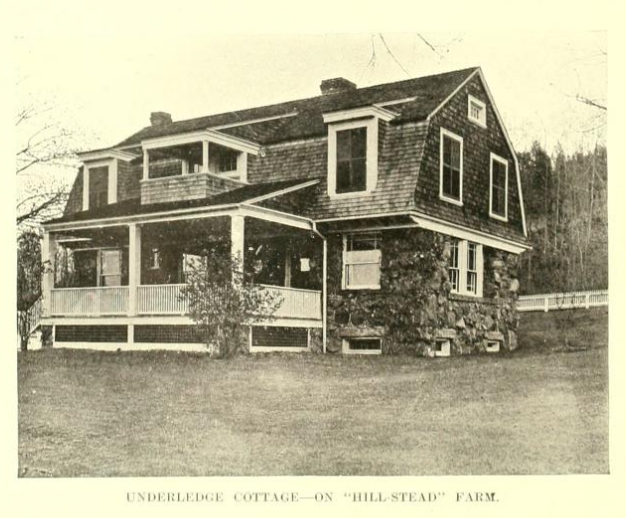
Underledge is a fieldstone cottage, built by William Potts on Mountain Road in Farmington around 1894-1896. Potts, a member of the Century Association in New York, wrote two books of nature sketches at Underledge: From a New England Hillside: Notes from Underledge (1895) and More notes from Underledge (1904). In 1898, Potts sold Underledge with eight acres to Alfred Pope and the cottage thus became part of the Hill-Stead estate. Later, Pope’s daughter, Theodate Pope Riddle, calling it the Field Office, used Underledge as her office and studio, where she planned her architectural projects. No longer part of Hill-Stead, the house is now a private home.

Brown-Elton Tavern (1810)

The striking pink, Federal-style Brown-Elton Tavern, located on the Green in Burlington, was built in 1810 as the private home of Giles Griswold, a merchant. It’s design is attributed to builder David Hoadley. By 1820, Griswold had relocated to Georgia and his properties were being foreclosed. The house was soon acquired by Julius Hotchkiss, who died in 1825. His widow, Laura Hotchkiss, later sold the Tavern, which passed through other owners over the years (pdf). The building served as a tavern on the Hartford and Litchfield stage line and later as an inn along the George Washington Turnpike. It was purchased by the Town of Burlington in 1974 and is now home to the Burlington Historical Society, which is restoring the Tavern as a museum.

Josiah Bronson House (1738)

The oldest surviving house in Middlebury was built by Josiah Bronson on Breakneck Hill Road in 1738. The house also served as a tavern and hosted a number of French officers during the Revolutionary War: first in 1781 when Rochambeau’s French army encamped in Middlebury from June 27 to July 1, on its way to the Siege of Yorktown, and again from October 26-28, 1782, during their return journey. One of the officers to stay in the tavern was the Baron de Viomenil, who was second in command to General Rochambeau during the Yorktown Campaign. At these times, Rochambeau himself most likely stayed with Captain Isaac Bronson, Josiah’s father, further down the hill. The Josiah Bronson House was acquired in 1940 by Lawrence M. and Esther Duryee, who restored it.

The Harriet M. Brainerd House (1886)

Edward M. Simpson, who lived in Middle Haddam at Knowles Landing, was a steamboat captain and pilot on the Connecticut River in the mid-nineteenth century. His daughter, Harriet M. Brainerd, was married to Edward R. Brainerd, a marble dealer in Chicago. The couple built a summer house near her father’s home in Middle Haddam in 1886. At the time, Knowles Landing was a destination for tourists and steamboats would dock at the landing. Harriet Brainerd built a Steamboat Dock House in the early 1890s to replace an earlier structure, built in the 1860s. Later used as a residence, this boat house burned down in the 1980s, but the Queen Anne-style Harriet M. Brainerd House (pdf) survives, displaying Victorian-era features, like the decorative stickwork on the front veranda. (more…)

Cyrus Beardslee House (1825)

The Cyrus Beardslee House, at 754 Monroe Turnpike in Monroe, is a brick Federal-style house built around 1823-1825 by Austin Lum, a brick mason, for Hall Beardslee, who deeded it to his son, Cyrus H. Beardslee, a lawyer who served in the state legislature for seven years, being Speaker of the House of Representatives in 1846. The house later became a boys’ school known as Gray’s Academy, operated by Dr. Robert Gray. In 1865, it was purchased by St. Peter’s Church Women to become the parsonage of St. Peter’s Episcopal Church. After nearly ninety years, the house was sold to an antique’s dealer and then became the Rectory of St. Jude Roman Catholic Church. Today it is again a private home.

David Ogden House (1750)

David Ogden and his new wife, Jane Sturges Ogden, moved into a recently completed house in Fairfield in 1750. The house remained in the Ogden family for the next 125 years, surviving the burning of Fairfield by the British in 1779. The house later fell into bad repair, but in the 1930’s, it was restored by the architectural historian J. Frederick Kelly. Today, this saltbox colonial house is museum, operated by the Fairfield Museum and History Center and furnished according to information in David Ogden’s will and estate inventory. (There is more information in this pdf file)