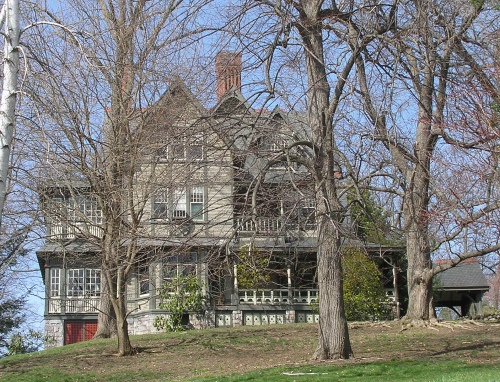
Benedict-Miller House (1879)

Dominating the ridge of Hillside Avenue, overlooking Waterbury, is the enormous mansion known as the Benedict-Miller House. A Queen Anne/Stick style extravaganza of gables, crisscross and diagonal boards and decorative railings, balustrades, braces and brackets, the house was built by the firm of Palliser, Palliser & Co. of Bridgeport for Charles Benedict. The brothers, George and Charles Palliser, specialized in Gothic and Queen Anne cottages and designed houses for P.T. Barnum. Benedict was president of the Benedict & Burnham Company, once the largest manufacturers of brass and copper appliances and fixtures in the country, and served as mayor of Waterbury in 1859-1860. Next to Benedict’s house, and once sharing with it a private drive, is another grand Stick-style mansion built for Benedict’s sister, Mary Mitchell. After Benedict’s death, in 1881, his house was owned by Charles Miller, of the Miller & Peck department store. The Benedict-Miller property was part of UCONN’s Waterbury branch campus from 1942 until 2004, when it was sold to Yeshiva Gedolah, a school for Orthodox Jews.

36 Lewis Street, Hartford (1840)

The house at 36 Lewis Street in Hartford, like that at 24 Lewis Street, was most likely built around 1840 by the builder, Austin Daniels. The houses originally resembled each other, but while no. 24 retains a Greek Revival pediment in the gable end facing the street, no. 36 was altered around 1860 to fit the newly popular Italianate style. The gable roof was replaced with a low-pitched hip roof with overhanging eaves, raised to allow the placement of small windows just below the roof on the two sides. The wide front porch is also an Italianate addition. By the 1950s, the house was the last building on Lewis Street to remain a private residence, but later became a restaurant. The property is currently available for rent.

The Daniel Judd House (1730)

The Daniel Judd House in Farmington (not to be confused with the 1875 Daniel Judd House in Cheshire) is a colonial saltbox home built around 1725-1730. The house was built on land that Daniel Judd inherited from his parents, William and Mary Steele Judd, early settlers of Farmington. Judd sold his house to his oldest surviving son, James, in 1741 and it was willed to James Judd, Jr. in 1779, although the younger James lost his money and the property was foreclosed on in 1805. It then passed through various owners until it was acquired by James O’Rourke in 1874. In 1890, O’Rourke rented the house to Theodate Pope, daughter of the wealthy industrialist Alfred Atmore Pope. She soon purchased the house in 1892. Calling it the “O’Rourkery” after its previous owner, Pope hired the architectural firm Hapgood and Hapgood to restore the house. Some years later, she added a side entrance porch to the house and would continue to make other alterations to the building over the years.

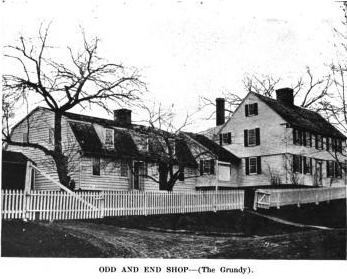
In 1896, she acquired the property next to her home, which included an earlier, seventeenth-century dwelling, possibly built for William Judd. She had this building moved and attached to the O’Rourkery as an ell. Calling it the “Gundy,” Pope opened the ell in 1902 as an “Odds and Ends Shop” for students at Miss Porter’s School. Pope would later persuade her parents to settle in Farmington, using her experiences in restoring the O’Rourkery in designing for them the famous Hill-Stead estate. She would go on to design a number of other buildings. Theodate Pope later resided at Hillstead with her husband, John Wallace Riddle, but continued to own the O’Rourkery, using it as a retreat. After her death, the estate, including the O’Rourkery, became the property of the Hill-Stead Museum. The Gundy shop continued in operation under various people until 1969, but in 1975 the Museum sold the house. It is now a private residence. Behind the Gundy today is a notable (private) Colonial Revival garden.

24 Lewis Street, Hartford (1840)

The former house, now a business, at 24 Lewis Street in Hartford was built around 1840. It has been attributed to the builder Austin Daniels, who also probably constructed the two adjacent buildings. Stylistically, the house represents the transition from the Federal to the Greek Revival styles and is typical of houses built in Hartford in the decades before the Civil War. The Italianate-style front portico was added later in the nineteenth century and the enclosed porch is a later Colonial Revival addition.