The Cook-Fowler House (1772)

Located across from the Public Library on Main Street in Durham, the Cook-Fowler House is a gambrel-roofed, central-chimney, “Cape Cod“-style cottage. It was built in 1772 by Jesse Cook, a carpenter, a year after his marriage to his third wife, Ann Griswold. Built by himself, the house was later given to Cook’s brother Thomas in 1790. It was later owned by the Lyman family and in 1860 became the home of William Chauncey Fowler, a professor, son-in-law of Noah Webster and author of a number of books, including Memorials of the Chaunceys (1858), The Sectional Controversy (1863) and History of Durham, Connecticut, from the first grant of land in 1662 to 1866 (1866). Two dormer windows were added to the house around 1850.

Cowles-Smith House (1836)

The Cowles-Smith House, at 536 Main Street in New Hartford, was built by Captain Henry Cowles in 1836. A blacksmith’s shop had once stood on the site, part of the grounds of a hotel, inherited by Henry Cowles from his father, Theodore Cowles. After experiencing financial reverses around 1840, Henry Cowles became proprietor of another hotel in Hartford, where he died in 1843. His widow and daughter then returned to New Hartford and occupied the old house until it was sold, in 1845, to John Cotton Smith. An entrepreneur, John C. Smith joined with his brother, Darius B. Smith, to establish the D.B. Smith & Sons cotton mill in Pine Meadow. He was also the agent of the Greenwoods Manufacturing Company. After his death in 1870, his widow continued to live in the house for many years. It is currently used for offices.

Lavinia L. Parmly House (1890)

The Parmly House, in the Marina Park district of Bridgeport, was originally built in 1890 by Lavinia L. Parmly, a wealthy New York widow. She used it as a summer home and, upon her death in 1894, bequeathed it to her grandson, Parmly S. Clapp, as a wedding present. He later became a New York City stockbroker. The house was later purchased by Allen W. Paige, whose widow, Elizabeth, donated it to the University of Bridgeport in 1950. Named Cortright Hall, in honor of E. Everett Cortright, first president of the Junior College of Connecticut (now the University of Bridgeport). Used at first as administrative offices, Cortright Hall now houses the Department of Public Relations.

The Trowbridge-Thoms House (1830)

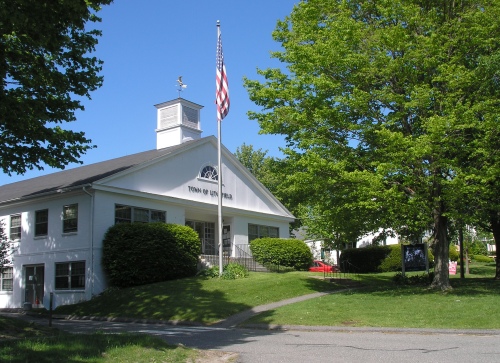
The Trowbridge-Thoms House, on West Street in Litchfield, was built in 1830 by Henry Trowbridge, a tanner. In the early twentieth century, the barn on the property was used as a classroom for students of landscape painter Alexander Van Lear. The house and barn remained in the Trowbridge family until 1927, when they were sold to a Mr. Thoms, who open a restaurant, called the Canteen, in the barn. The restaurant served patrons of a nearby community playhouse that was later replaced by the current town hall building. Floyd Thoms later turned the barn into an antiques shop, which was continued by the next owner, Thomas McBride, who acquired the property in 1965. Mr. McBride is now retiring and the house and antiques will be sold in an on-site auction on June 5.

Chase Cottage (Topsmead) (1923)

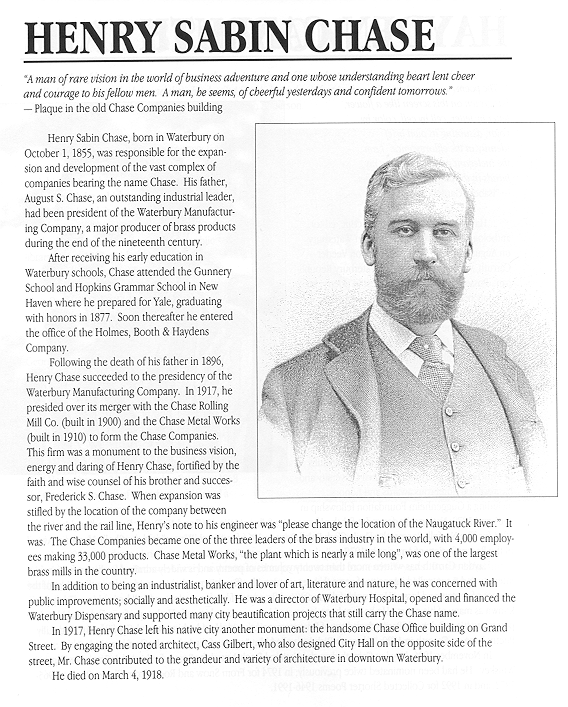
In 1917, Henry Sabin Chase, president of the Chase Brass and Copper Company in Waterbury, gave his daughter, Edith Morton Chase, sixteen acres on Jefferson Hill in Litchfield. Miss Chase had a rustic cottage built on the property, which she replaced with a larger Tudor Revival-style summer home, built in 1923-1925. Chase named the house “Topsmead,” meaning “top of the meadow,” and shared her home with her close friends, the unmarried sisters, Mary and Lucy Burall. They divided their time between the Chase Cottage at Topsmead and the Burall sister’s house on Church Street in Waterbury. When Miss Chase died in 1972, she bequeathed her property to the state. It is now Topsmead State Forest. (more…)