American Legion Hall, Granby (1847)

This Fourth of July we’re looking at the American Legion Hall in North Granby. In 1845, in his History of Simsbury, Granby, and Canton, Noah A. Phelps wrote that “There is a society of Universalists in North Granby. The members meet every other Sunday for worship, and have taken measures to erect a house for their religions meetings.” By 1848, as explained in The Universalist Miscellany, Volume 5, No. 8, “The Universalist Church recently erected in Granby, Ct., was dedicated on the 1st of December [1847]. Sermon by Bro. H. B. Soule, of Hartford. The church is a very neat building, and will seat three hundred persons.” The Universalist congregation disbanded in 1911 and the former church served as a school until 1949. It then became an American Legion Hall.

Church of the Epiphany, Durham (1862)

One of the few Gothic Revival style buildings in Durham is the Church of the Epiphany, an Episcopal church on Main Street, built in 1862. The earliest Episcopal church services in Durham were held in 1802, but it was not until 1861 that two men, Andrew Morse and Frank Goodwin, began raising money for the construction of a church. The cornerstone was laid in 1862 and the completed church was consecrated on January 28, 1863. The tower was constructed in 1877 and that same year, the building was raised 1.2 feet and placed on a new foundation.

Harwinton Congregational Church (1952)

Harwinton’s first Congregational meeting house was constructed in the early 1740s, to the south of where the current Congregational Church now stands. Surplus materials from its construction were later used to build the town’s first schoolhouse. Put to municipal use for thirty years after a new church was built in 1808, the old structure became dilapidated and was eventually torn down. The 1808 church, built in the Federal style, continued in use until it burned, after being struck by lightning, in 1949. Groundbreaking ceremonies for a new church occurred the following year and the building opened for worship in 1952. Due to a shortage of funds, the new church remained without a steeple for ten years, until 1962, when the Harwinton Congregational Church acquired the steeple of the Methodist Church in Torrington, which was being torn down at the time.

The Basilica of the Immaculate Conception (1928)


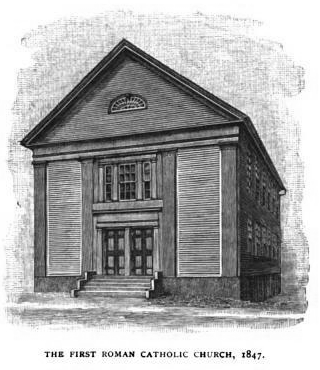
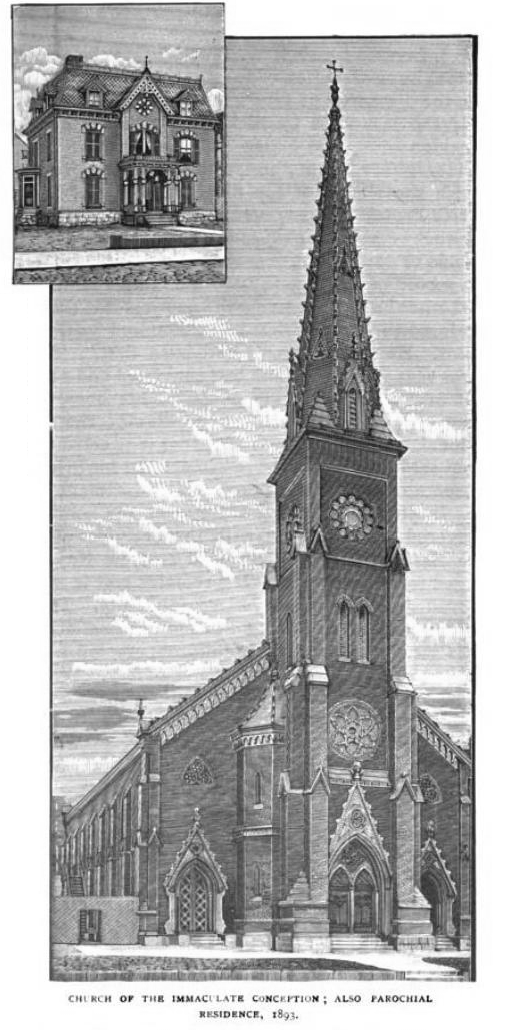
We conclude Waterbury Week with the Basilica of the Immaculate Conception. The first Roman Catholic church in Waterbury was St. Peter’s Chapel, purchased in 1847 from Episcopalians, who were at the time moving to a larger building. The Chapel was moved to the site on East Main Street where St. Patrick’s Hall would later be built. In 1857, across the street from the Chapel, the first church in Waterbury specifically built to be a Catholic Church, the Church of the Immaculate Conception, was dedicated. In 1925 to 1928, a new Immaculate Conception Church was built on Waterbury Green, on the site where the William B. Merriman House once stood. Designed by the firm of McGinnis and Walsh, the church was modeled on the Basilica di Santa Maria Maggiore in Rome, one of the four major Catholic basilicas. A Vatican decree in 2008 conferred on Immaculate Conception Church the status of a minor basilica.

Trinity Episcopal Church, Milton (1802)

Episcopal services were first held in the Milton section of Litchfield in 1792. At first, services were held five Sundays a year with the meetings taking place in private homes. In 1798, Episcopalians living in Milton were given permission by the First Episcopal Society to build their own chapel and Trinity Parish was established. Work on the church edifice began in 1802 and was not completed until 1826, with the church finally being consecrated (after all debts had been paid) in 1837. The church was designed by Oliver Dickinson, who modeled it on the second Trinity Church at Wall Street in New York. The church’s steeple was replaced, later in the nineteenth century, with four Gothic-style square-cornered turrets. The belfry and steeple were later both replaced after being struck by lightning in 1897. When the church was being repaired and wired for electricity in 1938, pinnacles with crosses were discovered that had once stood at the base of the initial steeple. This made it possible to determine the proportions of the old steeple and restore the church to its original appearance.

Bolton Congregational Church (1848)

The Town of Bolton was incorporated in 1720 and the town’s Congregational Church was organized in 1725. The first meeting house, located on Bolton Green, was built used for about forty years, being replaced by a new building on the same site in 1767. The second church remained until it too was replaced by the current Bolton Congregational Church, a Greek Revival building with a truncated box-spire, in 1848.

Congregational Church of Burlington (1836)

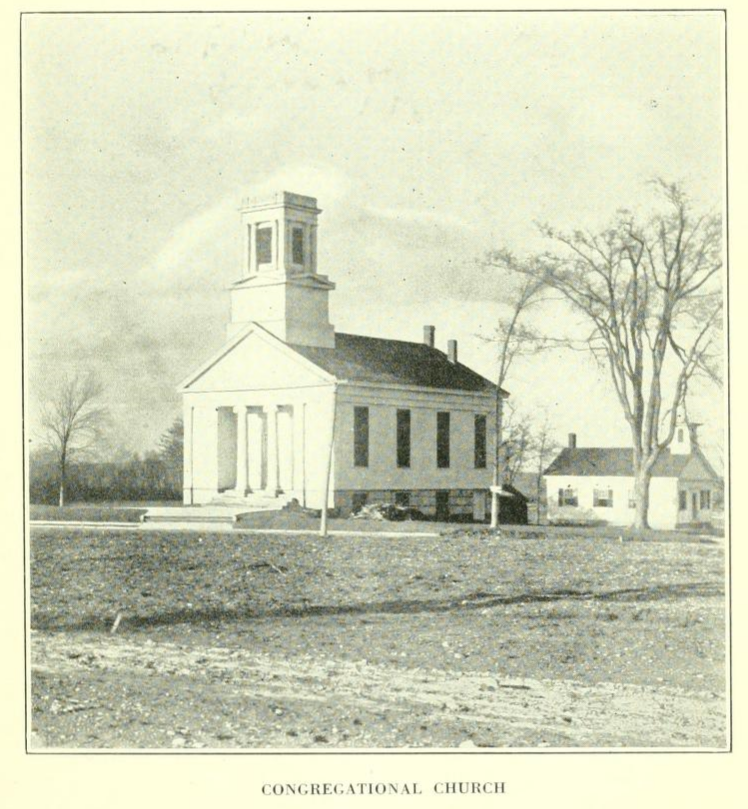
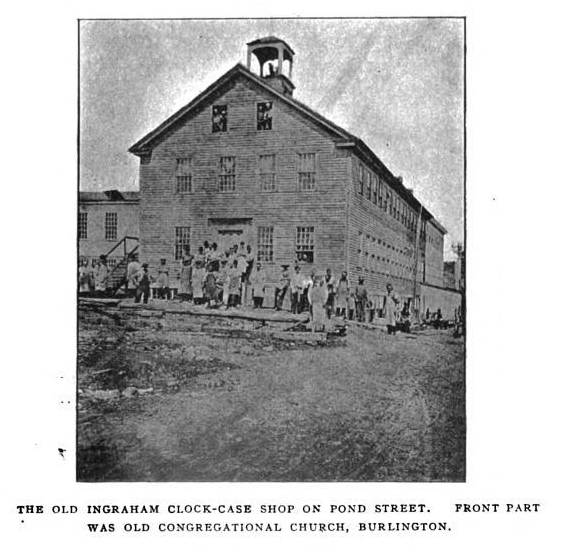
In the eighteenth century, two parishes were established in what was then the West Woods section of Farmington: the New Cambridge Ecclesiastical Society in 1742 and the West Britain Ecclesiastical Society, gathered in 1774 and incorporated in 1783. That same year, the West Britain Society dedicated their meeting house, constructed after several years of contention over where to build it. The two parishes of West Britain and New Cambridge joined in 1785 to form the new town of Bristol, but differences between the two parishes later led to the separation of West Britain as the town of Burlington in 1806. The first meeting house had been outgrown by then. According to Epaphroditus Peck, in a 1906 Address on the history of Burlington, “It is said that this little meeting-house was never finished inside, and that the swallows used to make their nests in the rafters and often fly in and out during service.” A new meeting house was built in 1809, near to the site of the first building which, according to Peck, “was removed to Bristol, and used as a cotton-mill. It afterward became the Ingraham clock-case shop, and was destroyed by fire in December, 1904.” The 1809 Congregational Church of Burlington was moved, reduced somewhat in size, and rebuilt in the Greek Revival style at its current location on the Burlington Green in 1836.