
Ezekiel Cowles was a prosperous farmer in Plainville whose Greek Revival house is located on Unionville Avenue. Built in 1843, it is one of three houses erected by members the Cowles family on their farm.
Ezekiel Cowles was a prosperous farmer in Plainville whose Greek Revival house is located on Unionville Avenue. Built in 1843, it is one of three houses erected by members the Cowles family on their farm.

The former parsonage of the First Congregational Church in Cromwell was constructed in 1834-1835 on Main Street. It was the second of three buildings to be constructed by the Church at the time, following the Academy building of 1834 and preceding the Meeting House of 1840. All three buildings are brick and in the Greek Revival style. The house remained a parsonage until the Church sold it to a private owner in 1965. The house’s Stick style circular side porch is a later addition. (more…)

The Church of Christ is a Baptist and Congregational church in West Winsted, Winchester. An Ecclesiastical Society in Winsted was first formed in 1778, half way between the societies of Winchester and Barkhamsted. In 1853, as related by John Boyd in Annals and Family Records of Winchester (1873), a committee was appointed to consider “the organization of a second Congregational church and society to be located in the West Village.” The committee reported “that the large increase of population, and the prospect of a more rapid accession in the future, rendered an increase of religious privileges and accommodations indispensable to the well-being of the community; and recommended an early organization of an Ecclesiastical society, and the location and building of a house of worship.” The new congregation constructed a church in 1857, later replacing it with the current church, dedicated in 1899. With the erection of a new church, the old building, together with an adjoining chapel built in 1860, were purchased and remodeled for business purposes. The dedication of the new church was described in the Hartford Weekly Times of September 7, 1899. The reporter explained that the church was built “of Torrington granite, trimmed with Long Meadow sand stone and is of French Gothic style.” The first and second churches of Winsted, faced with expensive repairs after the Flood of 1955, merged together with the First Baptist Church in 1957. The new federation was called the Church of Christ (Baptist and Congregational). 119 members of the old First Congregational Church, fearing that the use of their church building would be discontinued in favor of using just the Second Congregational Church for worship, left the federation. Their church is now known as the First Church of Winsted (also Baptist and Congregational), while the Second Church building continues under the name of the Church of Christ.
Edit: As noted in the comment below, the church has changed its name to the Second Congregational Church of Winsted.

The Royal Arcanum is an organization created in the nineteenth century to provide health insurance to its members. A group of businessmen, who were members in Norfolk, hired architect Alfredo Taylor to design an impressive multi-purpose building in the town center. The large structure was designed to have commercial businesses on the first floor and meeting spaces for the Royal Arcanum Council and the Masonic Lodge on the third floor. It also housed the town’s post office and fire department. The style of the brick building, constructed in 1904-1906, combines Romanesque and Chateauesque elements, with decorative terra cotta panels. Today, the building continues to contain offices, shops and apartments.

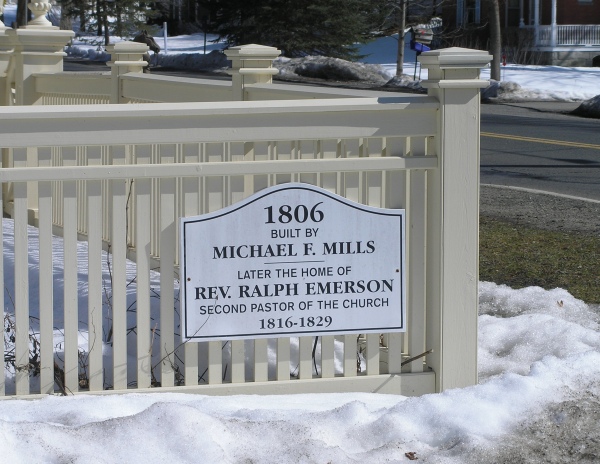
Across Maple Avenue from the Norfolk Library is the parsonage of Rev. Ralph Emerson, who was pastor of Norfolk’s Congregational Church from 1816 until 1829, when he left to become professor of Ecclesiastical History at Andover Theological Seminary. The house was originally built in 1806 by Michael F. Mills, a lawyer, Justice of the Peace and Representative in the General Assembly.

What is known as the Brick Tavern is a Federal-style brick house, located in Bolton Center. It was built around 1828 by Samuel Williams and was a tavern and station on the Hartford-Norwich stagecoach line. An earlier house on the property, built around 1770, had become an ell to the 1828 house, but was later removed. The Brick Tavern was purchased by the Town of Bolton in 2007.

According to the 1867 history, by Alfred Andrews, of the First Congregational Church of New Britain, Daniel Beadle Capron was born in 1813 in Broadlebin, New York. Having moved to New Britain, “he has been a mechanic, but in 1862 was in merchandise on Washington st., and now, in 1867, in shoe and harness business on Main st.” Capron‘s Italianate-style house, built around 1850, originally stood on the corner of High and West Main Street, but was moved, in 1906, further down High Street to make way for the building of the First Baptist Church. The house later served as a funeral home, then the offices of an architectural firm and the city’s Health Department.
You must be logged in to post a comment.