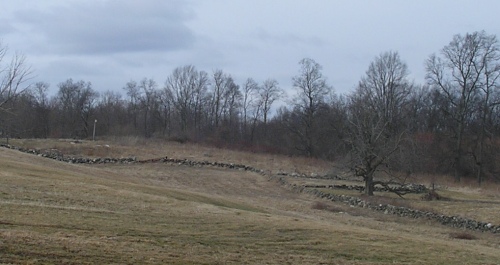
Rose Farm House, Bolton (1725)

In June of 1781, the army of the French general, the comte de Rochambeau, on its way to join George Washington and fight in the Battle of Yorktown, camped at what was later called Rose Farm in Bolton. Between June 21 and 25, 1781, four regiments of the French soldiers spent one night each at the camp, which was the fifth French army encampment of their journey from Newport, Rhode Island to Yorktown, Virginia. The farm was part of the land originally owned by the town’s first minister, Reverend Thomas White and at the time of the Revolutionary War, the property, called the Minister’s Farm, was owned by Reverend George Colton, who was Bolton’s minister from 1764 to 1817. The farm still has numerous stone walls, built by early settlers who initially cleared the land. Many of these walls were noted on a map made by Rochambeau’s engineer. The minister’s house, originally built in 1725 by Rev. White and where Rev. Colton entertained Rochambeau in 1781, has been significantly altered. Once believed to have been replaced by a new Greek Revival-style house, built around 1840 by Reverend James Ely, it is now thought that the core of the later house is the original colonial structure, much altered and added to in later years . The farm was owned by the Rose family in the twentieth century. It was saved from the building of an expressway in 1994 and in 2000, after a campaign to save the land from development, it was purchased by the town of Bolton and is now the Bolton Heritage Farm.

South United Methodist Church, Manchester (1925)

The Methodist Church in Manchester began with a sermon preached in the spring of 1790 by the Rev. George Roberts in the home of Thomas Spencer. Rev. Roberts was an assistant of the Rev. Jesse Lee, who had preached the first Methodist sermon in Connecticut in Norwalk on June 7th, 1789. A Methodist Society in Manchester was soon organized and the first church building was constructed in 1794. In 1822, a new building was built at the corner of Center and Main Streets, now the site of a Masonic Temple. In 1851, the expanding congregation decided to divide into two congregations. The North Methodist Episcopal Church was built in 1851 on North Main Street and, after receiving a hundred new members, a new South Church was built in 1854 at the corner of Main Street and Hartford Road. This church was enlarged in 1891 and replaced by the current church in 1925. It was designed in a Tudor Gothic style by architect Arthur Eaton Hill of Providence, Rhode Island, who died before it was completed. In 1958, the church acquired the estate of Frank Cheney, Jr., located across Hartford Road.

The Edwin McNeil House (1867)

The Edwin McNeil House, on North Street in Litchfield, is a good example of an older home which was transformed into a Colonial Revival edifice in keeping with the overall style of the neighborhood. The house was originally a vernacular home, built by Edwin McNeil in 1867. McNeil, a civil engineer who had served as a major in the Civil War, was instrumental in bringing the Shepaug Railroad to Litchfield in 1872. The railroad linked Litchfield to New York and spurred the town’s development as a summer resort. McNeil’s house became the Litchfield Inn in the early twentieth century and was transformed into a Colonial Revival estate after it was purchased by a wealthy Waterbury industrialist in 1911. It was renovated again in the 1990s.

The Stoner Mansion (1928)

The Stoner Mansion is a Tudor Revival house, on Stoner Drive, off Mountain Road in West Hartford. It was completed in 1928 for Louis Stoner, a manufacturer who became wealthy from the Jacobs Chuck company, which produces holding/clamping devices for stationary equipment and portable power tools. The family hosted famous parties at the mansion, which was situated on an extensive estate on a hillside with views of Hartford and a private golf course. Later, the family faced financial hardship and Louis Stoner committed suicide. In the 1950s, his widow, Clara Stoner, began to sell off lots of the property, with early houses being built down Stoner Drive, near Mountain Road. In the 1970s, homes were being built closer to the mansion itself. The Stoners eventually left the house and their furniture was put on auction in 1973. The mansion then had a number of other occupants: there’s a blog post by one former resident whose parents bought the house in 1974. In the 1980s, the house was owned by a man who was later arrested for tax evasion. Left empty for a decade by later owners who never moved in, the house deteriorated and had to be extensively restored by its most recent owners, one of whom owns an interior design company which, for a time, has been based in the mansion. The house will soon have new owners.

The Moses Loomis, Jr. House (1725)

The house of Moses Loomis, Jr. was built around 1725 on old Main Street in East Windsor Hill (now South Windsor). Moses Loomis, Jr., the son of Moses Loomis and Joanna Gibbs, was born in East Windsor Hill in 1696. His house in East Windsor Hill was built the year he married his first wife, Rebecca, in Harwinton. She died the following year and, in 1729, he married Elizabeth Bidwell. Moses and Elizabeth both died in 1761. He is buried in Edwards Cemetery in South Windsor

Oliver White Tavern (1743)

The Oliver White Tavern was built around 1741-1743 on East Street (now Brandy Street) in Bolton. Oliver White sold the house after it was built, although it continued to bear his name when it became a Tavern, between 1753 and 1764. During the Revolutionary War, Capt. Joel White owned the Tavern, which was situated near the farm where General Rochambeau’s French troops camped in June of 1781, during their march to the Battle of Yorktown. Some of Rochambeau’s officers stayed at the Tavern, while the general himself went to the Daniel White Tavern, nearby in Andover. The Oliver White Tavern continued in operation until around 1790.