Ensworth Carriage House (1888)

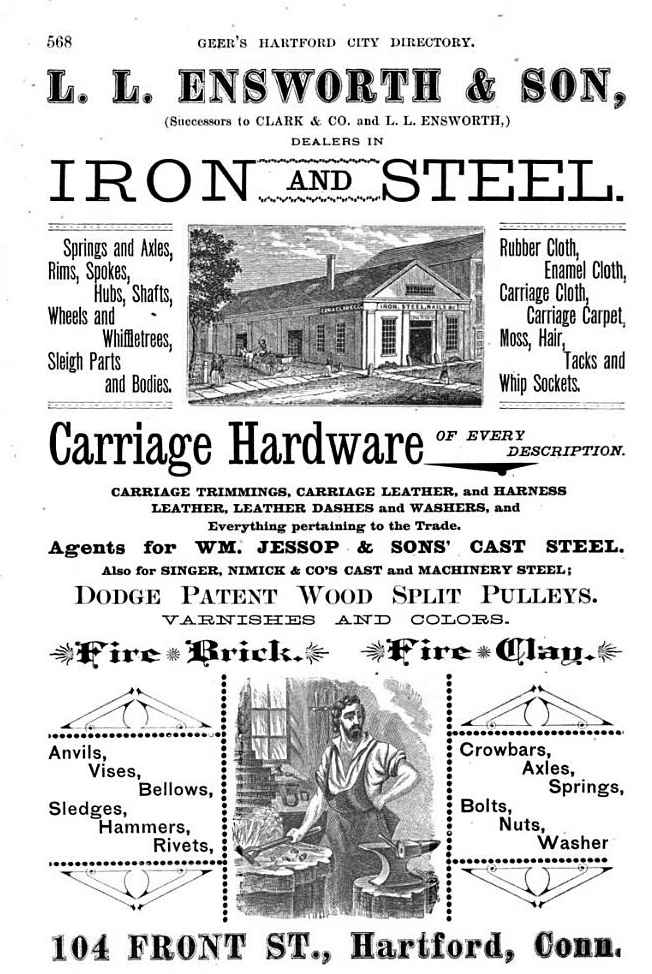
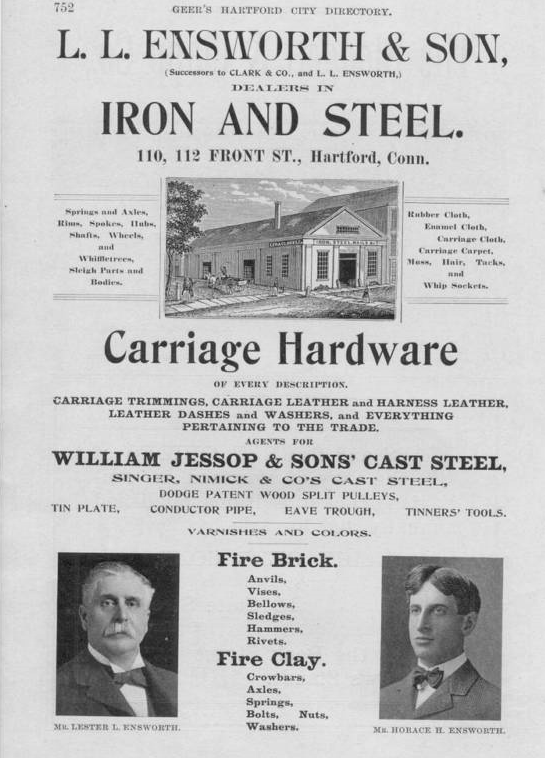
Lester L. Ensworth owned a business that produced iron and steel hardware and carriage parts. He was a partner with George H. Clark in Clark and Company, located at the corner of Front and Ferry Streets in Hartford. Ensworth became sole owner in 1892 and the company was renamed L. L. Ensworth & Son in 1901. In 1888, Ensworth moved his family into a large house on the corner of Farmington and Girard Avenues, in Hartford’s West End. The house is no longer standing, but the carriage house survives. Built in grand Queen Anne style to match the no longer extant house, the Ensworth Carriage House has a variety of Victorian features, unified by its exterior covering of shingle siding. Today, the building is home to a ballet company.

John Raymond House (1775)

The John Raymond House is located just south-east of the Congregational Church in Montville Center. It is listed as having been owned by John Raymond in 1775 and stood on part of the land which had been granted to Samuel Rogers by Uncas in the seventeenth century. In 1713, the land became part of the Raymond Farm (the house is located on Raymond Hill Road). John Raymond is described by Henry Augustus Baker, in his History of Montville (1896), as follows:

b. 7 Jan., 1748, son of John Raymond and Elizabeth Griswold; married 26 May, 1774, his first cousin, Mercy Raymond, daughter of Joshua Raymond and Lucy Jewett. He was a farmer, and settled at Montville. His farm was located next east from tho Congrogational church, and was afterwards owned by John G. Hillhouse. He was chosen first town clerk of Montville [in 1786], and held the office sixteen years. He died at Montville 30 March, 1828. She died 30 June, 1833.

First Congregational Church, Andover (1833)

The Andover Ecclesiastical Society was officially formed in 1748, when it also settled its first pastor, Rev. Samuel Lockwood, who served until his death in 1791. Once the Society was established, construction began on a meeting house on what is now Hebron Road, which took twenty years to complete (although it began to be in use before it was finished). A new church was built in 1832-1833, which was later renovated in 1869. The First Congregational Church was much expanded with a new addition in 1958.

Taft Hotel (1911)

Built in 1911, the Taft Hotel, on College Street in New Haven, opened its doors to the public on New Year’s Day, 1912. The elegant hotel was right near the Shubert Theater and many Broadway celebrities stayed there over the years, including Rogers and Hammerstein, who wrote the tune Oklahoma in their rooms at the Taft. Former President William Howard Taft, for whom the Hotel was named, lived there for eight years while he was teaching at Yale Law School. Before the Taft Hotel was built, other hotels and taverns had stood on the site, including one in which George Washington stayed in 1775. The Taft’s immediate predecessor was the New Haven House, designed by Henry Austin, which was built in 1858 and was razed in 1910. The Hotel closed in 1973 and was boarded while it was converted into apartments. Now known as the Taft Apartments, the building still has its historic tap room on the ground floor, restored and reopened as Richter’s Cafe in 1983. The Hotel’s grand ballroom is now a restaurant called Downtown at the Taft.

Phineas Camp House (1758)

According to a date carved on an interior wooden beam, the three-bay Phineas Camp House, on Main Street in Durham, was built in 1758. The property, including the house, a merchant shop and a barn, was sold to Phineas Camp in 1785 by his brother, Elnathan Camp, who had in turn bought the then new house from their father, John Camp, Jr., in 1760. In 1794, Phineas Camp sold the property to Phineas Squire, who then sold it back to Elnathan Camp. In 1808, Elnathan’s son, Sylvester Camp, sold it to Deacon Seth Seward, a wealthy shoemaker. The house then passed through many owners in the nineteenth century, during which time a Greek Revival addition was built on the southeast corner.

Frederick G. Platt House (1886)

The distinctive home, built in 1886 for Frederick G. Platt, is located at 25 Court Street in New Britain. With its prominent tower decorated with ornamental terra cotta, the house is a striking example of the High Victorian Gothic style. Frederick G. Platt was president of the New Britain Lumber and Coal Company, incorporated in 1871, and secretary-treasurer of the Railroad Block Company. As explained in David N. Camp’s History of New Britain (1889), “The Railroad Block Company, which consisted principally of stockholders of the New Britain Lumber and Coal Company, was organized under the law relating to joint stock corporations, in 1881, with a capital of $24,000, to build a business block. The land purchased for the purpose was on Main Street, north of the railway, and the building erected is known as the Railroad Block. H. P. Strong is president, and F. G. Platt secretary and treasurer of the company.” Platt was also president of the New Britain Machine Company. In 1895, responding to changing tastes in architecture, Platt sold his house and built a new one on Grove Hill in the Colonial Revival style. The next owner of the house on Court Street was Harriet H. Merwin, widow of Charles P. Merwin of the Berlin Steam Brick Works. Attached for many years to a hardware store, the house was restored in 1987 and is now used for offices.