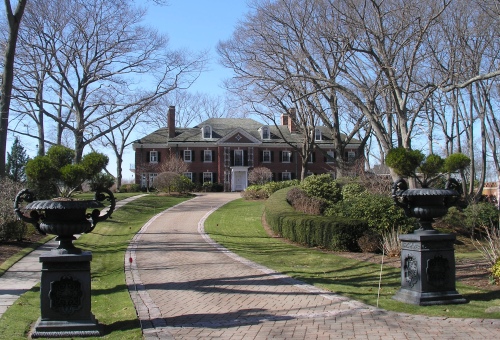
Chapin Park (1871)

Chapin Park, which is today a bed and breakfast, is an 1871 Gothic Revival house on Church Street in Pine Meadow in New Hartford. It was the second house on the site built for Edward M. Chapin (the earlier one was moved to make way for the new one). The house has a similar arrangement of interior rooms to that of Edward’s brother, Philip Chapin, nearby. Chapin Park was designed by Robert W. Hill, a Waterbury-based architect who designed buildings throughout Connecticut.

Mystic Congregational Church (1860)

Richard A. Wheeler writes, in the History of the Town of Stonington (1900), that the Mystic Congregational Church

was organized by thirty-seven seceding members from the First Congregational Church of Stonington, with five persons from other churches, on the 30th day of January, 1852, under the approval of a committee of the Consociation of Congregational Ministers and Churches of New London County[…..] The cornerstone of their present church edifice was laid with appropriate ceremonies Nov. 24th, 1859, and went on to completion and dedication. It was enlarged in 1869 by the addition of fourteen feet to its length.

Norfolk Academy (1840)

A school was established by the town of Norfolk as early as 1768. Initially, students were taught in the church parsonage, until the the School Society built a small structure, used as a school and church conference room, in 1819. According to an 1899 speech by librarian Henry H. Eddy (quoted in the 1900 History of Norfolk): When John F. Norton was the teacher at the school, it

was so successful that by 1838 there were upwards of seventy pupils under his charge. The next year, the need of still greater accommodations being felt, an Academy Corporation was formed for the purpose of building an academy, and in 1840 such a building was erected on the east side of the Green, for the sum of $2,000. As the career of Mr. Norton had been so successful he was appointed first principal, and continued as such until duties outside of the town took him away.

As Frederic S. Dennis relates, in his 1917 book, The Norfolk Village Green:

The Town Hall, originally the academy, was built in 1840 and from that time on was used as the place for the transactions of town business, including voting. In 1846 a committee was appointed to confer with the proprietors of the academy with a view to the use of this building for town meetings. The lower floor is used for town meetings; the upper floor is the property of Mr. and Mrs. Carl Stoeckel; it was not unusual in early days to have one building owned by two or more parties. In addition to the school room above and the town hall below, there was constructed in the basement a lock-up, which has been built on the first floor by partitioning off a room.

Today, the building serves a different purpose, as the Norfolk Historical Society Museum.

Millstreams (1917)

Millstreams is a mansion in Farmington, built in 1917 for the playwright Winchell Smith. Born in West Hartford and a graduate of Hartford Public High School, Smith was also an actor and director. He got his start in the theater company of his uncle, William Gillette, but became most known for his plays, many of which were written in collaboration with others, including Lightnin’ (1918), written with Frank Bacon, which ran for 1,291 performances. He also persuaded D.W. Griffith to film scenes from the film Way Down East, written and produced by Smith and starring Lilian Gish, in Farmington. Smith’s property in Farmington once included the old grist mill, which appears in the film, and the Gridley and Case Cottages, now owned by the Farmington Historical Society. Smith was fascinated by the Tunxis Indians and in his younger days had enjoyed camping near the Farmington River. His house was later built on Indian Neck, along a bend of the Farmington River, where it joins the Pequabuck River. Initial designs for the house were prepared by Edward T. Hapgood and completed by Cortland F. Luce after the architect’s death. At first, Smith called his estate “Lambs Gate,” because he had purchased and erected at his home the gates which had stood for many years at the entrance of the Lambs Club in New York City. Because another home in Farmington had recently been named “Old Gate,” Smith changed the name of his home to “Millstream Manor.” Smith, who died in 1933, is buried, near his home, in Riverside Cemetery. The house, surrounded by almost five acres of grounds and gardens, has recently been for sale.

The Williams-Pendleton House (1848)

The Greek revival house at 33 Main Street in Stonington Borough was built in 1846-1848 by Charles Phelps Williams, a prominent shipowner and businessman. The house replaced an earlier one, built shortly after 1768 by Ebenezer Cobb. Williams sold the house, in the year after it was completed, to Gurdon Pendleton, who then sold it to his brother Harris Pendleton, Jr. It was owned by printer Nathan G. Smith and his descendants from 1861 to 1924.