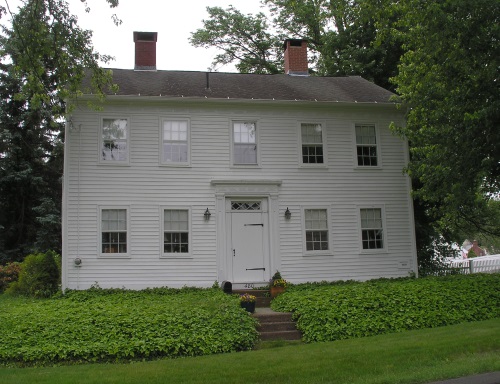
The Amasa Preston House (1828)

At 152 Cornwall Avenue in Cheshire is an 1828 house, built by Amasa Preston. A settler from Wallingford, Preston was on the building committee for the Methodist Church, constructed in 1834. The house had two rooms added to the rear in 1910. Owned by the Preston and Trithall family, the house was the childhood home of architect Alice Washburn. A former high school principal in the 1890s, in 1919 Washburn began designing Colonial Revival houses in Cheshire and surrounding communities. She continued until the Great Depression forced her retirement in 1933. Around 1920, she renovated the Preston House in the Colonial Revival style, creating a beautiful front entry featuring a semicircular fan above the door. Today, the Connecticut chapter of the American Institute of Architects sponsors the annual Alice Washburn Awards for excellence in traditional house design. (more…)

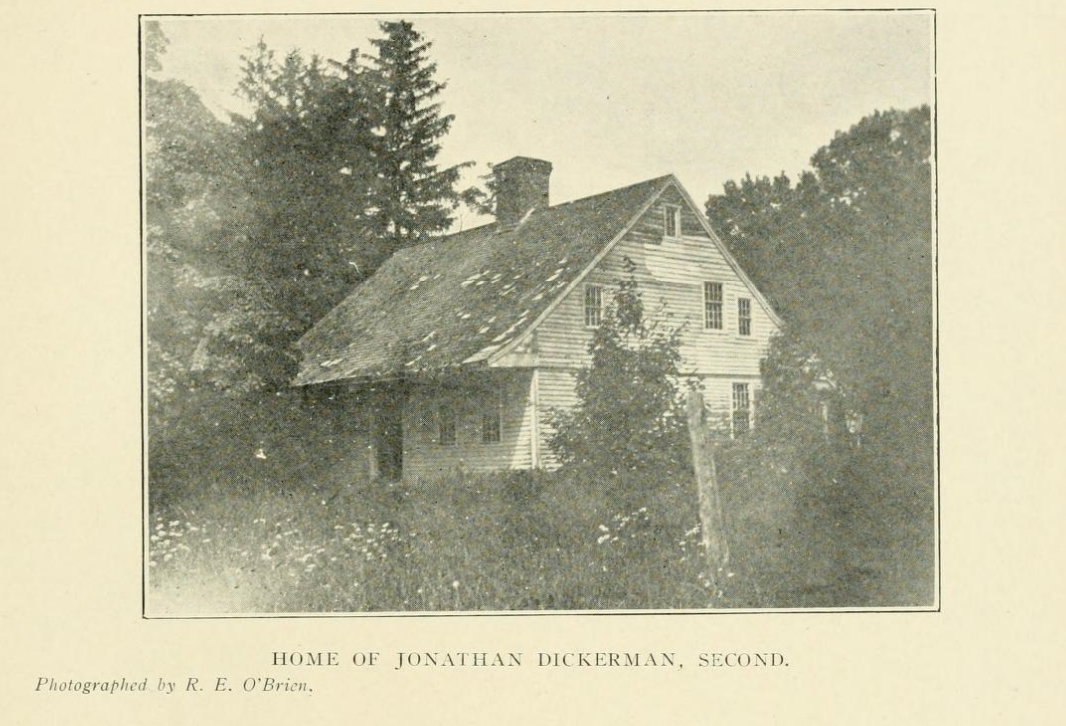
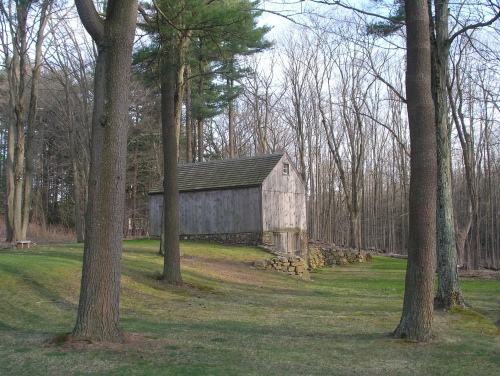
Jonathan Dickerman II House (1792)

In 1792, Jonathan Dickerman II built a farmhouse in Hamden, south of the Sleeping Giant, also known as Mount Carmel. Originally located on the north side of Mount Carmel Avenue, the house was acquired by the state in 1924, serving for a time as a ranger station when the Sleeping Giant State Park was being created. In 1961, when the Avenue was being straightened, the state gave the Dickerman House to the town and, the following year, it was moved across the street to its current location by the Hamden Historical Society. A historic cider mill barn was moved to the property in 1992 and an outhouse in 2002.

North Congregational Church, New Hartford (1828)

The first church building in New Hartford was the Town Hill Church, which took ten years to build, 1739 to 1749. By 1828, it was necessary to build a new church, but residents in North Village wanted the replacement to be relocated closer to their own homes. Forming the North Ecclesiastical Society of New Hartford, some residents in the northern part of town constructed their own Congregational Church. A new church was also built on Town Hill, but another split led to the establishment of Nepaug Congregational Church in 1848. The Town Hill Church was abandoned in 1854 and taken down in 1859. The interior of the North Congregational Church was renovated in the later nineteenth century.

Gleason-Harger House (1784)

The Gleason-Harger House, on the Albany Turnpike in Canton, was built around 1784 by Chauncey Gleason, who was involved in the East and West Indies trade, first with Elijah Cowles & Co. of Farmingtion and later in partnership with Matthew Ives, of Westfield, Mass. Around 1835, the house was acquired by John Wesley Harger, a Deacon of the Canton Baptist Church, who replaced the original gambrel roof. The house was also most likely altered around the same time to its current Greek Revival appearance. The house remained in his family well into the twentieth century and is now used as offices.

First Church Parsonage, Farmington (1875)

The Queen Anne style house at 96 Main Street in Farmington was built in 1875 as the Parsonage of the First Congregational Church. The stone store, built by Maj. Timothy Cowles, originally occupied the site, but was destroyed by fire on July 21, 1864. William Gay, a merchant who owned several parcels of real estate in Farmington, bought the lot in 1871 and sold it to the First Ecclesiastical Society.

Sloper-Wesoly House (1887)

The Sloper-Wesoly House, on Grove Hill in New Britain, is a Queen Anne-style residence, built in 1887. Designed by George Dutton Rand, the house was built for Andrew Jackson Sloper, an industrialist and third president of the New Britain National Bank. His son, William Thomson Sloper, who grew up in the house and was a survivor of the Titanic, wrote a biography of his father, The Life and Times of Andrew Jackson Sloper, 1849-1933 (1949), which contains many anecdotes of nineteenth-century New Britain. The house was later owned by Dr. Andrew Wesoly, who served as an army captain in the Second World War and who, as a physician and Polish speaker, treated many of New Britain’s Polish residents. After his death, his daughters donated the house to the Polish American Foundation of Connecticut. The building is now the Sloper-Wesoly Immigrant Heritage and Cultural Center.