The Charles E. Mitchell House (1880)

Charles Elliott Mitchell (1837-1911), a lawyer originally from Bristol, practiced law in New Britain, forming a partnership with Frank L. Hungerford in 1869. The partners wrote the charter when New Britain became a city in 1870 and Mitchell was also appointed the first city attorney. He represented New Britain in the General Assembly in 1880-1881, around the time his surviving residence in the city, a Queen Anne-style house at 15 Hillside Place, was constructed. While in the Assembly, as explained in David N. Camp’s History of New Britain (1889), he was “a member of the commission to consider and report upon the necessity of a new normal school building, and was largely instrumental in securing a favorable report and the appropriation necessary for its erection.” The building is located next to his house on Hillside Place. Mitchell came to specialize in patent law and served under President Benjamin Harrison as United States Patent Attorney, in 1889-1891. He retired from the law and returned to New Britain in 1902, where he served as president of the Stanley Rule & Level Manufacturing Company. In 1905, he had a new house built at 54 Russell Street, a Colonial Revival home, designed by Charles Rich of New York, where he lived until his death in 1911. This house became the home of Mark J. Lacey, the president of several manufacturing companies, in 1930. The Russell Street house was demolished for the construction of a highway in 1972.

Congregational Church of Naugatuck (1903)

The Congregational Church of Naugatuck is on Division Street, across from Naugatuck’s Green (part of which is owned by the Church and is leased to the Borough of Naugatuck). This is the Church’s third building. The first was built on a hill to the east in 1782, a year after the congregation was formally gathered. In 1831, it was moved to a location across from the present church, on the northeast corner of what is now the Green, on land donated by Daniel Beecher, an inn keeper. It was sold and moved again, this time across the street to become a store, being replaced by the second church, built in 1853-1854. The present church was built in 1903 and was designed by the renowned architectural firm of McKim, Mead and White. It was one of several commissions by the firm around Naugatuck Green arranged by the prominent local industrialist, John Howard Whittemore.

Salem School (1894)

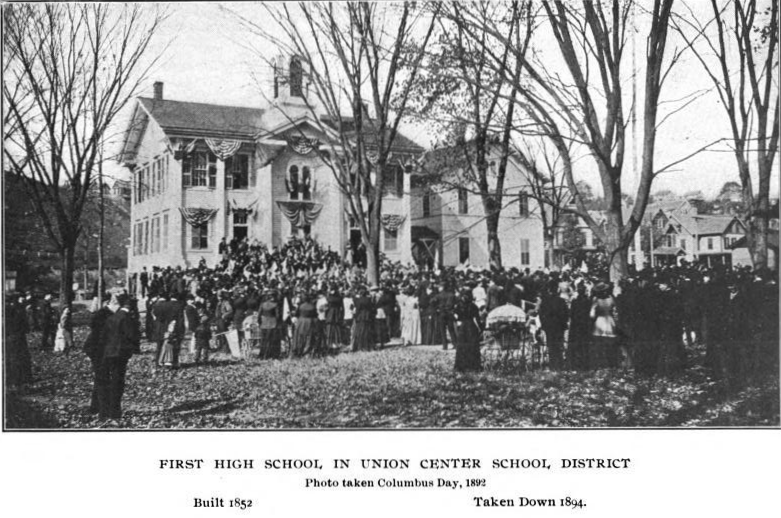
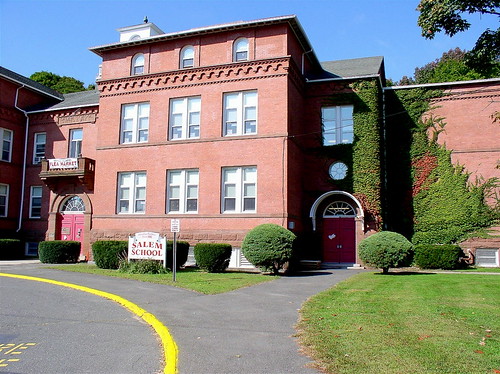
Naugatuck’s Salem School has been in the news recently. Just this past week, the Naugatuck Board of Education, facing a budget shortfall, voted to close the historic school, resulting in the circulation of a petition to save it. Salem School has been open since 1894. Previously, the Union Center School, built in 1852 and located on Naugatuck Green, had served the community. By the 1890s, the Borough of Naugatuck required a new and larger school building. The result was Salem School, the gift of John Howard Whittemore, a wealthy industrialist who wanted to enrich his hometown. He hired the nation’s leading architectural firm, McKim, Mead and White, to design the school, as well as many other prominent buildings in the center of Naugatuck. The old school on the Green was taken down and Salem School was built across Meadow Street in 1893 and opened the following year. The school served all grades until a separate High School building, also designed by McKim, Mead and White, was built in 1905. The Middle School grades were moved out in the 1950s. Salem School, named for “Salem Bridge,” an early name for Naugatuck, has continued since then as an elementary school, but is now slated to close. The future use of the building has not yet been determined.

The Edward Wilson House (1910)

The Arts and Crafts or American Craftsman style of house was popular at the start of the twentieth century. The house at 168 Buckingham Street in Waterbury, built around 1910, displays a number of Arts and Crafts features, including wide bracketed eaves, a low pitched front gable roof, and the use of mixed materials, in this case represented by the different exterior siding seen on each floor. The house may have been built by the Tracy Brothers construction company of Waterbury, because it was built for Edward Ely Wilson, a vice-president at the firm. According to Volume III of History of Waterbury and the Naugatuck Valley (1918), Wilson came to Waterbury in 1888 and “and became foreman of the shop of the Tracy Brothers Company. His ability won him immediate advancement and led to his admission to a partnership. Upon the incorporation of the business he was chosen vice president and so continues. […] He is today an officer in one of the foremost contracting firms of the city with a patronage that makes its business one of large volume and importance.”

The George Grannis House (1864)

The house of George Grannis, a photographer, was built sometime around 1864 on Church Street in Waterbury. In the 1870s, the house came to be owned by the Burrall family, being occupied in the early twentieth century by the sisters, Mary and Lucy Burrall, and their lifelong friend, Miss Edith Morton Chase. The daughter of Henry Sabin Chase, first president of the Chase Brass and Copper Company, Edith Chase was a neighbor of the Burrall sisters, who became her companions when she later made the Grand Tour of Europe. In 1917, Chase’s father gave her land in Litchfield, now Topsmead State Forest, where she built a country house. Chase and the Burralls then lived together, dividing their time between summers in Litchfield and winters in Waterbury.