Cyrus Beardslee House (1825)

The Cyrus Beardslee House, at 754 Monroe Turnpike in Monroe, is a brick Federal-style house built around 1823-1825 by Austin Lum, a brick mason, for Hall Beardslee, who deeded it to his son, Cyrus H. Beardslee, a lawyer who served in the state legislature for seven years, being Speaker of the House of Representatives in 1846. The house later became a boys’ school known as Gray’s Academy, operated by Dr. Robert Gray. In 1865, it was purchased by St. Peter’s Church Women to become the parsonage of St. Peter’s Episcopal Church. After nearly ninety years, the house was sold to an antique’s dealer and then became the Rectory of St. Jude Roman Catholic Church. Today it is again a private home.

Scudder Building (1855)

The Scudder Building, on Main Street in Newtown, was built in 1855 to house the town clerk and probate offices. Also known as the Brick Building, it held the town library for a time, until the Beech Memorial Library opened around 1900 (which was, in turn, followed by the C.H. Booth Library in 1932. Lacking interior stairs, the building originally had an external staircase on the right to reach the second floor, where town meetings were held. Today, the Scudder Building is used as offices.

David Ogden House (1750)

David Ogden and his new wife, Jane Sturges Ogden, moved into a recently completed house in Fairfield in 1750. The house remained in the Ogden family for the next 125 years, surviving the burning of Fairfield by the British in 1779. The house later fell into bad repair, but in the 1930’s, it was restored by the architectural historian J. Frederick Kelly. Today, this saltbox colonial house is museum, operated by the Fairfield Museum and History Center and furnished according to information in David Ogden’s will and estate inventory. (There is more information in this pdf file)

Monroe Congregational Church (1847)

In 1762, residents of New Startford, now Monroe, successfully petitioned the State Legislature to establish a new parish. Previously, residents had made the long journey to Huntington (now Shelton) for worship. A meeting house, for use during the winter, had previously been built on Moose Hill Road. Once the New Stratford Ecclesiastical Society was formed, a new meeting house was built in 1766 on what is now Monroe Green. This was replaced by the current Monroe Congregational Church, built just to the north, in 1847. In 1985-1986, the church was expanded and the interior was restored as closely as possible to its nineteenth-century appearance.

Benedict-Miller House (1879)

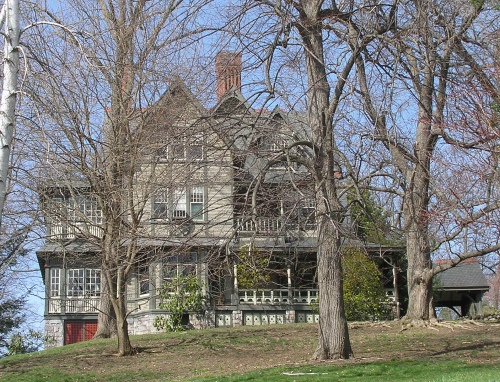
Dominating the ridge of Hillside Avenue, overlooking Waterbury, is the enormous mansion known as the Benedict-Miller House. A Queen Anne/Stick style extravaganza of gables, crisscross and diagonal boards and decorative railings, balustrades, braces and brackets, the house was built by the firm of Palliser, Palliser & Co. of Bridgeport for Charles Benedict. The brothers, George and Charles Palliser, specialized in Gothic and Queen Anne cottages and designed houses for P.T. Barnum. Benedict was president of the Benedict & Burnham Company, once the largest manufacturers of brass and copper appliances and fixtures in the country, and served as mayor of Waterbury in 1859-1860. Next to Benedict’s house, and once sharing with it a private drive, is another grand Stick-style mansion built for Benedict’s sister, Mary Mitchell. After Benedict’s death, in 1881, his house was owned by Charles Miller, of the Miller & Peck department store. The Benedict-Miller property was part of UCONN’s Waterbury branch campus from 1942 until 2004, when it was sold to Yeshiva Gedolah, a school for Orthodox Jews.

36 Lewis Street, Hartford (1840)

The house at 36 Lewis Street in Hartford, like that at 24 Lewis Street, was most likely built around 1840 by the builder, Austin Daniels. The houses originally resembled each other, but while no. 24 retains a Greek Revival pediment in the gable end facing the street, no. 36 was altered around 1860 to fit the newly popular Italianate style. The gable roof was replaced with a low-pitched hip roof with overhanging eaves, raised to allow the placement of small windows just below the roof on the two sides. The wide front porch is also an Italianate addition. By the 1950s, the house was the last building on Lewis Street to remain a private residence, but later became a restaurant. The property is currently available for rent.