Howard Whittemore Memorial Library (1894)

The Howard Whittemore Memorial Library, on Church Street in Naugatuck, was built in 1894 as part of the grand beautification plan of industrialist and philanthropist John Howard Whittemore for his adopted home town. The Library, named in honor of a son who had died young, was one of the first of the many structures that Whittemore, influenced by the “City Beautiful” movement, commissioned for Naugatuck Center. Designed by McKim, Mead & White and utilizing the same plan as the firm’s Walker Art Gallery at Bowdoin College, the Neo-Classical Revival library is constructed of pink granite, with buff terra-cotta panels above the windows and in the pediment above the front entrance. The frieze running around the buildings is incised with names of famous authors. The Library has a modern addition to the rear.

Raymond Library (1885)

When Albert C. Raymond of Montville and East Hartford died in 1880, he left $10,000 in trust for the establishment of a library in Montville. A library had existed in Montville Center as early as 1823: the Union Library, a private institution located in an old store on the site of the present Congregational Church. As described in Henry A. Baker’s History of Montville (1896),

After the death of Mrs. Raymond, 16 Sept., 1883, the sum donated for the founding of the Raymond Library was received from the executors of the estate of Albert C. Raymond by the Raymond Library Company, who immediately caused a library building to be erected at a cost of two thousand dollars. The building was a beautiful brick structure, built under a contract by Mr. Robert Turner of Norwich, and completed in the winter of 1884-5. At the annual meeting of the Raymond Library Company, held October 14, 1885, the library building was formally opened to the public; a bountiful collation was prepared by the ladies of the town, which was partaken of and heartily appreciated by all the persons who gathered at the chapel of the Congregational church at Montville Center on the occasion.

The Raymond Library has since been expanded with some very obvious modern additions.

Beardsley and Memorial Library (1898)

This week, we’ll be looking at libraries again. Our first library is the Beardsley (and Memorial Library) in Winchester. As explained by Robert S. Hulbert, in Winsted; the Development of an Ideal Town (1906):

The educational awakening of Winsted was also helped in 1874 by Mrs. Delia Ellen Rockwell Beardsley, widow of Elliott Beardsley, who gave into the hands of [seven] trustees $10,000 for the founding of a library [in West Winsted]. For twenty-five years the books were in a pleasant room in the Beardsley building. Before his death in 1897, the late Jenison J. Whiting began the construction of the Memorial Library. The building was completed [in 1898] after his death by Mrs. Whiting, and with the lot on which it stands, representing a total outlay of about $20,000, was given to the town for the reception of libraries. The Beardsley Library, whose funds had been augmented by a gift of $1,000 from Miss Martha Beardsley at her death, and by $600 given by Rufus E. Holmes of Winsted, was placed in the building. The town then voted [in 1899] an appropriation of $1,500 annually, to meet, with other expenses, those for which a small fee had been charged, and the books in the library were made free to the public.

Today, the Beardslee and Memorial Library continues as a private non-profit organization, voted by the citizens of Barkhamsted, Colebrook, and Winchester to be their public library.

St. John’s Episcopal Church, Waterbury (1873)

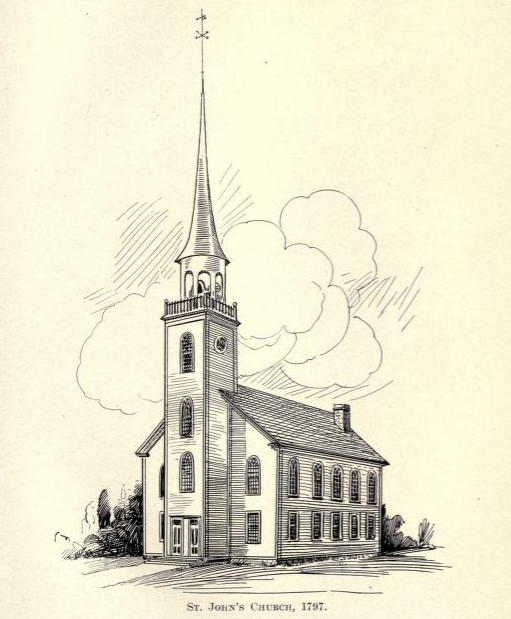
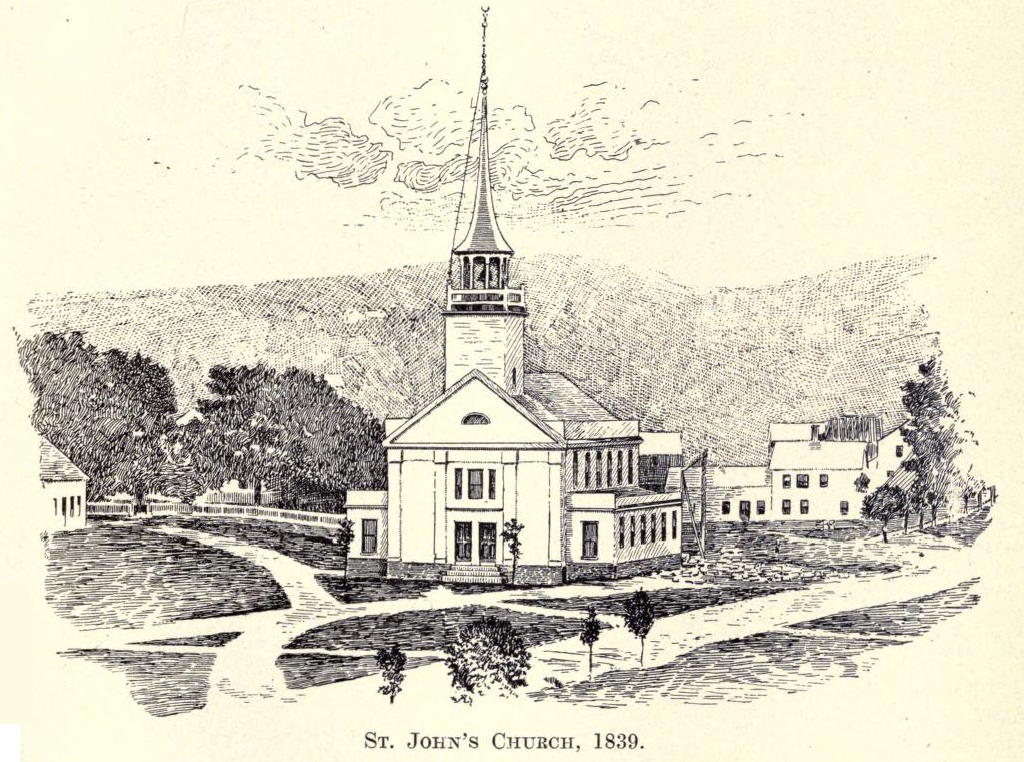
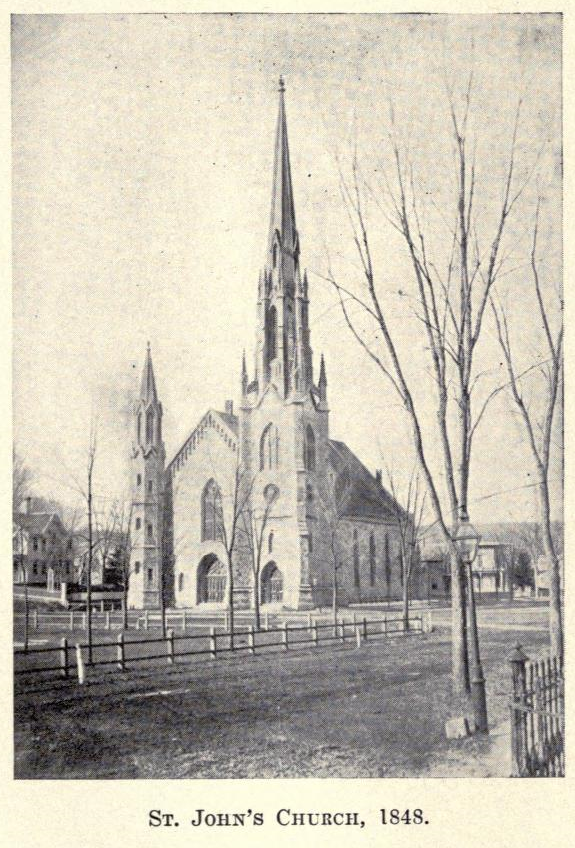
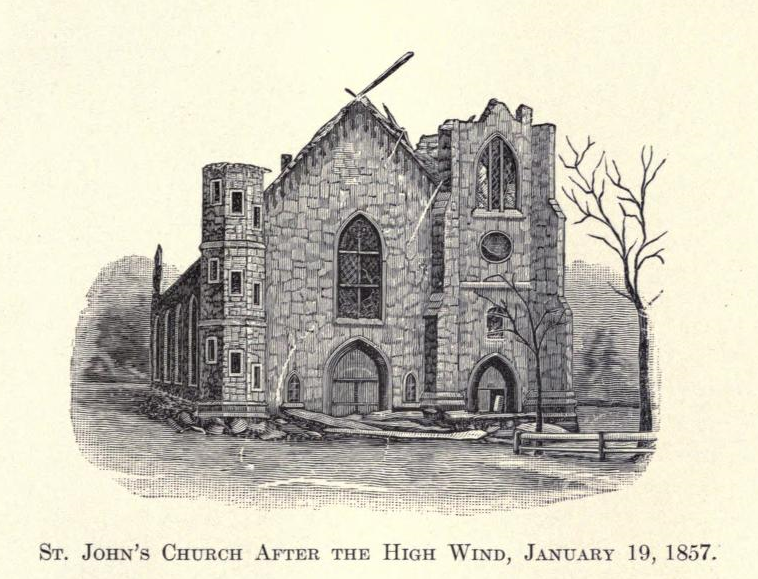
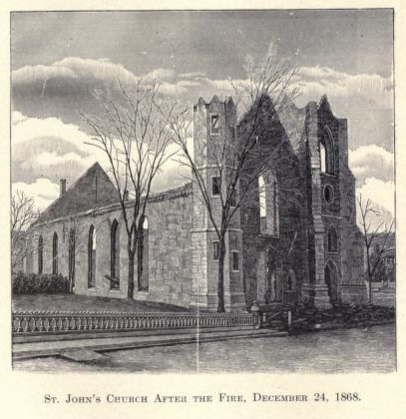
St. John’s Episcopal Church in Waterbury was established in 1737, with the first church building being constructed in 1743 at West Main and Willow Streets. A new church was built in 1797 at the west end of Waterbury Green, the first of three successive churches at that location. Expanded in 1839, the 1797 church was moved to East Main Street in 1847 to become St. Peter’s Catholic Church (it was torn down in 1888). The second, granite Gothic Revival church was built in 1848. This church’s steeple toppled in a high wind in 1857 and the church itself burned down on Christmas Eve, 1868. It was replaced by the current church, built in 1873 and designed by Henry C. Dudley, an architect known for his Gothic Revival churches. The church features stained glass windows by Louis Comfort Tiffany.

Josiah Bronson House (1738)

The oldest surviving house in Middlebury was built by Josiah Bronson on Breakneck Hill Road in 1738. The house also served as a tavern and hosted a number of French officers during the Revolutionary War: first in 1781 when Rochambeau’s French army encamped in Middlebury from June 27 to July 1, on its way to the Siege of Yorktown, and again from October 26-28, 1782, during their return journey. One of the officers to stay in the tavern was the Baron de Viomenil, who was second in command to General Rochambeau during the Yorktown Campaign. At these times, Rochambeau himself most likely stayed with Captain Isaac Bronson, Josiah’s father, further down the hill. The Josiah Bronson House was acquired in 1940 by Lawrence M. and Esther Duryee, who restored it.

The Harriet M. Brainerd House (1886)

Edward M. Simpson, who lived in Middle Haddam at Knowles Landing, was a steamboat captain and pilot on the Connecticut River in the mid-nineteenth century. His daughter, Harriet M. Brainerd, was married to Edward R. Brainerd, a marble dealer in Chicago. The couple built a summer house near her father’s home in Middle Haddam in 1886. At the time, Knowles Landing was a destination for tourists and steamboats would dock at the landing. Harriet Brainerd built a Steamboat Dock House in the early 1890s to replace an earlier structure, built in the 1860s. Later used as a residence, this boat house burned down in the 1980s, but the Queen Anne-style Harriet M. Brainerd House (pdf) survives, displaying Victorian-era features, like the decorative stickwork on the front veranda. (more…)

Sun Tavern (1780)

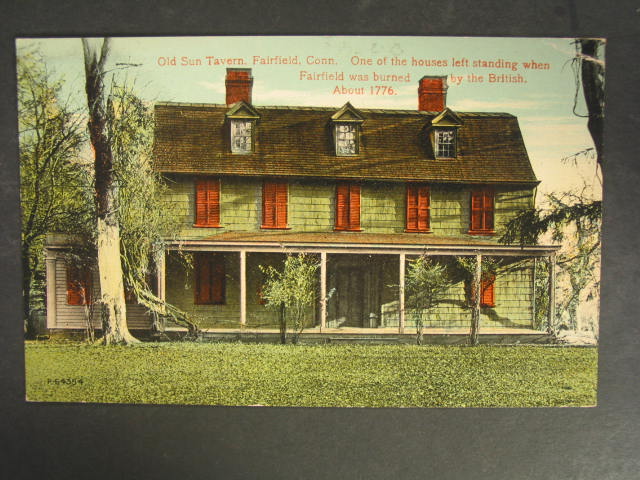
Sun Tavern, on the Fairfield Green, was built about 1780, replacing an earlier Sun Tavern, burnt during the British raid of 1779. The Tavern was operated by Samuel Penfield, who acquired the property in 1761. George Washington stayed at the Tavern the night of October 16, 1789, during a presidential tour of New England. The building, which had an early ballroom on the third floor, remained a tavern until Penfield’s death in 1811, after which it passed through several owners as a private home. It was purchased by Robert Manuel Smith in 1885 and remained in the Smith family until 1977. The following year, it was acquired by the Town of Fairfield and was used as the Town Historian’s residence into the early 1990s. Still owned by the town, Sun Tavern has been recently restored and is now managed as a historic site by the Fairfield Museum and History Center.