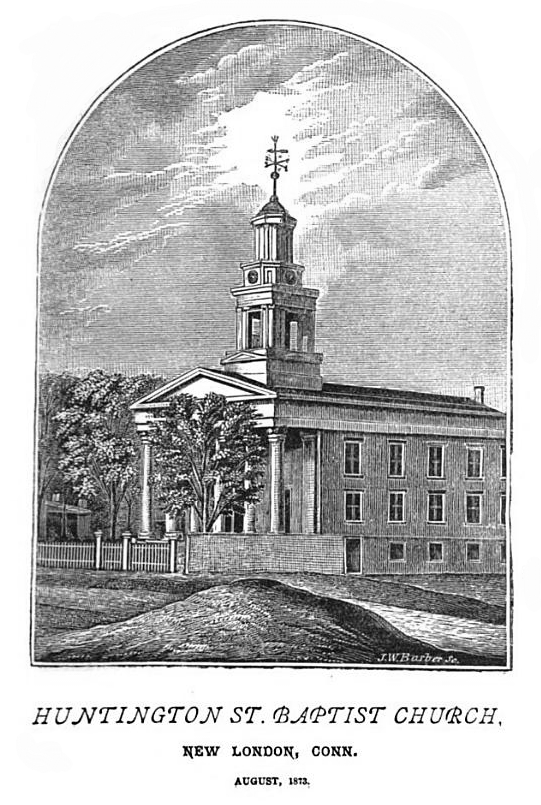
Huntington Street Baptist Church (1843)

The Greek Revival-style Huntington Street Baptist Church in New London was built in 1843 and was originally a Universalist church. It was designed and built by John Bishop, a member of the church, who was inspired the book, The Beauties of Modern Architecture (1835), by Minard LaFever, a prominent architect of churches in the early nineteenth century. Financial difficulties led the Universalists to sell the church in 1849 to a Baptist congregation. As explained in Frances Manwaring Caulkins‘s History of New London (1860):

A third Baptist church was constituted March 14th, 1849, by a division of one hundred and eighty-five members from the first church. This society purchased the brick church in Huntington Street, built six years previous by the Universalist society, for $12,000, and dedicated it as their house of worship, March 29th, 1849. Sermon by Rev. J. S. Swan, who was the chief mover in the enterprise, founder and pastor of the church. In 1850, the number of members was three hundred and eleven.

Jabez Smith Swan was a prominent preacher and hymnist (pdf link)

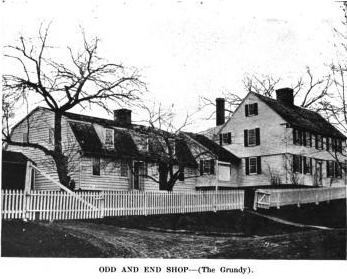
The Daniel Judd House (1730)

The Daniel Judd House in Farmington (not to be confused with the 1875 Daniel Judd House in Cheshire) is a colonial saltbox home built around 1725-1730. The house was built on land that Daniel Judd inherited from his parents, William and Mary Steele Judd, early settlers of Farmington. Judd sold his house to his oldest surviving son, James, in 1741 and it was willed to James Judd, Jr. in 1779, although the younger James lost his money and the property was foreclosed on in 1805. It then passed through various owners until it was acquired by James O’Rourke in 1874. In 1890, O’Rourke rented the house to Theodate Pope, daughter of the wealthy industrialist Alfred Atmore Pope. She soon purchased the house in 1892. Calling it the “O’Rourkery” after its previous owner, Pope hired the architectural firm Hapgood and Hapgood to restore the house. Some years later, she added a side entrance porch to the house and would continue to make other alterations to the building over the years.

In 1896, she acquired the property next to her home, which included an earlier, seventeenth-century dwelling, possibly built for William Judd. She had this building moved and attached to the O’Rourkery as an ell. Calling it the “Gundy,” Pope opened the ell in 1902 as an “Odds and Ends Shop” for students at Miss Porter’s School. Pope would later persuade her parents to settle in Farmington, using her experiences in restoring the O’Rourkery in designing for them the famous Hill-Stead estate. She would go on to design a number of other buildings. Theodate Pope later resided at Hillstead with her husband, John Wallace Riddle, but continued to own the O’Rourkery, using it as a retreat. After her death, the estate, including the O’Rourkery, became the property of the Hill-Stead Museum. The Gundy shop continued in operation under various people until 1969, but in 1975 the Museum sold the house. It is now a private residence. Behind the Gundy today is a notable (private) Colonial Revival garden.

24 Lewis Street, Hartford (1840)

The former house, now a business, at 24 Lewis Street in Hartford was built around 1840. It has been attributed to the builder Austin Daniels, who also probably constructed the two adjacent buildings. Stylistically, the house represents the transition from the Federal to the Greek Revival styles and is typical of houses built in Hartford in the decades before the Civil War. The Italianate-style front portico was added later in the nineteenth century and the enclosed porch is a later Colonial Revival addition.

The James R. Lanyon House (1903)

The house at 96 Cornwall Avenue in Cheshire is an American Foursquare built in 1903. It was constructed for James R. Lanyon, who was born in New Hamburg, NY, but five years later came to Cheshire, where his grandfather, James A. Lanyon, had been superintendent of the Barite Mines. Lanyon served as town clerk of Cheshire for 59 years, from 1894 to 1953. He served in the Connecticut General Assembly and chaired the Republican Town Committee. As described in Taylor’s Legislative Souvenir of Connecticut for 1901-1902, “Mr. Lanyon has been the recognized leader of his party in Cheshire—its leader without being its boss—thus winning the admiration of his party associates and the profound respect of his political opponents. He is a highly respected member of the Masons and Odd Fellows.”

Holmes Building (1904)

Located along a row of commercial buildings, across from the post office on Grand Street in Waterbury, is the Holmes Building, constructed in 1903-1904. It was one of many structures built in the area after the devastating Waterbury Fire of 1902. The building was home to C.L. Holmes & Company, which became Holmes and Burr in 1905. As described in the History of Waterbury and the Naugatuck Valley, vol 3 (1918), “The building is a three story structure with sixty foot frontage on Grand street, the upper stories being used for offices, while a part of the lower story is occupied by the Waterbury Trust Company. The firm of Holmes & Bull conducts a general brokerage business, handling investment securities, and they have an extensive clientage.” The Waterbury Trust Company, established in 1907 with C.L. Holmes as its president, eventually gave its name to the entire building. The Elks Club occupied rooms in the building until the Lodge constructed the a new Home in 1910. The WBRY radio studios were also in the building in the early 1940s.