Highfield (1914)

In 1911, Theodate Pope Riddle, famous for designing Hill-Stead in Farmington, completed plans for another country estate for her friends, Joseph and and Elizabeth Chamberlain. In 1909, the Chamberlins had acquired land in Middlebury, close to Whittemore estate. Their house, called “Highfield,” was constructed in 1911-1914, on a hill above Lake Quassapaug. Theodate’s design for the house was influenced by her recent trip to England, where she had studied traditional village architecture and the work of English Arts and Crafts architects like Edwin Lutyens. Designed to resemble a rustic English cottage, Highfield has a large interior, with the second story cleverly concealed behind the sloping shingled roof. Next to the house is a sunken garden, where Theodate created a sumer house with removable glass walls. Charles Downing Lay made alterations to the back of the house in 1925 and to the attic in 1929. In 1954, the Stillman family, who had suceeded the Chamberlins as owners of the house, sold the property, which became a nine hole golf course. The house is now the clubhouse.

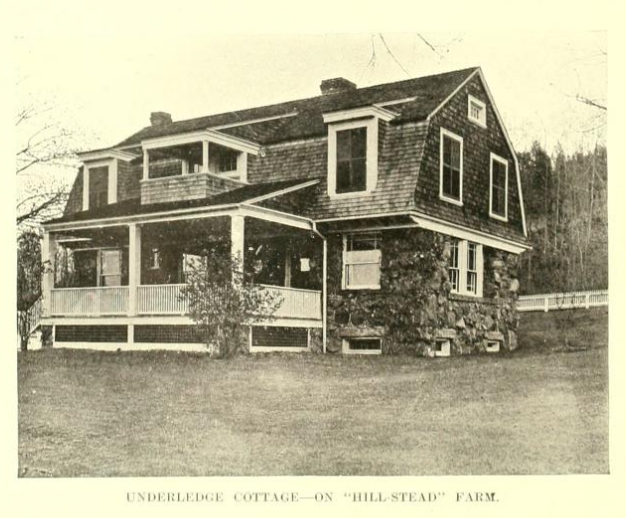
Underledge (1896)

Underledge is a fieldstone cottage, built by William Potts on Mountain Road in Farmington around 1894-1896. Potts, a member of the Century Association in New York, wrote two books of nature sketches at Underledge: From a New England Hillside: Notes from Underledge (1895) and More notes from Underledge (1904). In 1898, Potts sold Underledge with eight acres to Alfred Pope and the cottage thus became part of the Hill-Stead estate. Later, Pope’s daughter, Theodate Pope Riddle, calling it the Field Office, used Underledge as her office and studio, where she planned her architectural projects. No longer part of Hill-Stead, the house is now a private home.

Brown-Elton Tavern (1810)

The striking pink, Federal-style Brown-Elton Tavern, located on the Green in Burlington, was built in 1810 as the private home of Giles Griswold, a merchant. It’s design is attributed to builder David Hoadley. By 1820, Griswold had relocated to Georgia and his properties were being foreclosed. The house was soon acquired by Julius Hotchkiss, who died in 1825. His widow, Laura Hotchkiss, later sold the Tavern, which passed through other owners over the years (pdf). The building served as a tavern on the Hartford and Litchfield stage line and later as an inn along the George Washington Turnpike. It was purchased by the Town of Burlington in 1974 and is now home to the Burlington Historical Society, which is restoring the Tavern as a museum.

Stonington Free Library (1900)

The Stonington Free Library Association first met in 1887 and, the following year, established a library in Stonington Borough, located initially in a house on the corner of Main and Church Streets. Outgrowing this space, a new library building was constructed in Wadawanuck Park, on land donated for the purpose by the heirs of Samuel Denison. Opened in 1900, the new library was designed by Clinton and Russell of New York. The Stonington Free Library was expanded to the north in 1956 and again in 1990, with the addition of the Wimpfheimer Wing.

Plainville Public Library (1931)

A library in Plainville was founded in 1885 and occupied a series of rented rooms in commercial blocks for a number of years. In 1894, citizens voted to establish a free public library, which was at first located in the old town hall. The current library building was built in 1931 and was designed by Walter P. Crabtree. An interesting feature of the building is Colonial Revival the combination of a broken pediment and a semicircular window over the front door. The Plainville Public Library was expanded in 1962 and again in 2001-2004.

Olin Memorial Library (1928)

Rich Hall, dedicated in 1868, served as Wesleyan University‘s library until Olin Memorial Library was built in 1928. Henry Bacon, who was serving as Wesleyan’s advisory architect, made preliminary sketches for the new library in 1923, less than a year after the dedication of his most famous building, the Lincoln Memorial. Bacon died in 1924 and his ideas were passed on to the firm of McKim, Mead & White. The Library was built in 1925-1927 and dedicated in 1928. The following year, the street just south of Olin Library was moved further south to make room for a large front lawn. In anticipation of the need for future expansion of the Library, the north facade of the building, facing Andrus Field, was left unadorned and had a wall that could be easily removed. The anticipated rear expansion of the library stack area occurred in 1938. Another expansion was constructed in 1983-1986, with a modern addition cleverly designed by the firm of Perry, Dean, Rogers & Partners of Boston to wrap around and enclose the earlier expansion of 1938.

Norfolk Library (1888)

Frederic S. Dennis, in The Norfolk Village Green (1917), writes that the earliest library in Norfolk dates to 1761:

A library company was then formed, and about 150 volumes were collected; and this library remained in activity about thirty-five years, when it was dissolved, the books to be distributed among the original donors. In 1824 a second library was formed and incorporated with 142 volumes, besides periodicals. Like its predecessor it was short lived and dissolved in 1866. The books passed into the hands of Mrs. Charlotte Mills, and Miss Louise Stevens, who subsequently founded a third library, which was in the hands of a committee. This new Library was placed on a business basis and a yearly fee of one dollar was charged for membership. It continued for a year and its books formed the nucleus of a fourth Library. In 1881 Miss Isabella Eldridge opened a reading room in the Scoville house on the Green, and the books of the third Library were placed there.

Isabella Eldridge’s reading room was so successful, that in 1888 she decided to endow a library in memory of her parents, the Rev. Joseph Eldridge and Sarah Battell Eldridge. She hired architect George Keller of Hartford to design the Norfolk Library, which was constructed in 1888 and opened to the public in 1889. The library has a first floor built of red freestone, quarried at Longmeadow, Massachusetts. The upper floors feature fish scale shingles and the original roof had fluted Spanish tile, since replaced. In 1911, Keller designed a reading room, added to the rear of the Library. A later addition is the children’s wing of 1985, designed by Alec Frost and also constructed of Longmeadow red freestone.