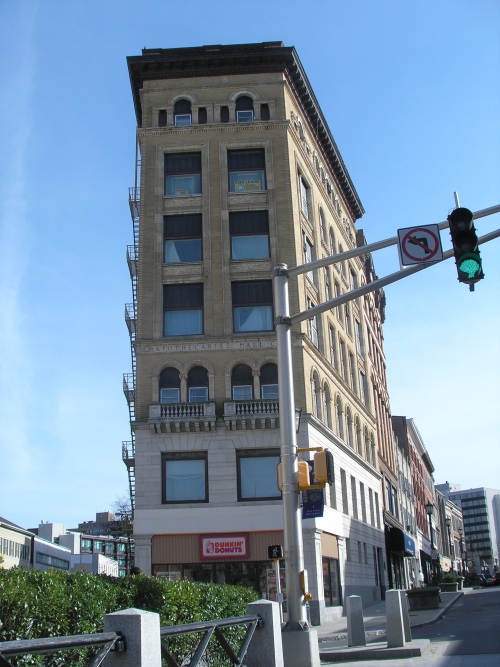
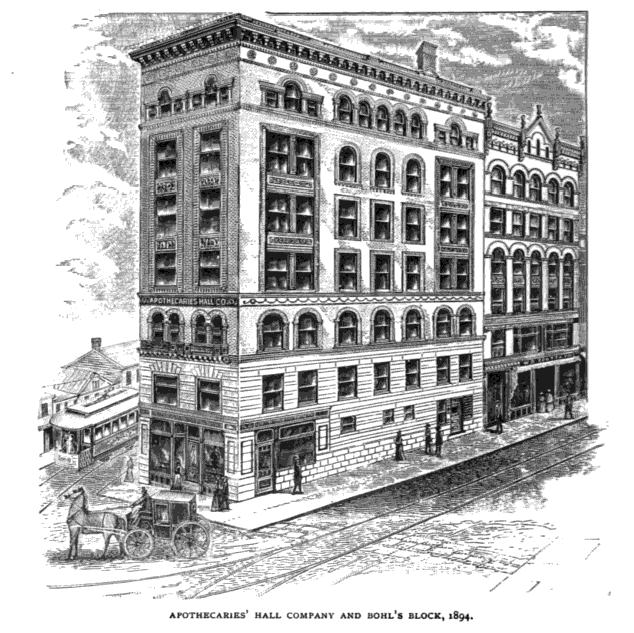
Apothecaries Hall Building (1894)

Another Waterbury landmark is the Apothecaries Hall Company building, a “flatiron” structure, located at Exchange Place, where several important city thoroughfares intersect. In 1849, Dr. Gideon L. Pratt opened a drugstore at Exchange Place in a Greek Revival-style building that had been built in 1829 by by Benedict and Coe as a general store. Called Apothecaries Hall, the business continued and grew under various owners for many years. In 1892, the original building was torn down and replaced, at the same spot, by the current structure in 1894. Designed by Theodore Peck, the Renaissance Revival building is constructed of marble, granite and Roman brick.

Waterbury Union Station (1909)

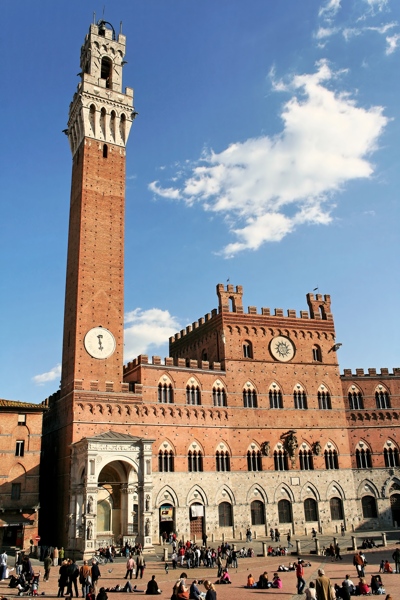
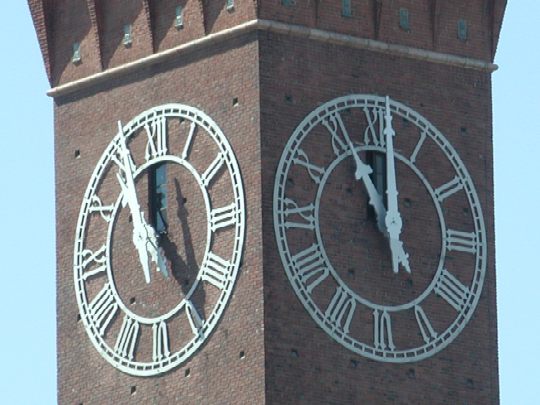
This week we look at buildings in Waterbury. Opened in 1909, Waterbury‘s old Union Station building, famous for its striking clock tower, was built by the New York, New Haven & Hartford Railroad and was designed by McKim, Mead and White. The 245 foot campanile, or tower, was added to the building at the request of a railroad executive who wanted a copy of the Torre del Mangia, built in 1325-1344 in Sienna, Italy. The tower’s clock, the largest in New England, was made by the Seth Thomas Company and the bell was installed in 1916. The tower features eight she-wolf gargoyles, reminders of the story of Romulus and Remus, the founders of Rome. The former station now houses the offices of the Republican-American newspaper.

Trinity Episcopal Church, Milton (1802)

Episcopal services were first held in the Milton section of Litchfield in 1792. At first, services were held five Sundays a year with the meetings taking place in private homes. In 1798, Episcopalians living in Milton were given permission by the First Episcopal Society to build their own chapel and Trinity Parish was established. Work on the church edifice began in 1802 and was not completed until 1826, with the church finally being consecrated (after all debts had been paid) in 1837. The church was designed by Oliver Dickinson, who modeled it on the second Trinity Church at Wall Street in New York. The church’s steeple was replaced, later in the nineteenth century, with four Gothic-style square-cornered turrets. The belfry and steeple were later both replaced after being struck by lightning in 1897. When the church was being repaired and wired for electricity in 1938, pinnacles with crosses were discovered that had once stood at the base of the initial steeple. This made it possible to determine the proportions of the old steeple and restore the church to its original appearance.

34 First Avenue, Waterbury (1875)

The house at 34 First Avenue in Waterbury is a Queen Anne-style house with an octagonal turret, built around 1875. The family of Richard Tennant, an immigrant from Scotland, occupied the house from the end of the nineteenth century until 1950. According to the Commemorative Biographical Record of New Haven County, Connecticut (1902):

Richard Tennant spent his boyhood and youth on the Scottish homestead, and availed himself of the opportunities of education presented by the local schools. After attaining his majority he went to Glasgow and served three years as an apprentice to the machinist’s trade, at the Neilson Locomotive Works. Howden & Co., marine engineers, had the young man in their employ for two years, and he was then with the London-Glasgow Engineering Co. one year. By this time Mr. Tennant had become an experienced and thoroughly efficient machinist, and his services were in demand. King & Co., a celebrated engineering house, counted him among their ablest employes. Only the desire to come to this country, where many of his compatriots had already reaped a rich reward for their courage and enterprise, induced him to break away from this firm. In 1871 Mr. Tennant came to the United States, and located in Paterson, N. J., where he was in the employ of the Rogers Locomotive Works until the close of the year 1873, and in the following spring he came to Connecticut, working for three months in Ansonia, and then for a year in Seymour, with the Swan Bit Co. Mr. Tennant then returned to Ansonia and engaged with Wallace & Sons until January, 1888, in which month he came to Waterbury to take a position with the Scovill Manufacturnig Co., where he is still at work. For a year Mr. Tennant was master mechanic for the Aluminum Brass & Bronze Co., at Bridgeport, and with that exception has been with the Scovill Co. since coming to Waterbury.

Hillbrow House (1718)

Hillbrow is a colonial house, built around 1718, at 74 Main Street in Newtown. Built, according to the original deed, at the “Head of Main Street,” the house gained its name from its position on the brow of the hill above the street. A granite marker in the front steps is engraved with the name “Hillbrow.” The land where the house stands was acquired by John Blackman in 1715. Later in the eighteenth century, it was owned by Ziba Blakeslee, a clockmaker, silversmith and bellfounder. As described in Newtown’s History and Historian: Ezra Levan Johnson (1917):

Ziba Blakeslee is said to have been a most skilled workman and manufactured all kinds of jewelry. His advertisement in the Farmers Journal, Dec. 22, 1792, shows that he carried on at the head of the Street in Newtown, the goldsmith’s business in all its branches; cast bells for Churches, made and repaired surveyor’s instruments, church clocks and clocks of all kinds.

Also, check out my most recent Massachusetts entry on the Library in Granville, designed by George Keller.