Charles E. Beach House (1900)

On Brightwood Lane in West Hartford is a Shingle-style house, built in 1900-1901. It was once part of the extensive agricultural estate of the Beach family, known as Vine Hill Farm. The farm was begun by Charles Mason Beach, who had earlier established with his two brothers the Hartford firm of Beach & Co., dealers in paints, aniline dyes and other chemicals. Beach settled in the area of South Main Street in West Hartford in 1859, purchasing a farm house. He began buying land for a dairy farm, which soon gained a reputation in the area for its high-quality milk, cream and butter. Beach’s son, Charles Edward Beach, managed Vine Hill Farm for many years and became a prominent citizen of West Hartford, serving on the town Board of Selectmen and being elected to the Connecticut General Assembly in 1907. In the 1860s, Charles E. Beach’s father had hired a German immigrant named Louis Stadtmueller, who planted the vines on the property which gave Vine Hill Farm its name. His son, Frank Stadtmueller, developed the farm’s process of producing infant milk formula that would keep for two to three weeks. Stadtmueller was later appointed Connecticut’s State Dairy Commissioner.

The house that Charles E. Beach built on Vine Hill Farm has an asymmetrical exterior covered with wood shingles, while the interior has rich architectural details. Parcels of Vine Hill Farm land began to be sold to developers in the 1920s, with the last piece of farmland being sold in 1948 by Charles Frederick Beach, grandson of Charles M. Beach. Smaller houses, built on the subdivided land, now surround the Beach House. The home’s original cobblestone port-cochere is now to the rear of the house, because the laying out of Brightwood Lane led to the entrance being shifted from South Main Street to the newer road.

36 Forest Street, Hartford (1895)

The Queen Anne house at 36 Forest Street in Hartford was built around 1895. It stands on the site once occupied by an earlier house that burned down in 1870. That house, rented for many years by the Rev. Nathaniel J. Burton and his wife, Rachel Pine Chase Burton, was one of the homes of the Nook Farm neighborhood, where Mark Twain and Harriet Beecher Stowe also lived. Rev. Burton settled in Hartford in 1857, when he became the pastor of the Fourth Congregational Church. In 1870, he succeeded Horace Bushnell as minister at Park Church, where he remained until his death in 1887. Burton’s son, Richard Burton, was literary critic of the Hartford Courant. He edited a posthumously published collection of his father’s Yale Lectures on Preaching, and Other Writings (1888), republished in 1896 as In Pulpit and Parish. Richard Burton, who was also a poet, later lived in the 1895 house on Forest Street.

12 West Main Street, Avon (1830)

Built around 1830 and thought to have served as offices and perhaps a warehouse for the Farmington Canal, the nineteenth-century commercial building at 12 West Main Street in Avon, adjacent to the Congregational Church, has since been a feed store, school, residence and, from 1947 to 1967, a post office. This former Farmington Canal Administration building continues today to house various businesses and living space.

Wapping Community Church (1801)

The Church in Wapping, a section of South Windsor, was built in 1801 and initially served several denominations. The Baptists and Methodists later founded their own churches, so that by 1817, only the Congregationalists remained. They eventually organized as the Second Congregational Church in South Windsor in 1830. The Congregationalists later merged with the Methodists to found the Wapping Federated Church, which became the Wapping Community Church in 1936. The original appearance of the church is not known. It was altered to its current Greek Revival style in 1849.

Old Naugatuck High School (1905)

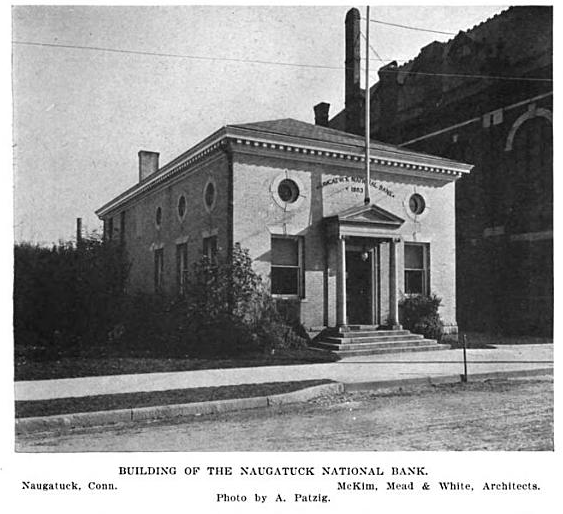
One of the most important buildings designed by McKim, Mead & White in Naugatuck is the High School on Hillside Avenue, constructed in 1905. Naugatuck industrialist and philanthropist John H. Whittemore wanted the school to have a prominent position on a hill overlooking Naugatuck Green and the many other structures that he had commissioned the firm to design. To adapt to the sloping site, the firm created a building in which each of its three floors has an entrance at ground level and each side is designed with its own distinct appearance. Based on Greek temples, the school is constructed in pink granite and pressed buff brick. A new High School was built on Rubber Avenue in 1959 and, although the original school’s interior was damaged by fire in the 1960s, it was painstakingly restored to become a junior high school, now called Hillside Middle School.

Sage-Allen Building (1898)

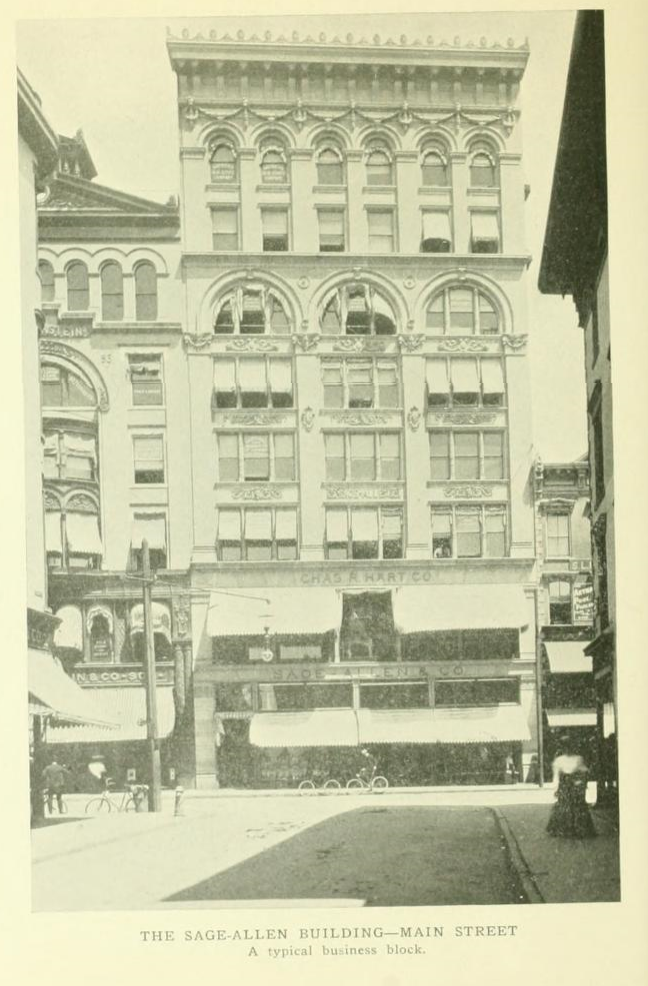
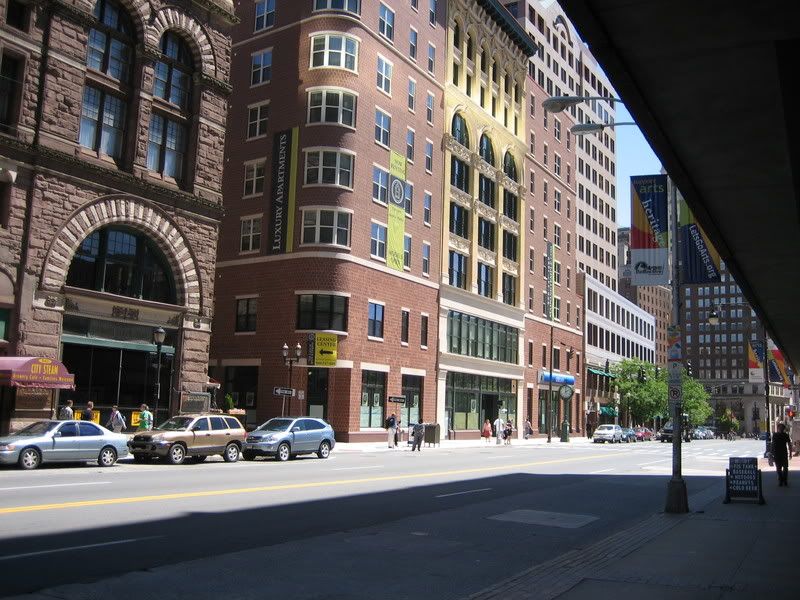
Like the Shoor Building, which I featured yesterday, the Sage-Allen building on Main Street in Hartford was designed by Isaac A. Allen, Jr. The yellow brick Renaissance Revival department store building was built in 1898 and originally housed both Sage-Allen & Co. and the Chas R. Hart Co., a carpet, drapery and wall paper retailer. The two companies each had display windows, on the first and second floors respectively. Sage-Allen soon grew and came to occupy the adjacent buildings on Main Street to the south. The company went bankrupt in the 1990s and the building was in danger of demolition. New apartment and retail space was to be constructed on the site and a design solution was found that incorporated the old facade with new additions on either side. The resulting new structure, called the Lofts at Main and Temple, has allowed the Sage-Allen facade to still dominate the view east up Pratt Street, as it has for over a century.

Also, check out the latest posts on my Historic Places blog about sites I recently visited in Pennsylvania and New York: Washington’s Headquarters in Newburgh NY and Knox’s Headquarters in New Windsor NY; the Eastern Orthodox and Greek Catholic Churches and Cemeteries of St Clair, PA; Trout Hall in Allentown PA and the Troxell-Steckel House in Egypt PA; and historic buildings of Jim Thorp and Bethlehem PA, including Bethlehem’s Colonial Industrial Quarter.