Mitchell’s Mansion House (1829)

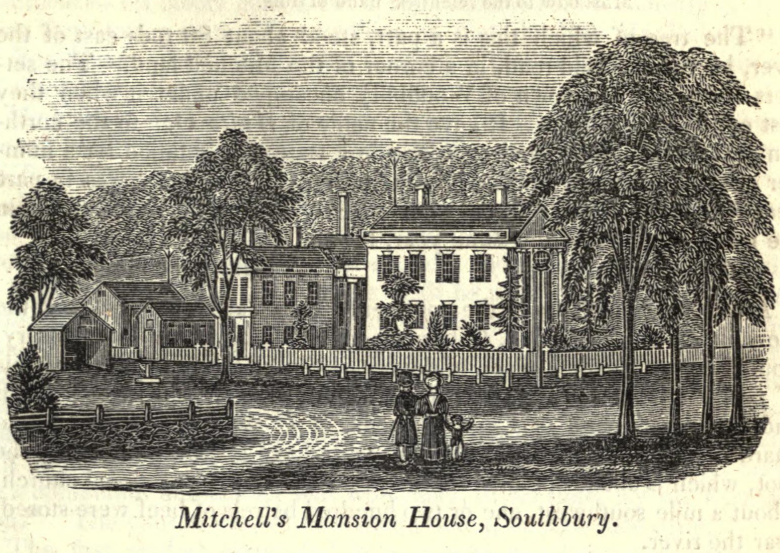
In Connecticut Historical Collections (1836), John Warner Barber features an image of

the Mansion House of M. S. Mitchell, Esq. recently erected, and designed as a house of public entertainment. It is about three quarters of a mile north of the Congregational church. For beauty of situation and superior accommodations, it is not exceeded by any establishment of the kind in any country village in the State. This edifice stands on the spot where the house of the first minister of the place, Mr. Graham, formerly stood.

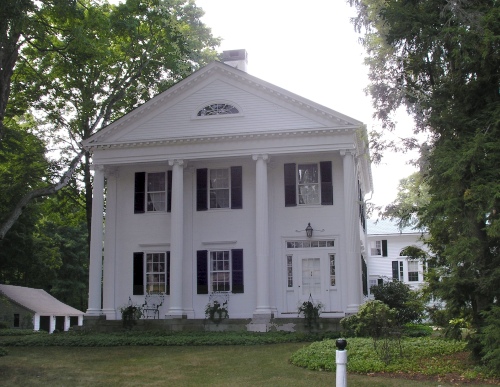
The Mansion House, on Mansion House Road in Southbury, was built in 1827-1829. One of the builders was James English, later a governor of Connecticut. The house was later owned by the famous furniture-maker Duncan Phyfe, who left the mansion in 1853 to his daughter, Mary, who had married Captain Sidney B. Whitlock, but was a widow by that time. There exists a table, made by Phyfe around 1840, that is known as the “Wedding Cake” table because it held the wedding cake of Phyfe’s grandson, Duncan Phyfe Whitlock, when he married Margaret Donaldson in Southbury.

Derby United Methodist Church (1894)

The first Methodist Episcopal society in Derby was organized in 1793. In the early years, the members did not have their own building. According to The History of the Old Town of Derby (1880), “The ministers preached wherever they found open doors.” This included private homes, taverns and a schoolhouse. Again quoting from the History:

For a long time the society continued small and encountered much prejudice and some persecution. On one occasion, while a meeting was held in the house of Isaac Baldwin, which stood on the flat east of H. B. Beecher’s auger factory, the persecutors went up a ladder and stopped the top of the chimney in the time of preaching, so that the smoke drove the people out of the house. Squibs of powder were often thrown into the fire in time of worship, to the great annoyance of the people.

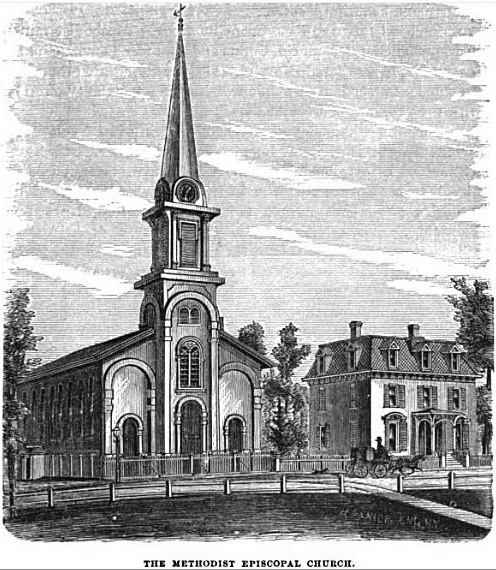
The Methodists constructed a church on Birmingham Green in 1837. This church continued in use until funds were raised at a tent revival in 1891 to build a new church. The current Derby United Methodist Church, built in the Romanesque style, was completed in 1894 on the site of the earlier church.

Cowell-Guilfoile Building (1908)

The Georgian-Revival style Cowell-Guilfoile Building is on the corner of Grand and Leavenworth Streets in Waterbury. It was built in 1908 and the architect was Joseph T. Smith. The building is named for two law partners who were involved in its construction: Francis P. Guilfoile, a lawyer, legislator and mayor of Waterbury, and Judge George H. Cowell of the Waterbury district court.

Sadd Memorial Library (1906)

The Library Journal, Vol. 31, No. 10 (October 1906), reported that:

The library recently built at a cost of $4000 by Mr. H. W. Sadd, of Wapping, Ct., as a memorial to the Sadd family, one of the first to settle in “Wapping parish,” a part of the town of South Windsor, was dedicated on Sept. 19. […] The library is built of blocks of cement, made in the cellar from sand dug from a hillside near by, is well lighted and spacious, heated by a furnace and well equipped for the needs of the neighborhood for years to come. The town of South Windsor voted in 1898 to establish and maintain a public library, which was kept in the basement of the Baptist church until lately, when it was moved to a room in the large new school-house. The Wapping Library is a very flourishing and successful branch, receiving books from the main library, which are changed every few months. A Chautauqua circle, which has existed for a long time, has been a most valuable and stimulating influence in creating a desire for a library.

In the 1960s, the Wapping Library collection was moved from the Sadd Memorial Library building to a shopping center storefront and consolidated with books from the Wood Memorial Library. These were moved in 1979 to the current South Windsor Public Library. The old Wapping library building now houses offices.