Fenner-Matthewson Mansion (1855)

The Fenner-Matthewson Mansion, in Plainfield‘s Central Village (pdf), has been described as one of the most outstanding Italian Villa-style houses in Connecticut. It was built around 1855 by Arnold Fenner at 40 Main Street, on what became known as Central Village’s “Manufacturers’ Row.” Born in Rhode Island, Fenner settled in Central Village about 1825 and in 1827 he purchased a major interest in the Central Manufacturing Company‘s cotton-spinning mill. Fenner and Allen Harris, a pioneering manufacturer in Central Village, constructed a second brick upper mill in 1828. Harris sold his interest in the company to Fenner in 1840. Fenner later replaced the company’s original lower mill with a brick one in 1845. After his death in 1871, Fenner’s daughter, Helen Walcott Fenner, lived in the house with her husband, Philip Matthewson, who was proprietor of a general store, which he sold in 1872 to live in retirement.

Chelsea Savings Bank (1911)

The Chelsea Savings Bank in Norwich was incorporated in 1858. According to A Modern History of New London County, Connecticut, Volume 2 (1922):

The home of the bank was in the Merchants Hotel building until April, 1864, when quarters were secured on Shetuckct street, which were occupied until 1909, when the bank building was so badly damaged by fire that the erection of a new modern building, large and imposing, was decided upon. The present building, most splendidly located and planned, was finished and occupied in November, 1911.

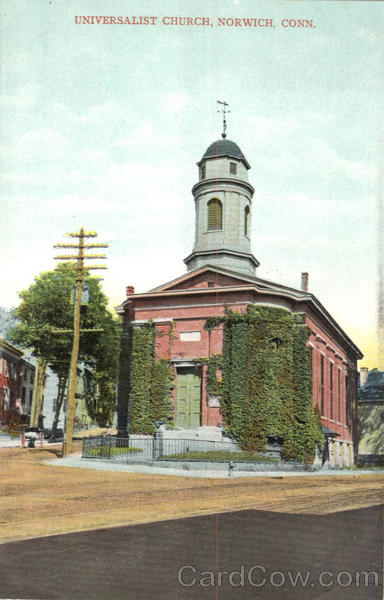
The building has a monumental character due to its location at the angle formed by the intersection of Cliff and Main Streets. A Universalist Church at the site was demolished to make way for the new building. The Chelsea Savings Bank was designed by the firm of Cudworth & Woodworth, who also designed the Norwich State Hospital.

Peter Parley House, Southbury (1777)

The house at 990 Main Street North in Southbury was built by Benjamin Hinman for his son Sherman in 1777. According to Biographical Sketches of the Graduates of Yale College with Annals of the College History, Vol. III (1903), by Franklin Bowditch Dexter, Sherman Hinman

married on February 9, 1777, his third cousin, Molly, youngest daughter of Captain Timothy and Emma (Preston) Hinman, of Southbury, and settled as a merchant and farmer in his native town. He built there an expensive brick house, and lived in dashing splendor for a few years, but was soon reduced to comparative poverty by his extravagance. His wife died on April 30, 1791, in her 34th year, and he married again shortly after. He died in Southbury on February 19, 1793, in his 41st year.

The house is known today as the Peter Parley House because Samuel Griswold Goodrich, who wrote many popular children’s books and textbooks under the name “Peter Parley,” lived in the house for a time, before his death in 1860. Goodrich was buried in Southbury. The house underwent extensive renovations in the 1890s and the History of New Haven County, Connecticut, Volume 2 (1892), edited by J. L. Rockey, states that it “was a pleasant country resort in 1890, kept by Egbert Warner.” In 1918, the house became a German Lutheran home for the aged (now the Lutheran Home of Southbury) and is connected to a modern complex of buildings.

William Wallace Block (1857)

The name William Wallace conjures up images of the movie Braveheart. Wallingford also had a William Wallace, and a building downtown is named for him. Not the Scottish patriot who fought Edward I of England, Wallingford’s Wallace was a real estate developer, possibly related to the Wallcaces who started the Wallace Silver Company. In the second half of the nineteenth century, North Main Street north of Center Street was being developed as a commercial center. The William Wallace Block, at 33 North Main Street, was one of the first of the new commercial buildings to be constructed there in 1857. The Italianate structure is impressively large for its early date. It has high stoops and a high first floor allowing basement shop windows, a feature typically found in more urban areas at the time. It remains the largest commercial structure in the Wallingford Center Historic District today.

Orange Congregational Church (1810)

The first meetinghouse in North Milford, now Orange, was constructed on the north end of what is now Orange Center Green in 1792. At that time, residents of Orange were still members of the Milford Congregational Church, but a separate Ecclesiastical Society was eventually formed in 1804. The separate Town of Orange was incorporated in 1822. The current Orange Congregational Church, designed by David Hoadley, was built in 1810-1811.

Emanuel Synagogue (1927)

Formed in 1919, Emanuel Synagogue in Hartford was Connecticut’s first Conservative congregation. In 1920, members dedicated its first synagogue in the former North Methodist Church on Main Street. With a growing membership, the congregation purchased farmland on Woodland Street in Hartford’s Upper Albany neighborhood. A new synagogue, designed by Ebbets and Frid, was completed in 1927. Emanuel Synagogue’s cemetery is located on Jordan Lane in Wethersfield. By the 1950s, with many Emanuel members having moved to West Hartford, the synagogue purchased land on Mohegan Drive and built a social hall and religious school there in 1959. Services continued to be held at Woodland Street until 1968. A new Emanuel Synagogue was completed on Mohegan Drive in 1970. The former Hartford synagogue is now Faith Seventh Day Adventist Church.

Rev. Samuel Andrews House (1801)

The Rev. Samuel Andrews House, 124 North Street in Milford, has been dated on different occasions to as early as 1685 (too early) and as late as 1801 (probably too late). It is typical of early nineteenth-century houses in Milford and has a later Greek-Revival entry porch. The house is named for Rev. Samuel Andrew, who was the third pastor of the First Church of Milford and was an original trustee of Yale, serving as Rector pro tempore of the University from 1707 and 1719. The house also has an unverified D.A.R. plaque stating that the house was built by Governor Robert Treat for his daughter, Abigail Treat, the wife of Rev. Samuel Andrew.