Frank Underwood House (1873)

The section on Tolland in A History of New England, Vol. I, (1880), explains that:

The business of tanning and currying leather had been carried on near the village for many years before 1840. About that time Mr. Moses Underwood purchased this property and continued the business successfully for several years, when he and one of his sons [Henry Underwood] engaged in manufacturing belts in connection with the business of tanning leather. The Underwood Belting Company, formed in 1875, have increased this business and have erected more commodious and extensive buildings, furnished with expensive machinery. This is the only manufacturing business now carried on in Tolland.

Frank Underwood, son of Henry, built his house at 25 Tolland Green in Tolland in 1873. Five years later, he constructed a factory behind his house, from which steam was piped to heat his residence. The factory burned in 1897, but the house survives and is notable for being the work of the architects Palliser and Palliser. The design of the house was featured in Palliser’s Model Homes (1883), where the house is described as follows:

This country residence embraces many novel and good features of exterior variety and interior compactness and convenience. The workmanship and materials throughout have been of the best description, the materials being purchased by the owner and the work done by the day, and no pains have been spared to make it first-class in every respect.

The interior arrangement is very complete and unique, the Hall being finished in Oak, Parlor in Maple, Library and Dining-room in Ash, all the fire-places having hard wood mantels of handsome design. The conservatory is a pleasing feature of the first floor plan, and is accessible from the Dining-room through a casement window; access is also obtained in a like manner to porch in rear of Dining-room. A clothes-shute is arranged from second floor to soiled clothes-closet in Laundry, an arrangement that is appreciated by every housekeeper.

Stained glass is used in all the windows above transoms. Roofs are slated and ridges covered with red terra-cotta cresting. The interior wood-work is filled with Crockett’s Preservative. The heating is done by indirect radiation, steam being brought into cellar from the Underwood Belting Company’s Factory. Cost about $4,500.00.

Marks-Brownson House (1820)

The Marks-Brownson House in Huntington (part of Shelton) was built between 1820 and 1825 for Hezekiah Marks, a merchant who served in the Connecticut General Assembly in 1828 and 1830. After his death in 1835, at the age of 54, the house was sold to the Bennett family, who sold it in 1866 to Henry Israel Brownson. The house eventually passed to his son, Harry Booth Brownson, who married Gertrude Buckingham in 1904. Making their living as farmers, the couple lived in the house for over sixty years. In 1960, the Brownson Country Club opened on land gifted for one dollar by the Brownsons, who wanted to save it from development. The Shelton Historical Society acquired the Brownson House in 1971, also for a dollar, and moved it from its original location, at the corner of Old Shelton Road and Shelton Avenue, to the corner of Ripton and Cloverdale Roads, where today it is open to the public as part of the Shelton History Center. The house is presented as it would have been during the early years of the marriage of Harry and Gertrude Brownson.

First Congregational Church of East Windsor (1802)

The Fourth Ecclesiastical Society of Windsor, or North Society, was established in 1752 and a meetinghouse was soon built near the Scantic River. In the late 1790s, there were intense debates over the issue of enlarging the building. A decision was finally reached to expand the meetinghouse, but it burned down on April 20, 1802. There was then a violent contoversy and accusations of arson, but a new meetinghouse on the same site was soon completed. In 1768, East Windsor had separated from the town of Windsor and in 1845 South Windsor separated fom East Windsor. The Congregational church in the East Windsor Hill section of the new town of South Windsor had been the First Church of East Windsor, but then became the First Church of South Windsor, while the former North Society Church in the Scantic section of East Windsor became the First Church of East Windsor. The church‘s exterior walls were extended in 1842. That same year, interior floor space was also enlarged, when the the empty space between the balconies above the main floor was floored over, creating a new upper floor for religious services. The lower floor was later known as Library Hall, because the town’s public library was located there from 1907 to 1920.

Frank E. Wolcott House (1924)

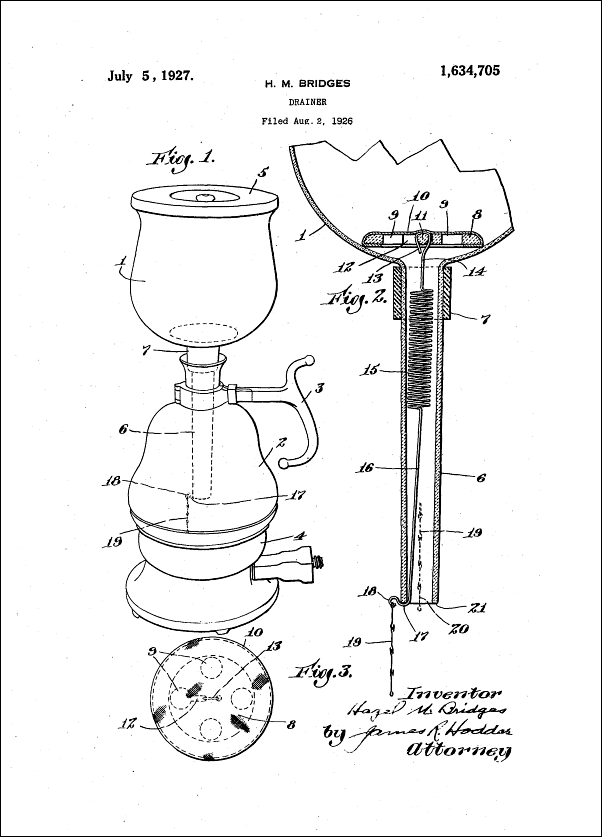
At 26 West Hill Drive, in the West Hill Historic District in West Hartford, is a Colonial/Tudor Revival house, built in 1924 and designed by Smith & Bassette for Frank E. Wolcott. His manufacturing company produced the Silex coffee pot. A vacuum brewer, the Silex coffee pot, utilizing heatproof Pyrex glass, was first produced in 1915. The rights to its design, which originated in Europe, had been acquired in 1909 by two sisters, Mrs. Ann Bridges and Mrs. Sutton, of Salem, Massachusetts. Wolcott’s company was later renamed the Silex Company. Its first patent for a coffee pot was assigned to Hazel M. Bridges in 1926. Frank E. Wolcott filed additional patents in the 1930s.