John Johnson House (1750)

Located at 19 Maiden Lane in Durham, the John Johnson House, with its unusually non-symmetrical configuration, was associated with several important local stone carvers. It was built between 1743 and 1750 as a dwelling and stone-carving shop by Thomas Spelman and Noah Lyman. Spelman was a gravestone carver who sold his half of the partnership with Noah Lyman and moved to Granville, Massachusetts in the early 1850s. Noah Lyman sold to Elizabeth Austin in 1761 and she and her husband Jesse sold to John Johnson, Jr. in 1773. Johnson came from a family of stone carvers in Middletown and became a successful farmer in Durham and a deacon of the town’s Congregational church. A brownstone quarry was located on the south side of Maiden Lane, which may have been the source of the stone Johnson carved for the town’s cemeteries. Johnson and his wife Abigail had three unmarried daughters: Rhoda, Eunice, Nabby, Nancy and Almira. Every Sunday, they would walk to church in single file in order of their ages. In 1825, Johnson sold the house to his daughters, for whom Maiden Lane was named.

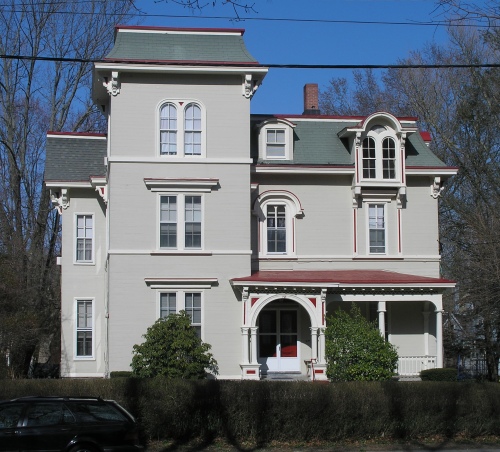
Anson J. Allen House (1834)

The house at 398 Main Street in the Pine Meadow section of New Hartford was built in 1834 as a Greek Revival house. Alterations in the Italianate style, including the addition of the front porch, were made around 1874. By that time, the house was owned by Anson J. Allen. With his brother, Samuel Allen, Anson owned a brass foundry begun by their brother Philemon. Selling the foundry in 1867, Samuel, as senior partner, and Anson operated a mercantile business in Pine Meadow. Samuel’s nearby Greek Revival house is at 405 Main Street. Anson J. Allen was born in Barkhamsted, educated at the Connecticut Literary Institute at Suffield (now Suffield Academy), and served in the state legislature. His house is now a bed & breakfast called the Pine Meadow House.

Joseph Isham House (1765)

The house at 23 Hayward Avenue in Colchester was built in 1765 for Joseph Isham, Jr. after his marriage to Sarah, daughter of Dr. Oliver Bulkeley (who provided the land for building the house). Isham operated a store and served in the Commissary Department during the Revolutionary War. After his death in 1810, Sarah lived in the house until 1834. The gambrel-roofed building originally had a large center chimney, which was taken down around 1820 by Isham’s son, Ralph Isham, who replaced it with two smaller chimneys and used the extra stone to build the foundation of his new house, next door at 11 Hayward Avenue. From 1834 until his death in 1852, Benjamin Swan, Jr., lived in the house. Originally from Woodstock, Vermont, he had married Ralph’s daughter Ann and worked for the Hayward Rubber Company. Later owners substantially altered the colonial house, adding a tall central wall dormer projecting from the gambrel roof, a large cupola and a porch across the front of the house.

St. Paul’s Episcopal Church, Shelton (1818)

Connecticut’s first Anglican parish was established in Stratford in 1707. Daniel Shelton, an Anglican who had settled in Stratford and later in Repton (later called Ripton and now Huntington, which was later incorporated into the city of Shelton) and been one those who had earlier petitioned for the Stratford parish, petitioned in 1722 for another parish to be established in Repton. Clergy from Stratford began making the trip to Repton to conduct Anglican services in private homes until the Repton parish was founded in 1740. A church building was soon constructed and survived until 1811. In that year, Sidney DeForest, seeking to rid the church’s belfry of pigeons by shooting them, ended up setting the church on fire with tow wadding from his musket. DeForest settled the claims for damages by giving some of his property as payment. The current St. Paul’s Episcopal Church was then built on the site of the earlier church. It was begun in 1812 and completed in 1818 and continued to stand next to what is now called Huntington Center Green. In 1870, a number of changes were made, in the Gothic style, to the interior of the church.

Pierpont Block (1893)

The Pierpont Block, on Howe Avenue in Shelton, is an impressively large Richardsonian Romanesque building, built in 1893. It was named for J. P. Morgan, one of the structure’s original investors. The Pierpont Block once contained Arcanum Hall, a hall for public gatherings, and also the public library, before it moved to a new building in 1894. The Pierpont Block was restored (pdf) in the early 1980s.