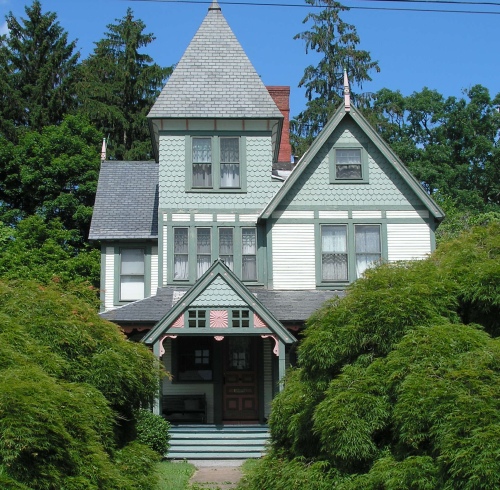
10 Ellington Avenue, Rockville (1885)

Cyrus Winchell, a real estate developer, constructed two adjacent Stick style houses on Ellington Avenue in Rockville as investment properties in 1885. The house at 12 Ellington Avenue has already been featured on this site as the Cyrus Winchell House. The house at 10 Ellington Avenue is known to have been designed designed by the firm of Palliser and Palliser of Bridgeport, and the similar No. 12 was likely their work as well. The house was a rental property until 1915, when it was purchased by Sherwood C. Cummings. It has remained in the Cummings family, which possesses original Palliser drawings of the house.

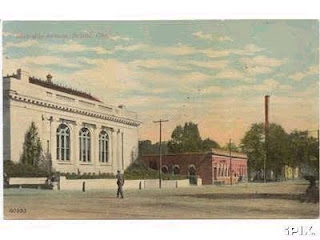
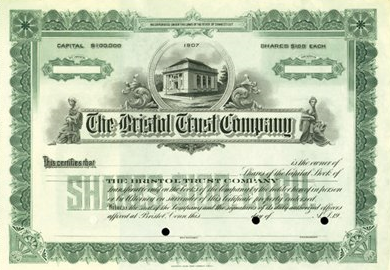
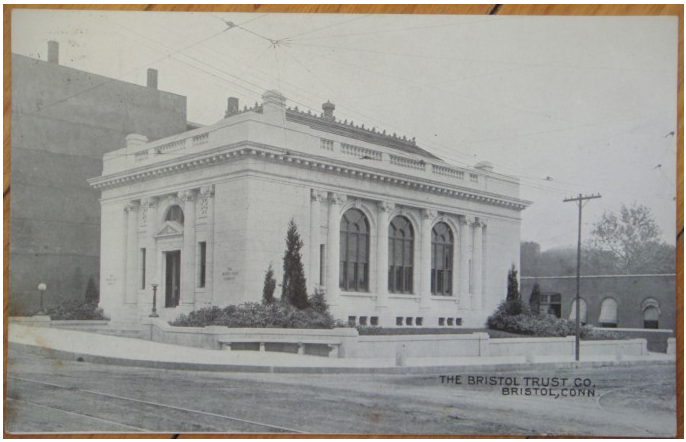
Bristol Trust Company (1907)

Walter Percival Crabtree designed the Bristol Trust Company building, now a branch of Webster Bank, which is located at 150 Main Street, on the northeast corner of Main and Riverside Avenue in Bristol. The company was incorporated in 1907, the same year the marble Neoclassical building with monumental brass doors was built. Outside, the building was surrounded by landscaped grounds, while the interior was designed by Mortensen and Holdensen, a Boston firm that created many interiors of public buildings and theaters at the time. The bank was later expanded to the north with the addition of space for a drive-in teller window.

John Rogers Studio (1878)

John Rogers, known as “the people’s sculptor,” was the most popular sculptor in America in the later nineteenth century, proucing relatively inexpensive works that filled the parlors of many Victorian-era homes. Rogers built his studio in New Canaan in 1878. His house in New Canaan, which was his residence until his death in 1904, was demolished in 1960. Rogers’ studio, which resembles a Victorian cottage, was saved and moved one lot away from its original location by the New Canaan Historical Society. It is now a museum displaying a large collection of Rogers‘ famous groups of plaster statuary.

White Hills Baptist Church (1839)

The White Hills Baptist Church was built in 1839 on School Street in the White Hills section of Shelton. Ferris Drew of Carmel, NY, who had purchased part of a farm in White Hills in 1837, provided land for the church and later additional land for a cemetery. At first the church did not have its own pastor, so pastors from other towns served on alternate Sundays until 1852. The church closed for regular Sunday services in 1916. Today, it is maintained by the Upper White Hills Cemetery Asoociation and is used for community events.

George Eliot House (1783)

At 62 East Main Street in Clinton, is a house built in 1783 by George Eliot, a farmer and likely a descendent of John Eliot, the seventeenth-century Puritan missionary to the Indians of Natick, Massachusetts. In the 1770s and 1780s, George Eliot was chosen moderator for a number of important town meetings in Killingworth, of which Clinton was then a part. The house, which remained for generations in the Eliot family, was later moved back from the street line when land was given to the town to straighten the road. Around that time, the building’s large central chimney was removed, a front porch, since removed, was added, and the house was altered to the Greek Revival style.

Killingworth Town Hall (1830)

The current Town Hall of Killingworth was originally built around 1830 as a house by Dr. Rufus Turner. According to The History of Middlesex County (1884):

Rufus Turner was born at Mansfield, Connecticut, September 1st 1790. With a good preliminary education, he entered the office of Dr. Joseph Palmer, of Ashford, and in 1813-14 attended the first course of lectures given at Yale College. Dr. Turner was licensed by the State Medical Society in 1814, and settled in Killingworth, where he continued in the practice of his profession for thirty-seven years, until his death, after an illness of four days, in November, 1851. As a practitioner he was a careful and conservative, but in cases where promptness was demanded, bold and fearless, faithful in attendance, giving freely of his time and thought to the case in hand, warding off unfavorable complications, and always striving to have the last blow at death. In the protracted fevers of those days he was particularly skillful, and was very frequently called to neighboring towns, in consultation.

His son, Sylvester Wooster Turner, also became a doctor. According to the Proceedings of the Connecticut State Medical Society (1907):

[he] was born in Killingworth, Conn., March 12, 1822. He prepared for college at Hill’s Academy, Essex, Conn., and entered Yale, graduating in 1842.

In 1843 he studied medicine with his father in Killingworth; then he taught in a private school in Norwalk, Conn., was a private tutor in Newbern, Alabama, and for a part of one term taught the district school in Killingworth after the teacher had been driven out by the big boys.

He attended two courses of lectures in the Yale Medical School, graduating in 1846, and at once began to practice with his father in Killingworth.

In 1848 he located in Chester, Conn., remaining until 1858, was in Norwich, Conn., in 1859, then returned to Chester, and was in active practice until failing strength moved him to gradually relinquish his work. A fall, resulting in a permanent disability, compelled him to give up his practice entirely, and from that time he rapidly failed physically until his death in January of this year [1907].

By the mid-twentieth century, the house had become the homestead of Herman and Bertha Heser, whose daughter sold it to the town for use as offices in 1965. The town library was on the second floor (it now has a separate building). (more…)