Captain Elisha White House (1750)

Capt. Elisha White was born in Windsor in 1706. As recorded in the Memorials of Elder John White (1760), by Allyn S. Kellogg, “He settled early in Bolton, but removed to East Guilford, (now Madison,) Conn., about 1744, and thence to the adjoining town of Killingworth, about 1749. He lived in that part of Killingworth which is now Clinton, and was for a while engaged in mercantile business. He died there, probably about the year 1778.” In 1750 he purchased the land in Clinton on which he soon built a house, constructed of brick thought to have been brought from England by ship as ballast. Known as “Old Brick,” the house is now a museum, owned by the Clinton Historical Society.

Giles Pettibone Tavern (1794)

In 1794, Giles Pettibone, Jr., son of Col. Giles Pettibone and grandson of Jonathan Pettibone of Simsbury, built a tavern on the Green in Norfolk. After Giles Pettibone died in 1811, according to The Norfolk Village Green (1917), by Frederic S. Dennis,

His son Jonathan Humphrey Pettibone, who died in 1832, succeeded his father as Tavern keeper. This Tavern a little later was kept by John A. Shepard […] This Tavern was known as Shepard’s Tavern and during the stage coach era was a place of great activity. Here the stages stopped to change horses en route between Hartford and Albany and between Winsted and Canaan. This Tavern was in late years rebuilt for a private residence by Mr. Frederick M. Shepard, the son of Capt. John A. Shepard, and was occupied by him and his family as a summer residence. […] An interesting fact connected with the old Tavern is that seven generations of the Shepard family have lived in it.

The Tavern is now covered with aluminum siding, but the central doorway surround is the original wood.

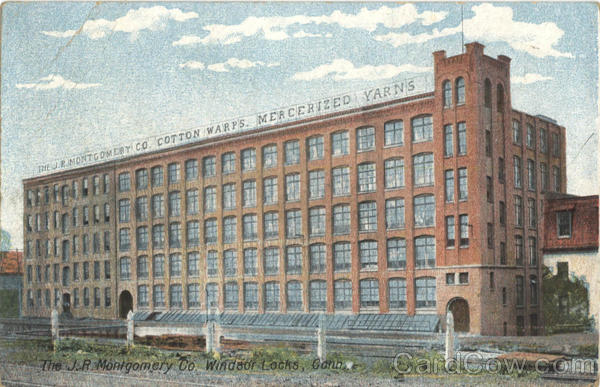
J.R. Montgomery Company (1905)

As detailed in the Nineteenth Annual Report of the State of Connecticut’s Bureau of Labor Statistics (1903):

The firm of J. R. Montgomery & Co. [in Windsor Locks] was established in 1871, for the purpose of manufacturing cotton warps used in satinets and union cassimeres. The firm was composed of J. R. Montgomery as the active partner, with two others who constituted the partnership. A few years after the outside interests were bought by J. R. Montgomery, who continued the business under the old firm name, until in 1885. George M. Montgomery was admitted into the business as an active partner, and the line of manufacture was enlarged, taking up the making of novelty yarns, which was a new and unique line of manufacture. […]

In 1891, the firm of J. R. Montgomery & Co. was merged into a corporation under the name of The J. R. Montgomery Co., of which J. R. Montgomery, President, and George M. Montgomery, Vice-President and Secretary, are the active managers. A new cotton warp mill and an addition to the Novelty Mill was built. The capital of $350,000 was invested in enlarging and increasing the scope of its business.

The first Warp Mill was expanded in 1904-1905, as described in Fibre and Fabric: A Record of Progress in American Textile Industries, Vol. XLL, No. 1054, May 13, 1905:

The machinery of the new factory of the J. R Montgomery Company is gradually being put into operation as fast as the various processes involved will allow. The completion of this building, states the Windsor Locks Journal, marks a new epoch in the prosperity of the town. Standing on the canal bank with its five stories beside the basement, and its frontage of 173 feet, it presents a handsome and imposing appearance. Its width is 63 feet, and it is so built as to connect with and open into the former five story building on the north, making a frontage of 248 feet. The designer is Fred. S. Hines of Boston and the contractors C. H. Hathaway & Co., of Providence, R. I. The work was begun early last Spring and has continued without interruption or accident. In its construction and equipment it embodies all the latest improvements in every feature, as regards fire proofing, heating, lighting, the distribution of power, etc.

All the power and lighting in the new mill is supplied by electricity, and the electrical plant is one of the most complete in this section of the country. The cotton machinery is all new and of modern construction for the manufacture of high grade yarns and warps. A combing plant has been installed for making a higher grade of work than heretofore attempted in that line. It is the intention of the company to continue along the same lines as in the past, but to improve the quality of the output, and to add to its reputation for high grade goods.

In the 1890s, the company began producing tinsel products, eventually becoming the country’s largest manufacturer of decorative and electric tinsels. In 1920, the Montgomery Company purchased the adjacent Anchor Mills Paper Company building, razing it and building a new white reinforced concrete building, which extended southwards from the 1891/1905 structure. The Montgomery Company ended its operations in Windsor Locks in 1989 and the factory buildings have since remained vacant, suffering fires in 2006, 2009 and again earlier this year. Since 2009, the Town of Windsor Locks has been attempting to foreclose on the now burned-out buildings.

2019 Update: The old factory buildings are currently being repurposed as apartment housing.

(more…)

St. John’s Episcopal Church, East Windsor (1809)

St. John’s Episcopal Church (pdf) was built in 1809 at Warehouse Point, a section of East Windsor which was undergoing economic development at the time. Some of the founders of the church included former members of the First Congregational Church of East Windsor, who had wanted a new church built and been tried and acquitted of the charge of arson after a fire had destroyed their meeting house. St. John’s was constructed on the Green at Warehouse Point, the work being supervised by builder-architect Samuel Belcher. The church was moved to its current location, at 96 Main Street, in 1844. Ten years later, Henry Austin of New Haven was hired to remodel the church in the Gothic style, work which was completed in 1855. While the exterior retains an early nineteenth-century appearance, it sharply contrasts with Austin’s later English Gothic interior.

Dr. Frederick Gilnack House (1890)

The house of Dr. Frederick Gilnack, at 19 Elm Street in Rockville (Vernon), constructed in 1890, is a quite late example of a Second Empire house. The mansard roof had been popular some decades before, but the house’s Eastlake style ornamentation places the it stylistically in the later nineteenth century. Dr. Gilnack was born in Saxony in Germany in 1844. His family came to America when he was ten and settled in Glastonbury. He was honored by Dr. Eli P. Flint in Proceedings of the Connecticut State Medical Society (1917), who gave an account of his life:

He was graduated from the College of Physicians and Surgeons, the School of Medicine of Columbia University, New York, March 14, 1867, and only three months later, in June, he located in Rockville, Connecticut, for the practice of his profession, which he continued there successfully, for forty-five years, until failing health obliged him to give it up.

He was especially successful as an obstetrician, and the loss of sleep and other exacting requirements which that class of practice necessitates, so lowered his vitality mentally and physically that he became unable to perform the duties of his profession for fiveyears, until an attack of epidemic influenza proved quickly fatal [in 1917].