Benjamin Clark House (1800)

The Federal-style house at 603 Orange Center Road in Orange, which dates to around 1800, was the first house to be built on Orange Center Green. Records indicate that the property was owned by Benjamin Clark in 1810 and it has remained in the Clark family ever since. The Clark farm, known as Maple View Farm, was established in the 1790s. A working dairy and produce farm, it now provides horse-related activities for the public.

The Arcade, Stonington (1837)

The Arcade building, at 61-65 Water Street in Stonington, is a nineteenth-century Greek Revival commercial building, constructed in the wake of the fire of April 1837, which destroyed the commercial center of Stonington Borough. The building has contained numerous retail establishments over the years. In 1952, the building was given as a gift by Colonel Frederick Horner to the Stonington Historical Society. The Arcade was then converted into an office and apartments. A number of Stonington locations were used in the movie Mystic Pizza (1988), including the arcade, which was temporarily repainted from white to a buff color for the filming.

Arbus Block (1893)

Jacob Arbus was a furrier in Rockville. In 1886 he established his own store, doing business at various locations until 1893, when he had a Mansard-roofed building constructed at 74 Union Street to serve as his store and residence. On an 1895 Bird’s-eye view of Rockville, the Arbus Block is listed as “63. Jacob Arbus, Furrier, Hats, Caps and Gents Furnishing Goods.”

Thames National Bank (1911)

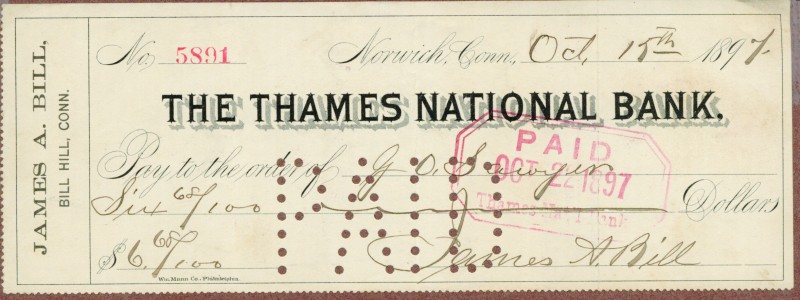
The 1911 Thames National Bank building is at 16-20 Chelsea Harbor Drive (formerly Shetucket Street) in downtown Norwich. As described in A Modern History of New London County, Connecticut, Volume 2 (1922):

The Thames Bank was the second institution of the kind chartered in Norwich, with a capital of $200,000, in 1825. By its charter the bank was obliged to purchase the stock of the Norwich Channel Company, and “maintain a depth of at least ten feet of water in the channel of the Thames river at common and ordinary tides.” The charter also permitted the bank to collect toll from all vessels coming to Norwich. These provisions of the charter were complied with so long as the bank operated under its State charter. The bank was also obliged to receive deposits from the State school fund, ecclesiastical societies, colleges and schools, at par, and pay on such deposits such dividends as were paid to their stockholders. The first bank rooms were on Main street

[…] Prosperity made it necessary to add to the facilities of the bank in order to properly meet the demands of increasing business, and in 1862 the bank erected enlarged quarters on Shetucket street. In 1864 the Thames Bank was succeeded by the Thames National Bank […] Its National Bank charter was renewed in 1884 and again in 1904, the home of the bank centering in the same quarters on Shetucket street until 1911, when the present building begun in 1910 was finished and occupied.

United Church of Christ, Southbury (1844)

The United Church of Christ in Southbury was constructed in 1844 as the the meeting house of the First Ecclesiastical Society of Southbury. It was the Society’s third meeting house, as described in Vol. II of the 1892 History of New Haven County, Connecticut (edited by J. L. Rockey):

For more than half a century the settlers of Southbury worshipped in Woodbury church, and were tributary to the First Ecclesiastical Society of that town. In May, 1731, the Southbury parish was incorporated, and November 29th, 1732, this society voted to build a meeting house, and asked the assembly for a committee to locate a site. In May, 1733, the committee selected a final place, “setting the stake down on the hill between Lt. Andrew Hinman’s and the house that was Elnathan Strong’s.” This site was in the highway nearly in front of the present White Oak school house. The building was a plain frame, 35 by 45 feet, with 23 foot posts, and was not fully completed for 20 years.

[…] It was not many years before the first meeting house was too small to accommodate the congregation, and a new house was demanded. As in the first instance, the question of site proved troublesome, and it was several years before an agreement could be reached. Finally, after four years’ effort, a site was selected on Southbury street, south of the old site, on which was begun in 1764 one of the largest and finest meeting houses in this part of the state. It was twelve years before it was fully completed and was a noteworthy object many miles around, with its high spire, in which was a good bell and also a clock. These were purchased by general subscriptions of the citizens of the town, which were secured in December, 1773.

The meeting house stood at the head of the lane leading to the middle cemetery, which it fronted, and was used until the present house was occupied in 1844, when it was taken down and the material removed.

Attached to the rear of the church is the former Southbury Methodist Church building. Also in the Greek Revival style, it was built in 1847 and was moved and attached to the Congregational church in 1957.

Horace Parmelee House (1847)

The Horace Parmelee House in Killingworth was built in 1847 and was the home of Horace L. Parmelee (1819-1898) and his wife Eunice (1822-1905). After her husband’s death, Eunice sold the farm to William Kathotka of New York in 1904, who then sold it to the Pavelka family in 1906. From 1948 to 1956, the property was owned by Edward and Martha McGrath, who ran it as a summer resort known as “Farm in the Dell.” It was then owned by the Bosco family and was known as Bosco’s Turkey Farm. The Parmelee Farm was purchased by the town of Killingworth in 2000 and it is operated as community open space, including trails and the Killingworth Community Gardens. The Municipal Land Use and Parmelee Farm Steering committees are exploring uses for the late Federal-style house and seeking grants for its restoration. The Killingworth Historical Scociety is interested in using the house to store and exhibit its collections.