Pierce N. Welch House (1907)

The stuccoed Colonial Revival house at 301 Prospect Street in New Haven was built in 1907 for Pierce Noble Welch. He was Yale graduate (1862) who then studied in Germany. In 1871 Welch became treasurer of the New Haven Rolling Mill Company, which his father, Harmanus M. Welch, had founded. He later became president of the company and in 1889 he succeeded his late father as president of the First National Bank of New Haven. In 1891, Welch and his two sisters donated Harmanus Welch Hall to Yale. He was also president and a director of the Bristol Brass Company, a director of the Bristol Manufacturing Company, a vice-president and director of the New Haven Gas Light Company, and a director of the New Haven Clock Company. Pierce N. Welch, born in 1841, died in Berlin, Germany in 1909. The house was acquired by Yale in 1935 and served as a dormitory and later as offices. It is currently home to the Yale School of Forestry and Environmental Studies.

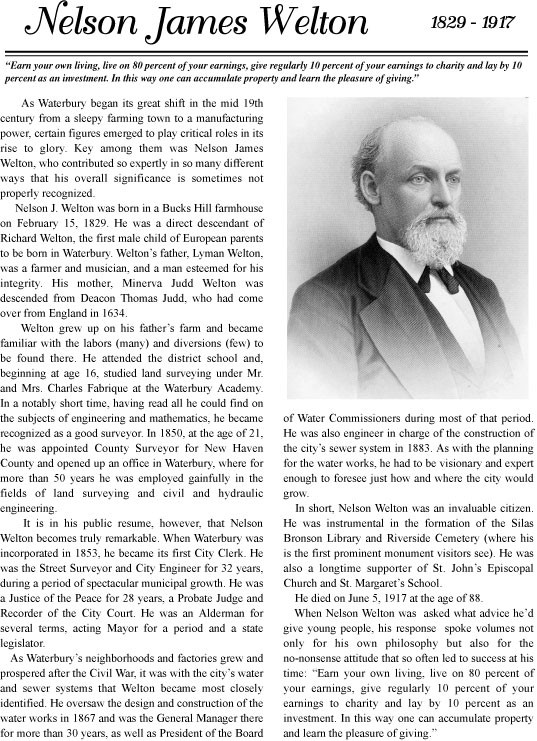
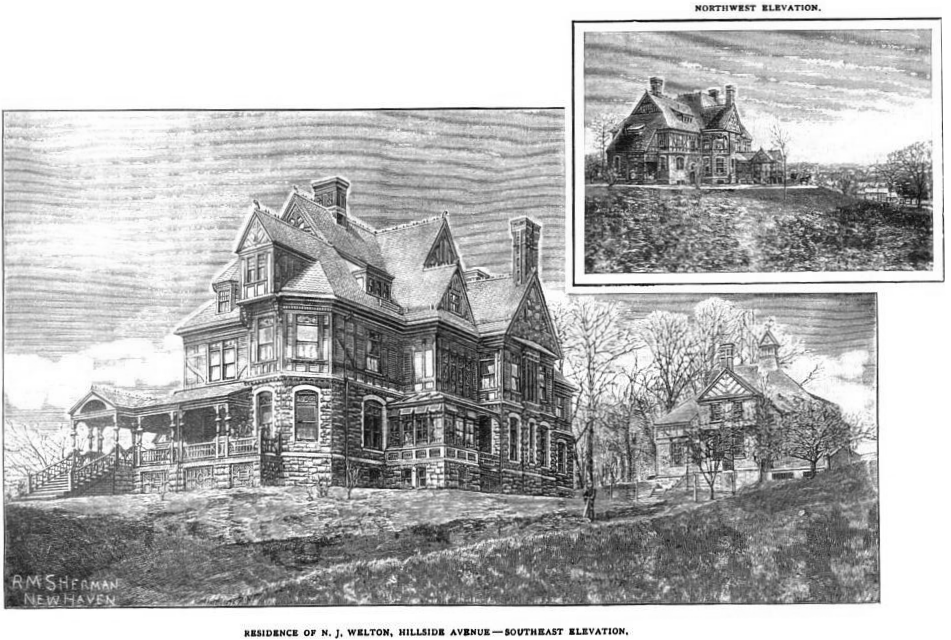
Nelson J. Welton House (1883)

The firm of Palliser and Palliser, who had earlier been responsible for the Benedict-Miller and Mary Mitchell Houses on Hillside Avenue in Waterbury, were hired by Nelson J. Welton to design another house on the same street. Built in 1883, the Stick style house at 83 Hillside Avenue was featured in the 1887 book, Palliser’s New Cottage Homes. According to The Town and City of Waterbury, Connecticut, Volume 2 (1896),

Mr. Welton is a civil and hydraulic engineer, and is a member of the state board of civil engineers. He was appointed surveyor for New Haven county in 1850; was street surveyor of the city of Waterbury for thirty-two years, and was engineer in charge of the construction of the city water works and of the city’s system of sewerage. He has been president of the water board, with the exception of two years, since 1867. He has served the city and town in various other official capacities, and was representative to the General Assembly in 1861.

The Welton House was later much altered from its original appearance, including the addition of a Colonial Revival porch in the 1920s.

Barnes-Waldo House (1789)

Jonathan Barnes, a lawyer, was born in Southington in 1763, graduated from Yale in 1784, studied at the Litchfield Law School, and was admitted to the bar in 1789. He soon settled in Tolland, which had become a county seat in 1785. He married Rachael Steele in 1789. Barnes, who served as a town selectman in Tolland from 1798 to 1802 and in the Connecticut Legislature for twenty-eight terms, died in 1829. His oldest son, also named Jonathan Barnes, later became a prominent lawyer in Middletown. The Barnes House, at 34 Tolland Green, was next owned by Obediah Waldo, also a lawyer, who served as selectman, postmaster, town clerk, and member of the state House of Representatives. The house’s side ell was once used as an office.

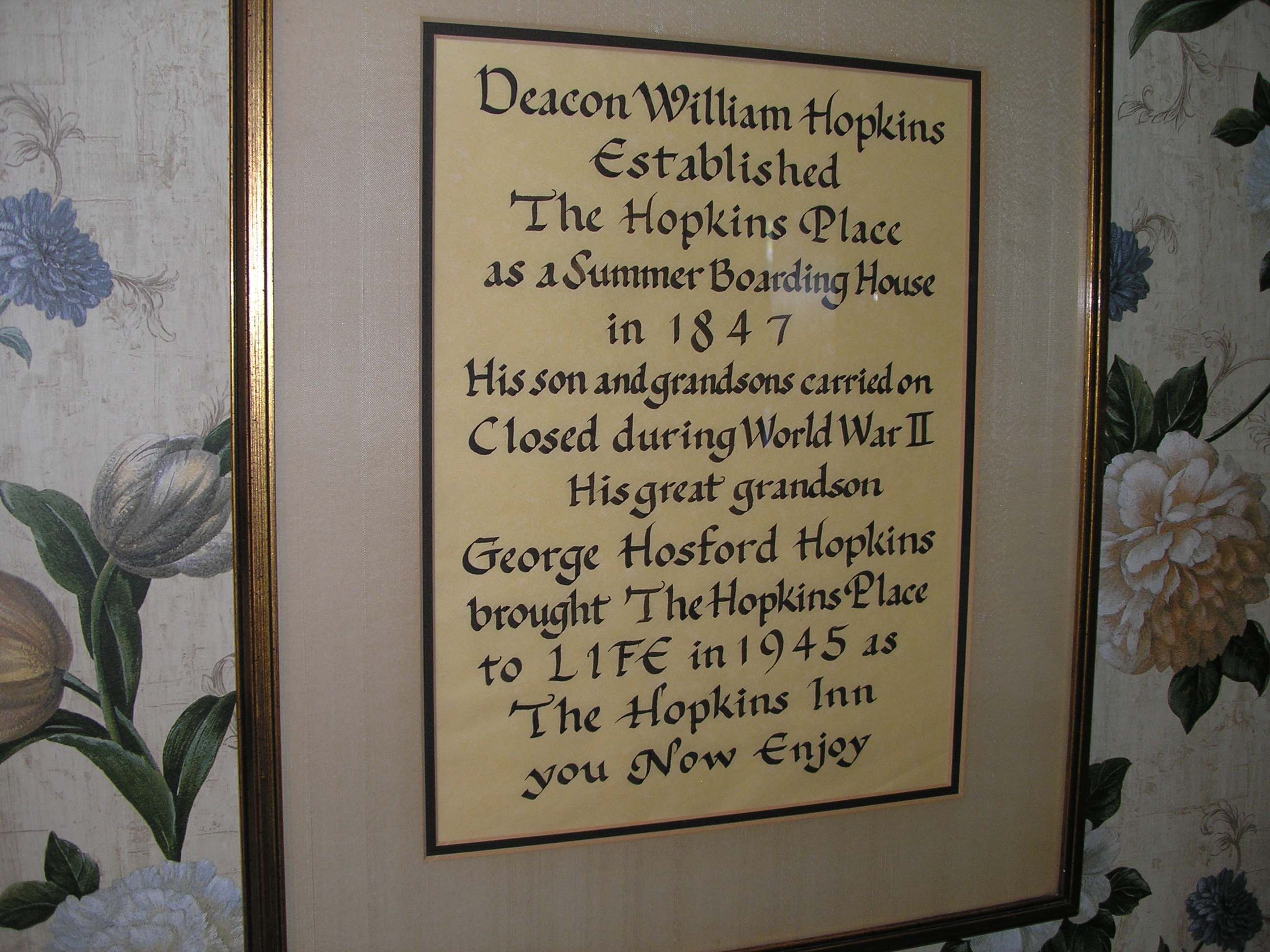
Hopkins Inn (1847)

The Hopkins Inn, overlooking Lake Waramaug in Warren, was opened in 1847 as a summer boarding house by Deacon William Hopkins on the farm he had inherited from his father, Elijah Hopkins. His son and grandsons, including George C. Hopkins, continued to operate the boarding house. Closed during the Second World War, it was reopened in 1945 by William Hopkins’ great-grandson, George Hosford Hopkins, and continues in operation today as an inn, restaurant and vineyard.

First Church of Bethlehem (1836)

At the time of its settlement, Bethlehem was the northern part of the Town of Woodbury. As related in the History of Ancient Woodbury (1854), by William Cothren,

Four years after the first settlement, the number of families amounted to only fourteen; yet this handful of people felt able to support a minister a part of the time, and accordingly petitioned the General Assembly at its October session, 1738, for liberty to have “winter privileges,” for five months,” in the most difficult season of the year, viz., November, December, January, February and March,” as they lived so far from church, it was impossible to attend. […] In May, 1739, they petitioned to be released from parish taxes as long as they should hire a minister, and from school taxes, on establishing a school of their own, “the school in the first society being so far off it was of no use to them.” The request was granted, and they were permitted to hire a “minister and set up a school.” At the October session of the same year, they petitioned that the “east half of the North Purchase” might be set off as a distinct ecclesiastical society.

The Society voted to build a meeting house in 1740 and, again quoting the History of Ancient Woodbury, “The clerk of the society in 1743, reported the house covered, and in May, 1744, that materials were provided for finishing the inside of the house.” This building was later replaced:

The first house in the society after a time was deemed too small for its accommodation. Accordingly on the 4th of January, 1764, when there were about one hundred within its limits that paid taxes, they voted to build a second church. On the 28th of the next month, they voted again to build the house, “and to begin and go on moderately and Little by Little.” […] By a vote of the society, October 20th, 1768, directing the society’s committee to “seat the new Meeting House,” “and dignify the Pues [sic]” therein, we learn when it was finished and ready for worship. In December, 1793, a tax of sixpence on the pound was laid to build a steeple, provided money enough to purchase a “good decent bell and a Lightning rod” for the same should be raised by subscription. Eighty pounds were soon subscribed, and the bell was obtained.

The current First Church of Bethlehem was built as the Society’s third successive meeting house in 1836. It is a Greek Revival, Doric tetrastyle, clapboard church.

Shove Building (1867)

The Shove Building, 281 Main Street South in Woodbury, was built in 1867 as a residence by Dr. Harmon Shove. According to his obituary in The Medical News, Vol. LX, No. 6 (February 6, 1892):

Dr. Harmon W. Shove, of Woodbury, Conn., died of pneumonia, on January 23d, at the age of sixty-nine years. He was one of the most prominent practitioners in the section in which he lived. Dr. Shove was graduated from the Yale Medical College in 1853, and at once entered upon the practice of his profession at Woodbury. By his studious habits and almost unlimited capacity for work, he was, after nearly forty years of active service, still in the full and successful practice of his profession, which, by his unblemished life and dignity of character he helped to advance and elevate.

The house was acquired by the Town of Woodbury in 1952 is now used for town offices.