Society for Savings (1893)

The former Society for Savings building, at 31 Pratt Street in Hartford, was that bank’s third sucessive building on the same site. Organized in 1819, Society for Savings was the state’s first mutual savings bank. Its first building was constructed in 1834, the second in 1860, and the present structure in 1893. It has since been altered: the ground floor during an interior renovation in 1927 and the upper floors in 1957, when architect Sherwood F. Jeter departed drastically from the Renaissance Revival style of the first floor. Society for Savings merged with Bank of Boston Connecticut in 1993 and the old building remained closed for over a decade. More recently, it has become the Society Room of Hartford, which takes advantage of the grand 1926 interior, an ornate space designed by Denison & Hirons with ornamental plaster work by Anthony DiLorenzo and murals by H.T. Schladermundt.

Caleb Baldwin Tavern (1763)

Happy Fourth of July! During the Revolutionary War, the French General Rochambeau’s army passed twice through Newtown: first in June, 1781, during the march to the Battle of Yorktown, and again in October, 1782, during the return march. On June 23, 1781, Claude Blanchard, the French commissary officer, arrived five days before the army to make arrangements for supplying the French camps. As Blanchard related in his diary (translated by William Duane, edited by Thomas Balch and published in 1876):

Newtown is on a hill surrounded by hills which are still higher. There are only a hundred houses with two temples [churches]. One of them was near the place where I lodged; and, as it was Sunday, I saw many people from the vicinity dismount there. As all the inhabitants of the country are proprietors and, consequently, in pretty easy circumstances, they had come on horseback, as well as their wives and daughters. In the neighborhood of Boston, they come in carriages; but here the country is mountainous and the horse is more suitable. The husband mounts his horse along with his wife; sometimes there are two women or two young girls together; they are all well clothed, wearing the little black hat in the English style, and making as good an appearance as the burghers in our cities. I counted more than a hundred horses at the door of the temple, where I heard singing before the preaching, in chorus or in parts. The singing was agreeable and well performed, not by hired priests and chaplains, but by men or women, young men or young girls whom the desire of praising God had assembled.

To-day I was rejoined at Newtown, where I spent the whole day, by M. de Sançcon, my secretary and some surgeons and apothecaries. I pointed out to them the site which I had selected for the hospital, and set out, on the 25th, to proceed to the American army.

Blanchard stayed in Newtown at the Caleb Baldwin Tavern, which had been built about 1763. Caleb Baldwin was a schoolmaster, postmaster and town clerk in Newtown. The tavern is where local farmers would drink sassafras beer after the sheep grazed in Ram Pasture. According to Newtown’s History and Historian, Ezra Levan Johnson (1917):

Caleb Baldwin’s Inn had the reputation of being the pattern of neatness, homelike in all surroundings and it was also claimed that there could be had the best broiled chicken or sirloin steak to be found in Fairfield county. The motherly reputation of the hostess made it a much sought place for restfulness.

The building remained in the Baldwin family until 1917. Still standing at 32 Main Street in Newtown, the former tavern was later remodeled twice, in the Federal and Victorian eras.

East Granby Congregational Church (1830)

As related by Albert Carlos Bates, in the introduction to his Records of the Congregational Church in Turkey Hills: now the Town of East Granby, Connecticut, 1776-1858 (1907):

The Congregational Church in Turkey Hills, now the town of East Granby, Connecticut, is said by tradition to have been organized in 1737, the year in which the society or parish in which it is located held its first meeting. The General Assembly in October of the previous year had passed an act which divided the town of Simsbury into four ecclesiastical societies, the section previously called the “northeast corner” being established as Turkey Hills. The same year another act of the Assembly enlarged the limits of the society, by adding to it on the east a section of the town of Windsor, having a length of about four miles and known from its width as “the half mile”. In 1786, by division of the town of Simsbury, the section of Turkey Hills which had been in that town became a part of the town of Granby; and in 1854, by the same method, the section which had been in Windsor became a part of the town of Windsor Locks. On June 2, 1858, the town of East Granby was incorporated [from portions of Granby and Windsor Locks] with practically the same boundaries as the society of Turkey Hills.

The Society’s first meetinghouse was completed in 1744. The current East Granby Congregational Church is a masonry building of ashlar granite, built in 1830 by Connecticut Valley master builder, Isaac Damon, of Northampton, Massachusetts.

Dibbell House (1848)

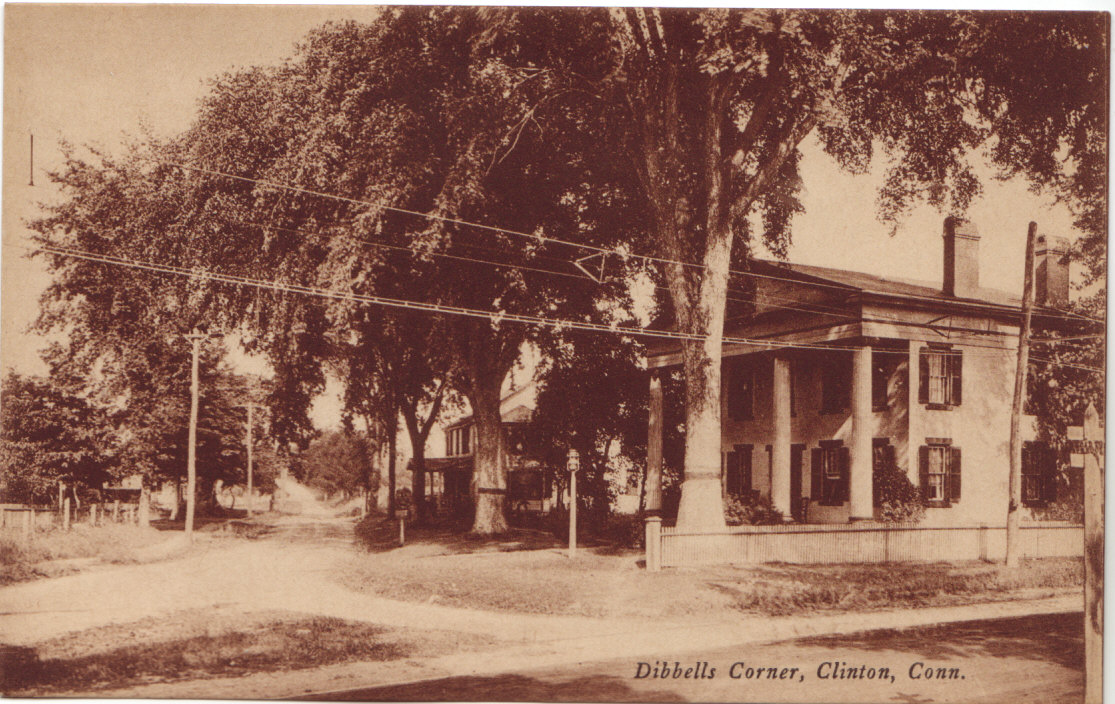
At 170 East Main Street in Clinton is a brick Greek Revival house, built around 1848. The earliest surviving deed to the house dates to October 1850, when it was transferred from Samuel R. Dibbell to Charles Dibbell. The plot where the Dibbell House sits, at the corner of Boston Post Road and Old Clinton Road (Route 145), is known as Dibbell’s Corner and the house is still in the Dibbell family. The house has a full, two-story Greek portico with freestanding Ionic columns, which were originally made by hand in a barn then on the property. The house’s corner location makes it vulnerable to damage from vehicle crashes. Twenty years ago, a motorcycle crash which killed the driver destroyed the two left columns. Preservationist Jeffrey Bradley crafted exact replacements. Last year, another crash just missed the right column and damaged brickwork on the house. The column survived, but rot was discovered. Bradley’s services were again called upon to repair the damaged column.

Eclectic Society (1907)

The Eclectic Society was established as a fraternity at Wesleyan University in Middletown in 1837, later adopting the Greek letters Phi Nu Theta. The Society‘s first permanent house, which did not have residential accommodations, was built 1882. In 1906, the Society hired architect Henry Bacon to design a Doric Greek revival structure at 200 High Street. Bacon had previously worked for the architectural firm of McKim, Mead and White and would go on to design the Lincoln Memorial in Washington, DC and to make preliminary sketches for Wesleyan’s Olin library. Completed in 1907, the Eclectic building is seen as a precursor to the Lincoln Memorial, both having a Doric design but lacking the typical accompanying pediment. In 1970, there was a split between undergraduate and alumni members: ties were severed and the alumni organization, the Socratic Literary Society, incorporated a century before, was dissolved. The undergraduates abandoned the use of Greek letters, elected women to membership and sold the house to the University.