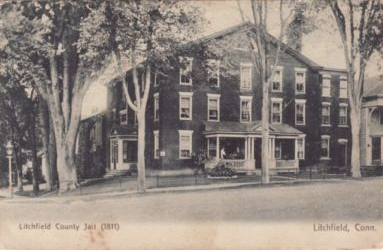
Litchfield County Jail (1812)

The old Litchfield County Jail, at 7 North Street in Litchfield, built in 1812, is the oldest public building in town and one of the oldest penal facilities in the state. It also has the distinction, unique in the nation, of sharing for many years a wall with the adjacent bank. The jail had a cell block added in 1846 and a three-story wing with additional cell blocks in 1900. In 1992, the jail became a drug treatment center for 30 men serving prison sentences, but was shut down in 1993 and reopened the following year as McAuliffe Manor, a rehabilitation center for women. Since that center’s closing in 2010, the state has sought to sell the building. Among the possibilities being considered for the future of the facility are its conversion into municipal offices or its acquisition by the adjoining bank.

Captain James Thomas House (1790)

The Captain James Thomas House, which has Federal-style detailing, is on Killingworth Road, in the Ponsett District of Haddam. Capt. Thomas served in the Revolutionary War and returned to Haddam to farm on land given to him by his father, Lt. Ebenezer Thomas, in 1786. After occupying a house on Lynn Road, he moved to the one on Killingworth Road, which was completed by 1795. Rev. William C. Knowles, in his book By Gone Days in Ponsett-Haddam, Middlesex County, Connecticut: A Story (1914), writes of the house:

Large two-story house erected by Capt. James Thomas, soon after the Turnpike was opened. Was at one time a tavern. Capt. Thomas died in 1842. A few years later his son-in-law, Mr. Alfred Brainerd, came here to live. The present occupant is an enterprising Bohemian, Mr. Paul Jiroudek.

Sachem Farmhouse (1870)

The Sachem Farmhouse, at 15 Hopkins Road in Warren, overlooking Lake Waramaug, is just down the road from the Hopkins Inn. The house was built in 1870. In 1895, it was purchased by George Hopkins from the Beeman family. The Hopkins House was already being operated as a boarding house and George Hopkins also opened the Beeman House to guests, naming it the Sachem. It remained open until 1960. Still owned by Hopkins descendants, it opened again in 2007 as the Sachem Farmhouse Bed & Breakfast.

Congregational Church in Killingworth (1820)

In 1735, responding to a petition from the farmers residing in the north section of Killingworth, the town was divided into two separate Ecclesiastical Societies, north and south. The southern section of town was later incorporated as the town of Clinton in 1838. The northern society‘s first meeting house (1736) was located on “Stoney Hill, just north of the bridge across Bear Swamp,” (near the intersection of the present Routes 80 and 81). This initial building was replaced by a new one in 1743. The third and current house of worship of the Congregational Church in Killingworth, at 273 Route 81, was built between 1817 and 1820. The bell was installed in 1870 and the organ in 1875. The addition of the Parish Hall was begun in 1959 and was dedicated in 1961, the same year the church voted to join the United Church of Christ.

Beckwith Block, Litchfield (1896)

At 16 South Street in Litchfield is a commercial block, built by a member of the Beckwith family in 1896. It has served as the Litchfield Post Office since 1958. In the early 1980s, Litchfield citizens successfully fought to prevent the Post Office from moving to a large facility on the outskirts of town. $175,000 was raised to buy the building from its private owners by a partnership led by the Litchfield Preservation Trust. An additional $165,000 was then raised to remodel the building to comply with government mandates, and for architectural and legal fees. The remolded Post Office was rededicated in November, 1982.