Elm Grove Cemetery Chapel (1893)

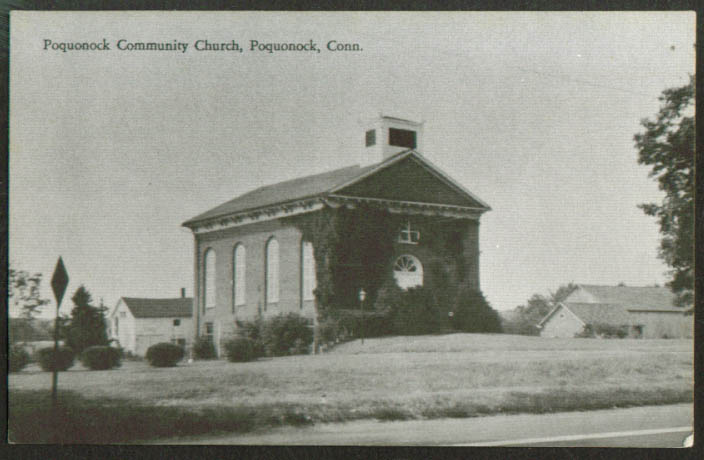
The Ecclesiastical Society of Poquonock in Windsor was first established in 1726 and a meeting house was built the following year. This was replaced by a second meeting house in 1798. By 1820, church membership had completely diminished, but in the 1840s a new Congregational Church of Poquonock was formed (now the Poquonock Community Church), which built a new meeting house in 1854. The old Society’s church was eventually torn down in 1882, but in 1893-1894 a mortuary chapel for the adjacent Elm Grove Cemetery (earliest stone 1738) was constructed on the same site.

Bellamy-Ferriday House (1754)

Joseph Bellamy was a prominent Congregationalist minister, theologian and leader during the Great Awakening. He was pastor of the First Church of Bethlehem from 1760 until his death in 1790. Rev. Bellamy was the author of twenty-two books, the best known being True Religion Delineated (1750). In 1760, Bellamy moved into a Bethlehem farmhouse built in 1754. In 1767, he expanded the house and his son David, a farmer and legislator, added Federal-style embellishments (the Palladian pavilion on the south front) in the 1790s. After the Bellamys, some additional changes were made as the house had various other owners. The property continued as a working farm. In 1912, it was acquired as a summer residence by Henry McKeen and Eliza Ferriday of New York. After Henry’s death, his widow and daughter, Caroline Ferriday, continued to make improvements to the house and established a formal garden. After her mother’s death, Caroline Ferriday sought to restore the house, removing later Victorian-era additions. Miss Ferriday was an actress, conservationist and philanthropist. She left her house and furnishings to the Antiquarian and Landmarks Society (now Connecticut Landmarks) upon her death in 1990. Much of her land is now owned by the Bethlehem Land Trust, which she had helped to establish. (more…)

46 Tolland Green (1815)

Perhaps built as early as 1815 by Danforth Richmond, the building at 46 Tolland Green in Tolland served as a general store for a century and a half. Various businesses have occupied space inside over the years and at one time, manufacturer Henry Underwood had a workshop on the second floor. Other businesses included a shoe shop in the 1850s, A.W. Munger’s store in the 1860s, and J.P. Root’s store around 1900. In the mid-twentieth century, the building housed the Red and White grocery store, run by the Clough family, complete with gasoline pump. More recently, the Homestead gift and antiques shop has been located here. Update: Again a store called Red & White is located in the building.

First Baptist Church of Wallingford (1870)

The Baptist church in Wallingford begun as a branch of the Waterford Baptist church in 1731 and was organized as the Third Baptist Church in Connecticut in 1735 and then the First Baptist Church of Wallingford in 1786. The church used a dwelling house in Meriden (then a part of Wallingford) as a house of worship starting in 1801. After Meriden became a separate town, the Wallingford members established their own church in Wallingford and built a meeting house in 1821. After the church burned down in 1869, the current church was constructed and dedicated in 1870. Located at 114 North Main Street, it is a brick building in the Romanesque Revival style.

Tariffville Mill (1868)

Starting in 1825, a mill and associated factory housing were built in the village of Tariffville in Simsbury. The original carpet factory burned in 1867 and was replaced the following year by the current factory. Built by the Connecticut Screw Company, a business that did not succeed, the Tariffville Mill, at 2 Tunxis Road, served a variety of industries over the years. Today, the structure is a mixed use office building, called the Mill at Tariffville, housing a restaurant several other businesses.

Whitehouse (1799)

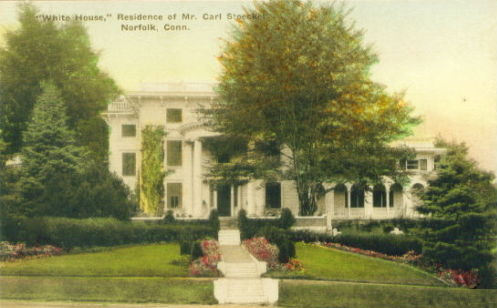
The Joseph Battell House, a 1799 mansion off Norfolk Green on the Ellen Battell Stoeckel Estate, has long been known as “Whitehouse,” its name predating that of the White House in Washington, D.C. The house was built by Joseph Battell, a wealthy merchant whose store had become the market center for the region. He built the house for his future bride, Sarah Robbins, daughter of Rev. Ammi Ruhamah Robbins, minister of the Congregational Church next door. One of their sons, Robbins Battell, was born in the house in 1819 and died there in 1895. An 1839 Yale graduate, Robbins Battell was an adviser to Abraham Lincoln, and a benefactor to his town and Yale University. Called by Frederic S. Dennis “the father of modern Norfolk,” Battell was also a composer and art collector, who had a picture gallery at Whitehouse containing the works of many notable American artists. His only daughter, Ellen, was raised in Whitehouse and later lived there with her second husband, Carl Stoeckel. They were great patrons of music, constructing the Music Shed on their Norfolk estate in 1906. Carl Stoeckel died in 1925 and when Ellen died in 1939, she bequeathed the estate as a trust, primarily for the performance of music under the auspices of Yale University. It continues as the home of the Yale Summer School of Music–Norfolk Chamber Music Festival. Whitehouse, which has been enlarged and altered over the years, is currently being renovated.