Dr. Edward Fitzgerald House (1901)

The Colonial Revival house at 480 East Washington Avenue in East Bridgeport was built in 1901 (or perhaps as early as 1893). It was the home and office of Dr. Edward Fitzgerald, who was appointed medical examiner in the city in 1924. In the 1970s, the house was bequeathed to the United Way of Eastern Fairfield County by Dr. Fitzgerald’s widow and was then sold to an immigrant resettlement agency. By the 1980s, many Victorian-era homes in the Washington Park neighborhood were in bad condition and abandoned as drugs and crime dominated the neighborhood. In 1989, the house’s owner was beaten over the head with a crowbar and tied up by a burglar, but managed to free himself and shoot the intruder three times. In 1995, the house was eventually foreclosed on and sold to investors who were anticipating the opening of a casino nearby that was never built. The house was then acquired by the Washington Park Association and in 1999 was the first of ten properties in the neighborhood to undergo restoration by the Association in a revitalization project supported by grants, a loan and Federal tax credits.

Old Town Hall, Killingworth (1881)

Behind the Congregational Church in Killingworth is a building known as the Old Town Hall. It was built in 1881, as described by William H. Buell in the chapter on Killingworth in the History of Middlesex County, Connecticut, published in 1884:

Several of the farmers of Killingworth, about eight years since, formed themselves into an association […]. In 1880, Deacon L. L. Nettleton, Washington E. Griswold, R. P. Stevens, Francis Turner, Nathan H. Evarts, and all others who had subscribed to the articles of association, petitioned the Legislature that they be constituted a body politic and corporate by the name of the “Killingworth Agricultural Society.” The petition was granted, the society organized under their charter […]

As the society had no building in which to hold their meetings and their fairs, they at once made arrangements to build an Agricultural Hall, and to this end appropriated their share of the State bounty to agricultural societies towards paying the expenses of the building their hall. But some evil minded persons brought the subject before the Legislature, and the society was debarred from having any further benefit of it for that purpose, and they, instead of letting the State have it, divided it among the rest of the agricultural societies. How rich it must have made them!

But the hall was built, and it is 33 by 56 feet, with basement, and by dint of perseverance and their annual fairs (without any further State aid), the society have paid their bills. The basement is now thoroughly cemented, and the society expect to pay this bill as they have their former ones.

Unfortunately, the Agricultural Society later failed and the building was sold in 1910 to the Killingworth Grange. The building became the Town Hall when the town purchased it from the Grange in 1923 for $1.00, with the Grange reserving the right to have its meeting in the building for a reasonable rental fee. In 1965, the town bought a new building to use as Town Hall and in 1966 sold the old Town Hall to the Congregational Church. Today, the restored building is used for various public functions, performances and events.

Enoch P. Hincks House (1894)

The early Colonial Revival house built for Enoch P. Hincks in 1894 is at 515 Washington Avenue in Bridgeport. Warren Briggs was the architect of the house, which is constructed of brick with limestone and terra cotta highlights. Enoch P. Hincks was president of Hincks & Johnson, carriage manufacturers. As described in the second volume of Orcutt’s A History of the Old Town of Stratford and the City of Bridgeport (1886):

Hincks and Johnson, manufacturers of fine heavy carriages, such as coaches, landaus, broughams, coupes, hansom cabs, established their business on Broad street in May, 1879, as successors to Wood Brothers, who, with Stephen and Russell Tomlinson, gained a well deserved reputation during seventeen years of successful labors in the business. Mr. David Wood was among the first to commence a manufactory of heavy carriages in this country, beginning in 1828, under the firm name of Tomlinson, Wood and Company, Mr. Hincks is a native of this city, and Mr. Johnson was engaged In New York for a term of years before starting the business here. They occupy the original edifice built in 1831, with such additions as have been made from time to time, and now cover over two acres of ground floor, giving employment to 100 or 150 hands. They turn out complete about 200 of the larger carriages or coaches yearly, and of other styles a greater number, being, in fact, the largest establishment of the kind in New England and the second in this country. The departments for construction in wood and iron work each in itself would make a large business. They were the first to introduce recently the London hansom cabs, making some changes from the English design, and have already sold a large number of them in the most populous cities of the country. All their business is transacted at the office of their manufactory.

As reported in The Hub, Vol. I, No. 2 (May, 1908):

In connection with the revival of the rumor that the old firm of Hincks & Johnson, the well-known carriage manufacturers of Bridgeport, Conn., intend to go out of business, Enoch P. Hincks, senior member of the firm, practically confirmed the report recently, when he said that nothing definite had been decided upon, but that neither he nor Mr. Johnson cared to continue in business much longer. “We are both getting along in years,” said Mr. Hincks. “We have no plans for the future.”

This firm has had many years of a prosperous trade and its reputation among the trade is of the best. At different times during the past ten years there have been reports of the sale of the firm’s valuable property in Bridgeport.

The Hartford Club (1904)

The Hartford Club

The Hartford Club was founded in 1873 as a union of several local clubs and soon developed a reputation as a literary club: Samuel Clemens joined in 1881. By the turn-of-the-century, the Club was focused on serving the political and business community of the state. In its early decades, the Hartford Club rented a series of increasingly larger spaces on Prospect Street. After merging with the Colonial Club in 1901, the enlarged Club built a new clubhouse at 46 Prospect Street. Designed by Robert D. Andrews of the architectural firm of Andrews, Jacques and Rantoul, the Georgian Revival clubhouse was opened in 1904. (more…)

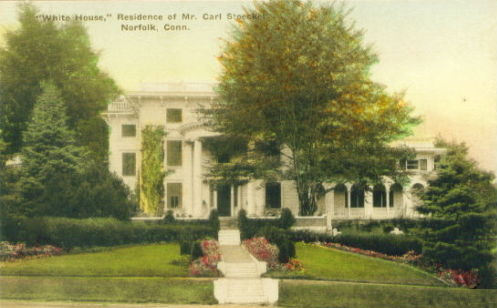
Whitehouse (1799)

The Joseph Battell House, a 1799 mansion off Norfolk Green on the Ellen Battell Stoeckel Estate, has long been known as “Whitehouse,” its name predating that of the White House in Washington, D.C. The house was built by Joseph Battell, a wealthy merchant whose store had become the market center for the region. He built the house for his future bride, Sarah Robbins, daughter of Rev. Ammi Ruhamah Robbins, minister of the Congregational Church next door. One of their sons, Robbins Battell, was born in the house in 1819 and died there in 1895. An 1839 Yale graduate, Robbins Battell was an adviser to Abraham Lincoln, and a benefactor to his town and Yale University. Called by Frederic S. Dennis “the father of modern Norfolk,” Battell was also a composer and art collector, who had a picture gallery at Whitehouse containing the works of many notable American artists. His only daughter, Ellen, was raised in Whitehouse and later lived there with her second husband, Carl Stoeckel. They were great patrons of music, constructing the Music Shed on their Norfolk estate in 1906. Carl Stoeckel died in 1925 and when Ellen died in 1939, she bequeathed the estate as a trust, primarily for the performance of music under the auspices of Yale University. It continues as the home of the Yale Summer School of Music–Norfolk Chamber Music Festival. Whitehouse, which has been enlarged and altered over the years, is currently being renovated.