
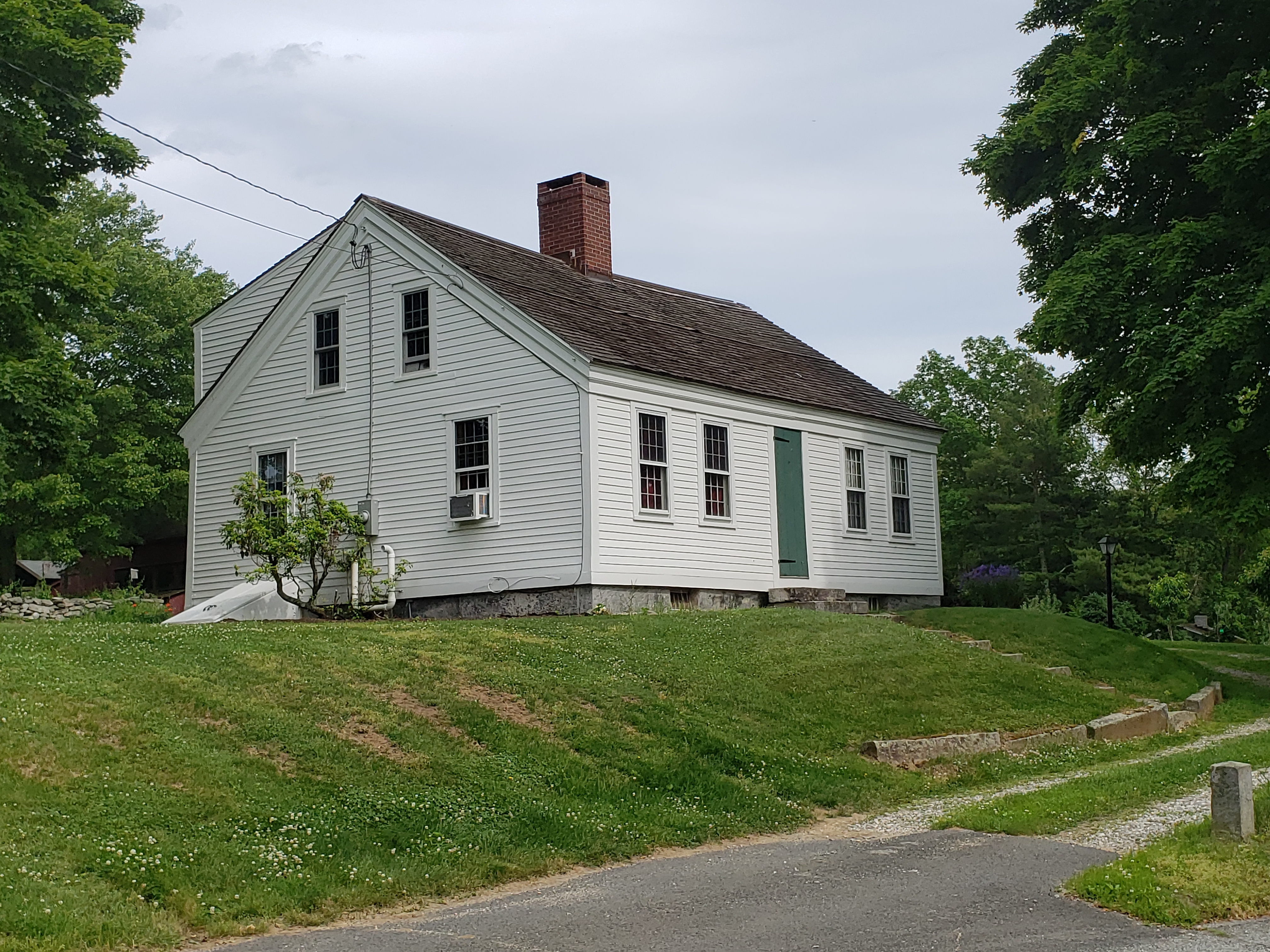
The grand Greek Revival-style house at 155 Burrows Hill Road in the Amston section of Hebron is thought to have been built in 1852.
(more…)The grand Greek Revival-style house at 155 Burrows Hill Road in the Amston section of Hebron is thought to have been built in 1852.
(more…)
By the early nineteenth century, Hopevale, or Hope Valley, located in the Town of Hebron, was an active area for farming as well as manufacturing along the local streams. There were also camp meetings, held on the shores of Barber’s Pond, one of which in 1823 lasted for a full week of preaching. The earliest Methodist Churches in Hebron were one built c. 1805 on Burrows Hill and taken down in 1845 and the 1838 church on Hebron Green that later became the Town Hall. Another Methodist church was established in Hopeville, as related in the Souvenir History of the New England Southern Conference in Three Volumes (1897):
In the year 1849 the church property, situated in what was then called Hope Valley (now Hopevale), was deeded by David Chapman to the trustees in trust for the use of the Wesleyan Methodist Society, and the deed was recorded in the Hebron Town Records.
For some years thereafter that denomination sustained services until unable to do so longer on account of members dying or removing. For some years previous to the year 1881 preaching was sustained by the Methodist Episcopal denomination, but only at the rate of twelve Sabbaths per year, preachers coming from Colchester or Marlborough.
At the Willimantic Camp Meeting in the year 1881 a religious interest was started among the people of Hopevale. Soon afterwards Brother Kathan, laboring among the people, was rewarded by seeing a number converted. One of the results of this revival was an earnest desire to form a Methodist Episcopal Church in this place. Consequently, Sunday, October 10, 1881, Mr. Mitchell formally received into the church Mr. and Mrs. David Johnson and Mrs. Sarah Thompson, the only survivors of the Wesleyan Methodis Society, then living in Hopevale. He also received a number of others by letter and from probation, and baptized and received seven others on probation.
The church property was deeded to a board of trustees for the use of the Methodist episcopal Church February 3, 1882. and the deed recorded in the Hebron Land Records. In the spring of 1882 the church was repaired, painted, papered and a new bell, carpet, lamps, chairs and organ purchased. The church was rededicated September 3, 1882, by Presiding Elder H. D. Robinson.
Since the organization of the church, services have been held regularly, with the exception of three years, when it was closed for want of funds.
[. . .] The church membership has been small, never numbering more eleven by removals and deaths.
[. . .] The quaint Communion Service which was used in the old church is still in good condition, and is used at the present time in Communion Services. It is said that the first Camp Meeting held in Connecticut was held in a grove about one mile from this place.
As related in an historical address by Cyrus H. Pendleton, on the occasion of Hebron’s Bicentennial in 1908:
Of the subsequent history of this church I have been able to obtain scarcely anything definite. There would now seem to be in connection with it no regular church organization, and the trustees are now all residents of Colchester, and services are held in the church just sufficient to use up the income of a small fund bequeathed by Samuel Skinner, a former resident of Hebron, and a member of the Methodist Church on the green.
The church building was also used in the late nineteenth century by the Seventh Day Adventists. Adjacent to the church is a house (built c. 1790-1810), at 29 Reidy Hill Road, that once housed the Adventist school. The church, located at 21 Reidy Hill Road, is now known as the Hope Valley Church.
(more…)
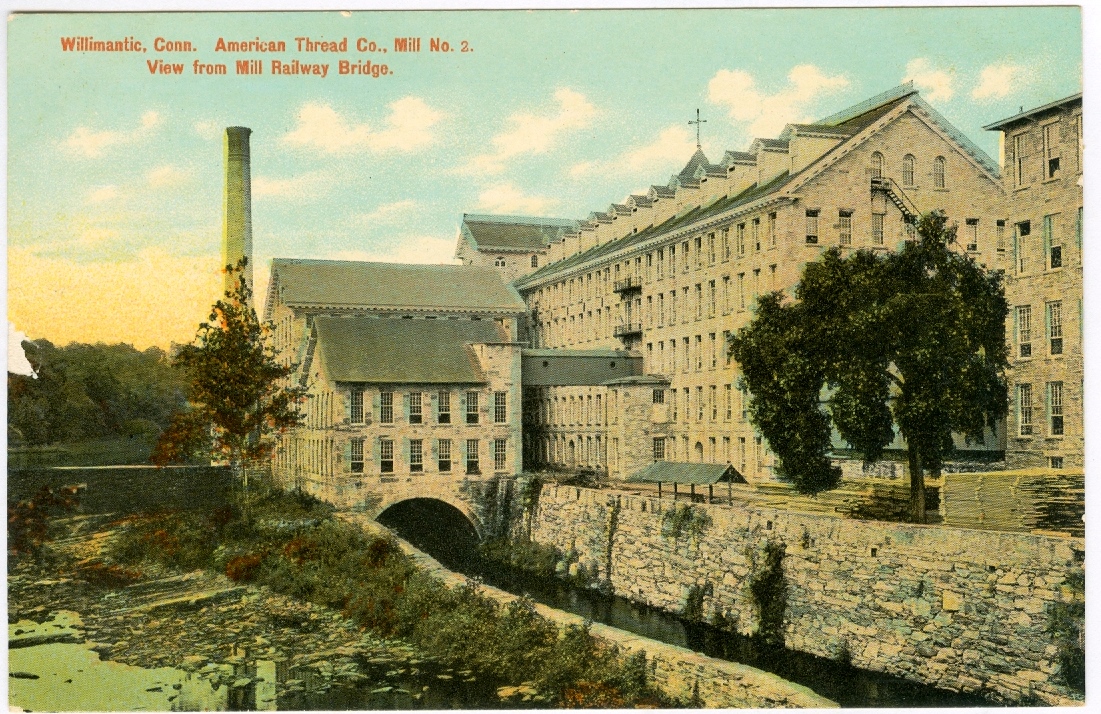
The second major building constructed by the Willimantic Linen Company was Mill No. 2, completed in 1864. The company, founded by Austin Dunham (1805-1877) and Lawson Ives (1804-1867) in 1854, had erected its first mill building in 1857. Like that earlier structure, Mill No. 2 was constructed of gneiss by builder Nathaniel Olin. He had already built a dam for the new mill the previous year. Anticipating the effects of the coming Civil War, Dunham and Ives had started stockpiling raw cotton in the 1850s and were later able to use the proceeds from the sale of cotton thread during the war to erect Mill No. 2, as well as worker housing. In 1872, dormer windows were added to the mill to urn the attic into a usable workspace. These windows were removed after they were damaged in the Hurricane of 1938. More buildings would be added to the mill complex over the years, with several structures being connected to Mill No. 2: the Dye House on the west and the Wheel House and Machine Shop on the south were built in 1864. The Store House & Inspection Building was built on the east side in 1872. The Bleachery (later also called the Dye House) was attached on the west side of the 1864 Dye House in 1883. The result was an extended façade of connected mill buildings that extends over 700 feet. In 1898 the mills were taken over by the American Thread Company. Mill operations ceased in 1895. The complex, located at 322 Main Street in Willimantic, has been redeveloped as the Windham Mills Business Center.
(more…)
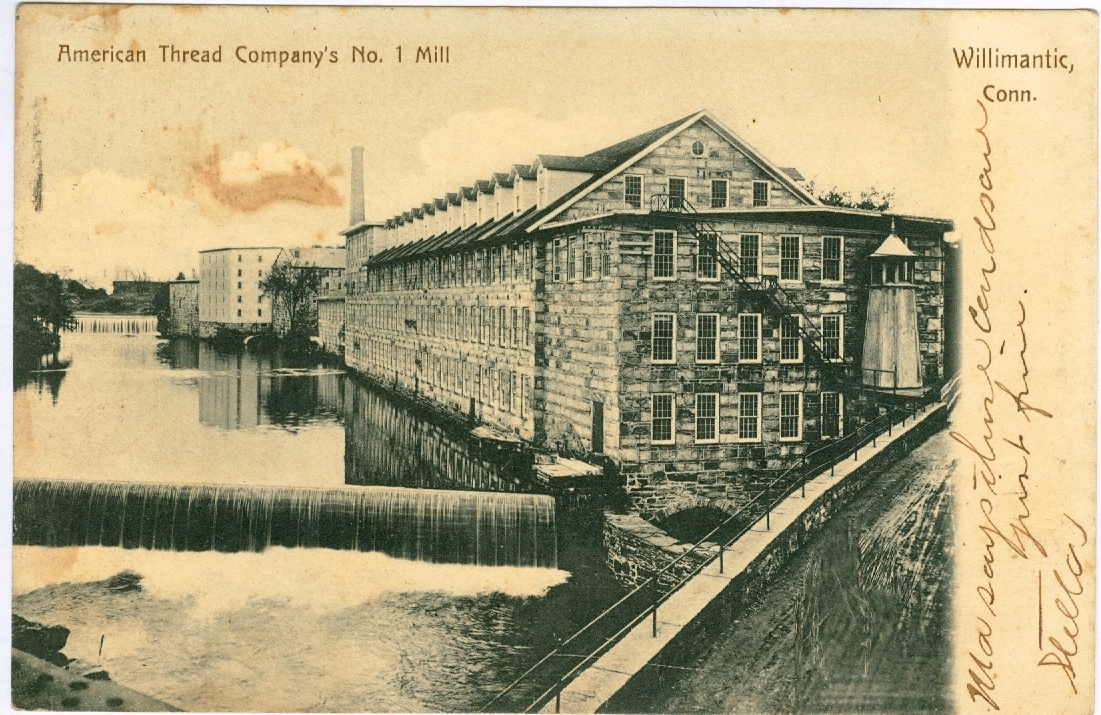
The Willimantic Linen Company was founded in 1854 by Austin Dunham (1805-1877) and Lawson Ives (1804-1867). The company acquired the old Jillson cotton mill in Willimantic with the intention of producing linen, but soon switched exclusively to cotton manufacturing. In 1857, the company erected its first mill building north of the Willimantic River, at the current address of 480 Main Street. Later known as Mill No. 1, it was constructed of locally quarried gneiss by builder was Nathaniel Olin. That same year the company erected an accompanying dam and a stone arch bridge, known as the Windham Road Bridge, on the east side of the mill. Built by Lyman Jordan and Nathaniel Olin, the bridge is now Windham Garden on the Bridge, part of Windham Mills State Heritage Park. The mill building was expanded with an addition on the west side in 1878. The company would expand over the years into a mill complex of many buildings, which were eventually taken under over by the American Thread Company in 1898. Textile production came to an end in 1985. The former Mill No. 1 was converted c. 2003 to become ArtSpace, a housing facility with a community art gallery. The building’s dormer windows were removed at that time.

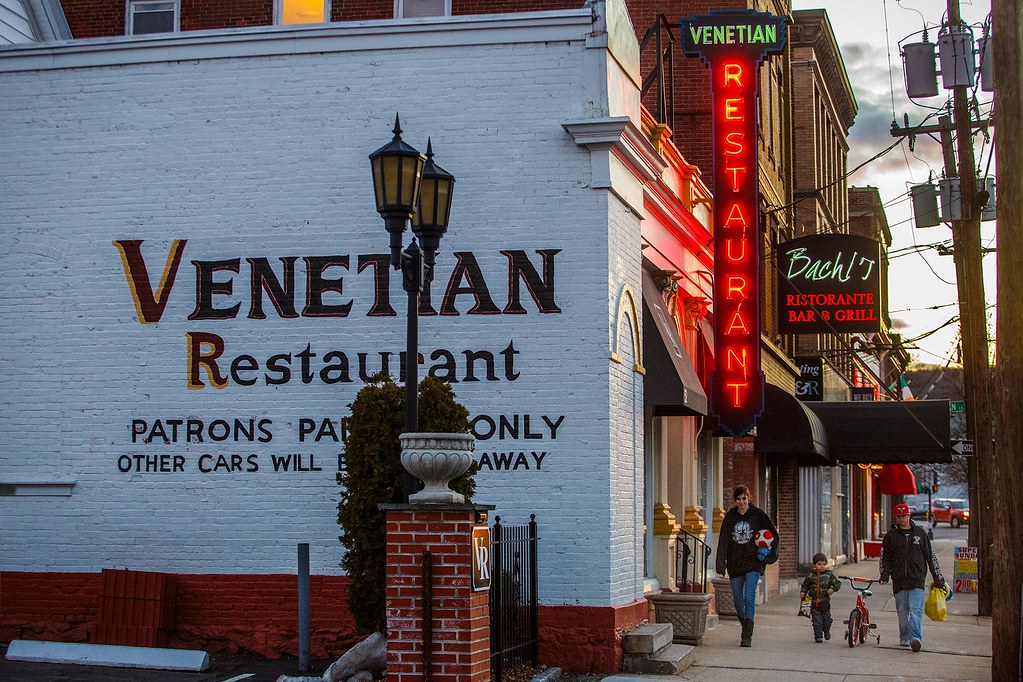
The Venetian Restaurant has been a landmark at 52 East Main Street in Torrington for nearly a century. The rear wood-frame section of the building dates to 1844 and was erected as a store and residence. The front portion, with its Neoclassical façade, was built in 1898 by two German immigrants, William Witzke and Oscar Stoeckert, who opened a saloon in the building. An Italian restaurant opened in 1921 named Charles and Antoinette for its owners, Charles and Antoinette Finello Giampaolo. In 1925 they renamed it The Venetian. In 1931, the building was remodeled with the addition of a neon sign, art deco glass block windows and interior murals of Venice. In 1970, the Giampaolo family sold the restaurant to Michael and Fiorita DiLullo, who are only the second owners in The Venetian’s ninety-eight-year history.

In 1829 Leonard Kenney purchased a parcel of the 1728/29 grant to the heirs of John Stoddard, one of the original proprietors of Litchfield. Soon thereafter he erected the house with the current address of 1083 Bantam Road (Route 202) in Litchfield. Leonard Kenney may be the same Leonard Kenney/Kinney who was postmaster for Bantam Falls. The house remained in the Kenney Family until 1881. It was later the home of Merritt Clarke, who sold dry goods and expanded the rear of the house for his business. Begun in 1923, Merritt Clarke’s Store is still in operation today in the house next door, at 1101 Bantam Road.
(more…)
At the corner of Depot Hill Road and Old Middletown Road in the village of Cobalt in East Hampton is a building erected as a store about 1871. The Mansard-roofed structure was built by three brothers, Russell E., James N. and Rufus D. Tibbals, whose family had owned a store in the area since the late 1840s. The new store, which also contained the Cobalt Post Office, may have been built to take advantage of the opening in 1873 of “The Air Line” railroad, which had a station in Cobalt. The Tibbals also owned factories that manufactured oakum (used for caulking wooden ships), a businesses started by their father, Thaddeus, in 1828. The brothers initially leased the store building to Charles A. Bailey and Francis Kinner, who sold groceries and dry goods. In the early twentieth century, the store was owned and operated by Arthur S. Bailey. After 1940, the building was converted from commercial use into a private residence.

You must be logged in to post a comment.