The house at 825 Worthington Ridge in Berlin was built sometime before 1804 for Daniel Dunbar (1774-1841), who practiced law in town from 1804 until his death in 1841. His law office stood in the north front corner of his yard.

The house at 825 Worthington Ridge in Berlin was built sometime before 1804 for Daniel Dunbar (1774-1841), who practiced law in town from 1804 until his death in 1841. His law office stood in the north front corner of his yard.

Built in 1898, on Main Street in Wethersfield, the town’s Grange Hall served as a meeting place and social center for farmers and their families. The Grange Movement, which began after the Civil War, focused on encouraging farm families to bond together for their own economic and political benefit. The town’s grange was founded in 1890 and received support from the State Grange. The organization hosted numerous programs that provided an active social life for Wethersfield families. Members met at the Old Academy building until 1898, when the Grange Hall was completed. (more…)

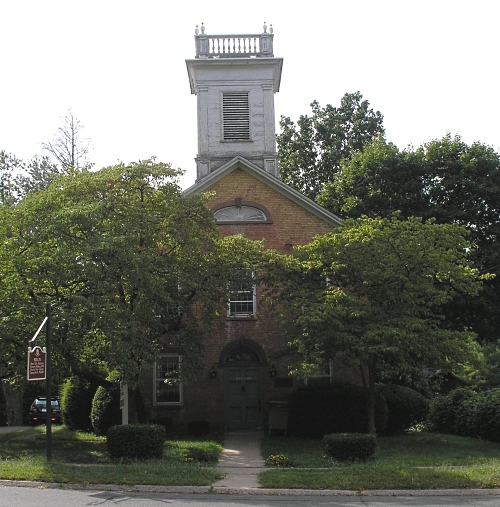
At 834 Worthington Ridge in Berlin is a building erected around 1831 as the second Berlin, or Worthington, Academy Building. The first floor was used as the school, while the second served first as space for the Presbyterian Church, and later as a courthouse. With declining enrollments, the school closed in 1873 and the building served various purposes until in 1900 it was sold to the Brandegee family. In 1949, it was donated in honor of the family to the Berlin Free Library Association and still serves as a library today.
The Asahel Hart House, in the Worthington Ridge Historic District in Berlin, was built around 1786. The doorway, with its semi-circular window, is clearly in the Federal style. A chimney on the southern half must have been removed at some point. Asahel Hart was a tailor, who had his shop in the rear. After his death in 1821, his son, Freedom Hart, inherited the property and had a shop where he made combs from the shells of the turtles that were found in abundance in Berlin’s swampy areas.

Constructed in 1893, on Main Street in Wethersfield, the Keeney Memorial Cultural Center was originally a public school and later served as a court and a library. In 1985, the building was renovated with support from Mrs. William Keeney, becoming a cultural center named in honor of her son, Robert Allan Keeney, who was lost at age 21, when the U.S.S. Indianapolis was sunk in the final days of World War II. The Center houses the Wethersfield Historical Society.
Across Main Street from First Congregational Church in Farmington is the house built in 1740 for Deacon John Hart. Like a number of other historic buildings on Main Street, the house of John Hart is now owned by Miss Porter’s School.
The house built in 1815 for Major Timothy Cowles, on Main Street in Farmington, just south of First Congregational Church, is notable for its three pillared porticoes. When the Amistad survivors were staying in Farmington in 1841, Kagne, one of the three young girls in the group, was probably sheltered in the Timothy Cowles House. The house now owned by Miss Porter’s School.
You must be logged in to post a comment.