Raynham (1804/1856)

raynham.jpg

Raynham, a mansion on Townsend Avenue in New Haven, was built in 1804, but was completely transformed in 1856. With decorative elements derived from the writings of A.J. Downing, the house was transformed, and is maintained today, as an excellent example of the Gothic Revival villa. The house was built on a hill overlooking New Haven Harbor by the Townsend family of merchants. Originally called Bayridge, the house was later renamed Raynham, after Raynham Hall, the seat of the Townsend family in Norfolk, England. The house is still owned by members of the Townsend family.

The Pardee-Morris House (1680)

pardee_morris_house.jpg

The original Thomas Morris House was built around 1680, off what is now Lighthouse Road in the Morris Cove section of New Haven. It is a rare example of a stone ender house in Connecticut. The ell was added around 1767. On July 5, 1779, during the Revolutionary War, the British raided New Haven and burned the house. The surviving stone and timbers were used by Capt. Amos Morris to rebuild the home the following year. In 1915, William Pardee bought and restored the house, bequeathing it to the New Haven Colony Historical Society in 1918. Known as the Pardee-Morris House, it was open to the public as a house museum for many years, but was forced to close in 2000 due to a lack of funds. Now falling into disrepair, the house, which William Hosley describes as, “the most historic property of the Colonial era in New Haven,” faces an uncertain future.

Gideon Welles House (1783)

gideon-welles-house.jpg

The Gideon Welles House, on Hebron Avenue in Glastonbury, was built in 1783 by Samuel Welles, a Revolutionary War captain, for his son of the same name, who had married Anna Hale in 1782. The most famous member of the Welles family to live in the house was Gideon Welles, who was born there in 1802 and would become Lincoln’s Secretary of the Navy during the Civil War. The house was inherited by Gideon‘s brother Thaddeus Welles, but Gideon Welles made a notable return visit in 1864 for the funeral of his nephew, who had been a casualty of the war. During the visit, Welles sat on the porch with Admiral David G. Farragut to plan what would become the successful Union victory at the Battle of Mobile Bay. Gideon Welles had been living in a house on Linden Place in Hartford before the Civil War and later lived in a house on Charter Oak Place. Welles also wrote about his time in Lincoln’s cabinet in his book, Lincoln and Seward and in his posthumously published diary.

The house was lived in by members of the Welles family until 1932. It was originally located where the Welles-Chapman Tavern now stands, but was going to be demolished in 1935 to make way for a Post Office. Dr. Lee J. Whittles and others in town formed a committee to save the house and in 1936, Ernest Victor Llewellyn purchased the house and moved it to a neighboring lot on the New London Turnpike (Hebron Avenue). This committee would eventually become the Historical Society of Glastonbury. In 1974, the house was again moved further up Hebron Avenue to become a Senior Center. Still owned by the town today, the building now houses businesses and shops.

The Buell-Cook House (1877)

buell_cook.jpg

Built on South Street in Litchfield in 1877, when the Gothic Style was still popular, the Buell-Cook House survived the early twentieth-century Colonial Revival transformation of the town, although the home is now painted a Colonial Revival influenced white, rather than its original dark colors. The house was originally a duplex, but in 1982, it was converted for use by a single family.

Sheldon’s Tavern (1760)

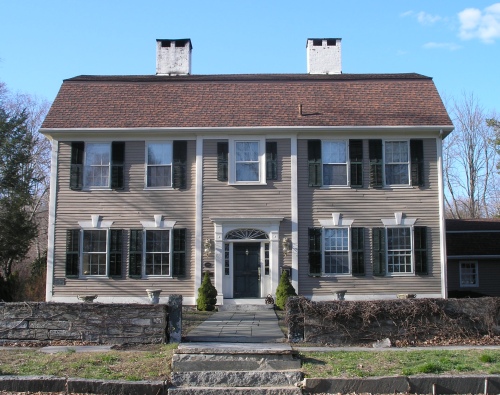
Sheldon's Tavern (1760)

The house built by Elisha Sheldon, on North Street in Litchfield in 1760, is commonly known as Sheldon’s Tavern, because it served as one in the late eighteenth century. There is a tradition that George Washington slept in the house. In 1795, the house’s then owner, Uriah Tracy, hired builder William Sprats to add the central pavilion and Palladian window, which resemble those of the house Sprats designed for Julius Deming across the street. Tracy was a US Congressman and Senator. His son-in-law, James Gould, was the partner of Tapping Reeve at the Litchfield Law School and continued running it after Reeve’s death. The Tavern, also once known as the Gould House, is notable for having shingles rather than the clapboards typical in the eighteenth century.

First Congregational Church of Litchfield (1829)

first-congregational-church-of-litchfield.jpg

Litchfield‘s first meeting house was built on the Green in 1723, the second in 1761 and the third in 1829. In 1873, a fourth church, in the High Victorian Gothic style, was built and the 1829 Federal-style structure, with its steeple removed as was typically done with deconsecrated churches, was moved around the corner. In the coming years it would serve as a community center and theater, known as Amory Hall or Colonial Hall. In the early twentieth century, tastes had shifted back from favoring the Gothic to an interest in the Colonial Revival. In 1929, the Gothic church was demolished and the 1828 church returned to its original site on Torrington Road and restored, complete with a new steeple (1929-30). Reconsecrated, it continues today as the First Congregational Church of Litchfield.

Harkness Memorial Tower (1917)

harkness-memorial-tower.jpg

The most recognizable structure at Yale University is the Harkness Memorial Tower. Designed by James Gamble Rogers, with ornamentation by the sculptor, Lee Lawrie, the Gothic-style tower has long stood as a symbol for Yale. It was constructed between 1917 and 1921 and was donated by Anna M. Harkness in honor of her deceased son, Charles William Harkness, Yale class of 1883. Rodgers, who designed many buildings at Yale in the Collegiate Gothic style, was also the architect for the Harkness family. He said the design for the Tower was inspired by the 15th-century tower of “Boston Stump,” the parish church of Saint Botolph in Boston, England. Apparently, the often told story that Harkness Tower was once the tallest freestanding stone structure in the world is a myth. Inside, the Tower contains the Yale Memorial Carillon, which was originally installed in 1922 and expanded in 1964. It is played by Yale University Guild of Carillonneurs.