
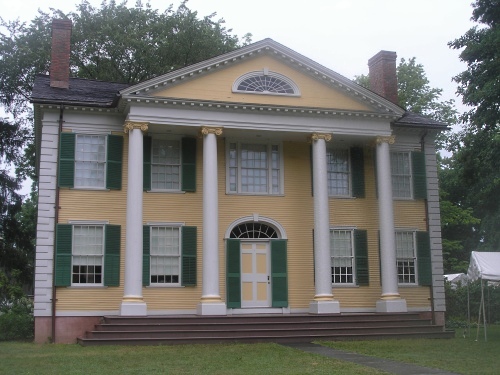
This week we will look at some notable buildings on Lyme Street in Old Lyme. The most famous residence on the street is the Florence Griswold House. Originally built in 1817 for William Noyes, Jr., a son of Judge William Noyes, the house was designed by Hartford builder Samuel Belcher, who was already at work on Old Lyme’s Congregational Church. In 1839, the house was sold to Richard Ely and in 1841 to the sea captain Robert Griswold. His daughter, Florence Griswold, was born in 1850. “Miss Florence” and her sister Adele inherited the house but, left in a precarious financial position, had to take in borders. In 1899, artist Henry Ward Ranger boarded at the house and soon encouraged other artists to stay there. In the following years, a number of notable American Impressionist painters made the home the center of an artist’s colony. The artists included Childe Hassam, Willard Metcalf, Matilda Browne, William Robinson and many others. Several of the artists painted panels in the house’s dining room.
By the 1930s, Florence Griswold was in debt and her property was sold, although the land’s new owner, Judge Robert McCurdy Marsh, who built a new house, allowed her to live in the old house until her death in 1937. In 1941, the house was purchased by the Florence Griswold Association and opened as a museum in 1947. In recent years, the Florece Griswold Museum has expanded, with the gift of the Hartford Steam Boiler and Inspection Company’s art collection in 2001, the construction of the Krieble Gallery in 2002 and the 2005-2006 restoration of the house, which is furnished as it would have been in 1910 at the height of the art colony. Edit: I’ve replaced my earlier image of the house with a new one!



You must be logged in to post a comment.