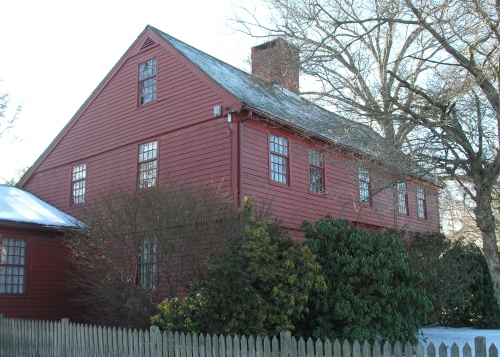
John Pratt, Jr. House (1732)

pratt-house-museum.jpg

The John Pratt House, on West Avenue in Essex, evolved to its present form over many years. John Pratt, Jr. was the grandson of Lt. William Pratt, one of the first settlers of Essex. At the time, the Pratt’s were a family of blacksmiths. In 1701, John Jr. built the gambrel-roofed section, which is now at the rear of the Pratt House. In 1732, he began to construct the front part of the house, which grew over time. The house passed through several generations of the family and became a rental property in the early twentieth century. In 1953, it was given to the Society for the Preservation of New England Antiquities. The house has been owned and operated as a house museum by the Essex Historical Society since 1985.

The Noah Clark Tavern (1791)

noah-clark-homestead.jpg

Noah Clark, Sr. built his house in Haddam on Saybrook Road in 1791. In the seventeenth century, the property had been the location of Haddam’s first meetinghouse. The house served as a tavern in the nineteenth century, run by Noah Clark, Jr. and, after his death in 1834, by his widow, Charity and son, Austin S. Clark. The house was restored in 1997 and is now a private residence. There is also a nineteenth century barn which survives in good condition on the property. (more…)

Thankful Arnold House (1794)

thankful-arnold-house.jpg

The Thankful Arnold House, on Hayden Hill Road in Haddam, was built in three stages between 1794 and 1810. The first section, built in 1794-1795 by Linus Parmalee, was a small house, with a shop on the first floor. The mortgaged house was foreclosed in 1797 and sold to Joseph Arnold, a merchant who had his shop in the basement. In 1800, the second section was built adding two bays to the western end of the house. The third section to be added, in 1810, was an extension to the rear, making the gambrel-roofed house have a saltbox profile. The two-story ell on the west side, which was originally a separate mid-eighteenth century building, was also added at this time. Joseph Arnold died in 1823 and his widow, Thankful Clark Arnold, continued to live in the house, which was known as the Widow Arnold House, until her death in 1849. It was occupied by Arnold descendants until it was purchased in 1963 by one who lived in Texas, Isaac Arnold, who died in 1973, leaving the house to the Haddam Historical Society. By that time, the house had already been restored to its 1810 appearance and opened to the public as a museum in 1965.

Gillette Castle (1919)

gillette-castle.jpg

Gillette Castle was built by the actor and playwright William Gillette. Born in Hartford in 1853, William Hooker Gillette was the son of Senator Francis Gillette and the nephew of John Hooker and Isabella Beecher Hooker. He grew up in Hartford’s Nook Farm neighborhood and made his debut in Mark Twain‘s Gilded Age in 1877. Gillette became most famous for his portrayal of Sherlock Holmes on the stage. He also wrote plays and a work of theory celled The Illusion of the First Time in Acting (1915). Gillette built his castle, in East Haddam, on the southernmost hill of a chain called the Seven Sisters. Modeled on the ruins of Medieval German fortress on the Rhine, Gillette’s Castle was built between 1914 and 1919 of local fieldstone supported by a steel framework. He supervised the construction of the distinctive building, which was surrounded by Gillette‘s eighty-four acre estate on the Connecticut River. He also had his own steam train. Gillette, who died in 1937, stated in his will that he did not want his property to going to “some blithering saphead who has no conception of where he is or with what surrounded.” The home and estate was purchased by the State in 1943 to become the Gillette Castle State Park. Recently restored, the castle is open to the public for tours.

First Congregational Church of Cheshire (1826)

first-church-cheshire.jpg

Cheshire became a seperate parish from Wallingford in 1724. The first meetinghouse was a log cabin on the corner of what is now Lanyon Drive and South Main Street. This was replaced by the second meetinghouse in 1737, on the east side of Cheshire Green (where a Civil War monument stands today). This church was taken down in 1826-1827 and parts were used in the construction of the current church, designed by David Hoadley. The church has a similar design to those of the Congregational churches in Litchfield (1829) and Southington (1830).