Epaphroditus Champion House (1794)

epaphroditus-champion-house.jpg

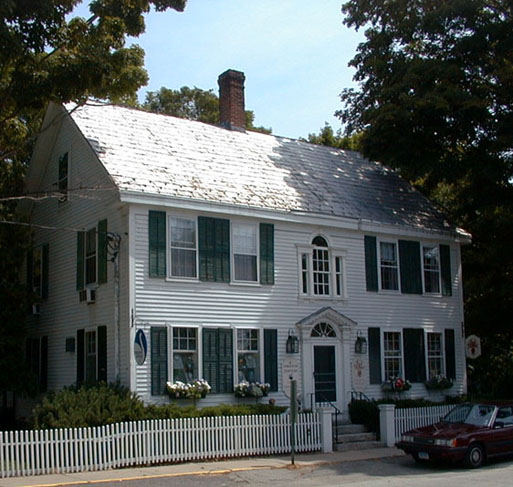
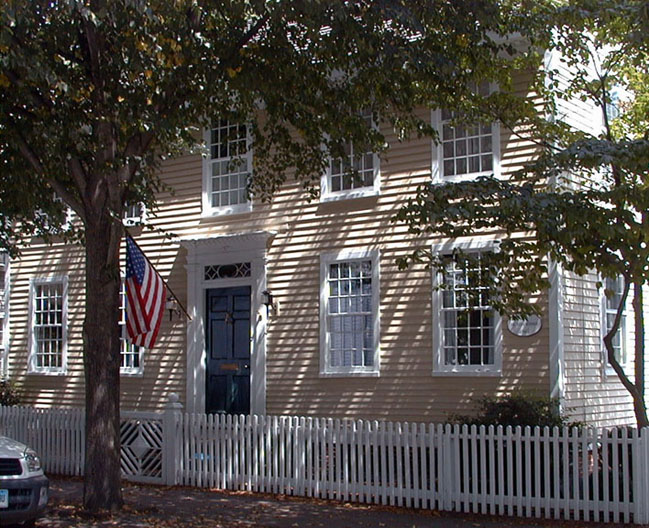
Epaphroditus Champion was the son of Col. Henry Champion, the primary purchasing agent for the Continental Army during the Revolutionary War. Father and son drove a heard of 300 cattle to feed the Washington’s soldiers at Valley forge in 1778. After the War, Epaphroditus Champion, who was a merchant, later settled in East Haddam and served as a U.S. Congressman from 1807 to 1817. The house he built in East Haddam, on a bluff which provides a view of the Connecticut River, is also known as The Terraces. Champion was the cousin and brother-in-law of the merchant Julius Deming of Litchfield. He hired William Sprats, the architect of Deming’s home, to recreate a similar house for himself in East Haddam. In 1940, the Champion House was purchased by the artist, Northam Robinson Gould, who restored it. According to John Warner Barber, in his Connecticut Historical Collections (1836), the house “is distinguished for its bold and lofty terraces, and is a striking object to travellers passing on the river.”

Ira Shailer House (1791)

ira-shailer-house.jpg

UPDATE: This house was destroyed in a fire on June 7, 2023.

Ira Shailer, a descendant of Thomas Shailer, one of the original settlers of Haddam, built his house on Syabrook Road in the Shailerville district of Haddam. It was built in the 1790s, sometime after Shailer married his cousin, Anna Shailer, around 1790. Members of the Baptist Shailer family kept to themselves in their own settlement of Shailerville, often marrying cousins and avoiding outsiders.

Governor’s Residence (1909)

governors-mansion.jpg

The house, which today serves as the Connecticut Governor’s Residence, was originally built in 1909 for Dr. George C.F. Williams, a physician and president of the Capewell Horse Nail Company. Williams hired the firm of Andrews, Jacques & Rantoul, the architects of the Hartford Club, to design his 1908 Georgian Revival home on Prospect Avenue in Hartford. In 1916, additions, designed by the architects Smith & Bassette, were made to the north and south sides of the house. Members of the Williams family resided in the house until 1940 and in 1943 it was purchased by the state to become the Governor’s Mansion. The first governor to reside in the house was Raymond E. Baldwin. Guided public tours of the residence are available.

The Marcus H. Holcomb House (1876)

holcomb-house.jpg

The Italianate-style House, built in 1876 by J.F. Pratt on Main Street in Southington, was later the home of Governor Marcus H. Holcomb from 1899-1932. Holcomb was a state attorney general and superior court judge, before serving as governor of Connecticut from 1915 to 1921. Gov. Holcomb was a Mason and his house, located on the west side of Southington Green, has been the home of Friendship Lodge No. 33 since 1933.

Deep River Town Hall (1893)

town-hall-deep-river.jpg

Deep River‘s distinctive Town Hall was built in 1893 in a “flatiron” shape to conform to its location, where Elm and Main Streets intersect diagonally. The building originally had businesses and a post office (which moved out in the 1960s) on the first floor, with town offices being on the second floor. The third floor has an auditorium. The building’s granite foundation and the 1905 granite fountain outside were both donated by Samuel F. Snow in memory of his wife.

First Church of Christ, Congregational, East Haddam (1794)

first-church-east-haddam.jpg

East Haddam‘s first Ecclesiastical Society began in 1704 and the first meetinghouse took five years to build. The first minister was Rev. Stephen Hosmer. A second meeting house replaced the first in 1728 and the third and current church was built in 1794. It was designed by Lavius Fillmore, an architect who later designed the Congregational churches in two Vermont towns, Bennington (1805) and Middlebury (1809), the latter being considered his masterpiece. The Federal-style East Haddam church has an elaborate interior with Doric columns and Roman arches. It was also built with a domed ceiling which provides excellent acoustics.