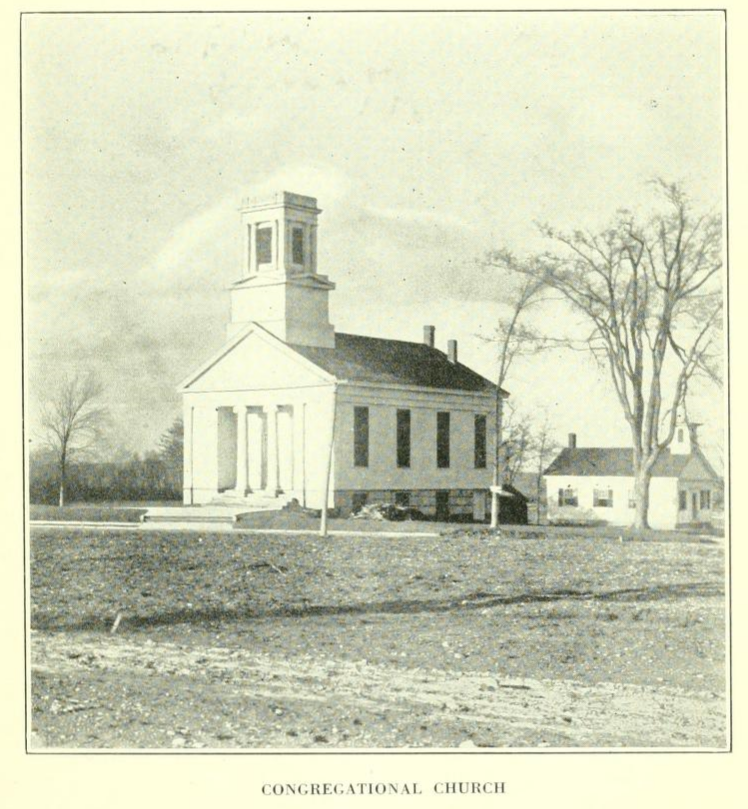
Congregational Church of Burlington (1836)

In the eighteenth century, two parishes were established in what was then the West Woods section of Farmington: the New Cambridge Ecclesiastical Society in 1742 and the West Britain Ecclesiastical Society, gathered in 1774 and incorporated in 1783. That same year, the West Britain Society dedicated their meeting house, constructed after several years of contention over where to build it. The two parishes of West Britain and New Cambridge joined in 1785 to form the new town of Bristol, but differences between the two parishes later led to the separation of West Britain as the town of Burlington in 1806. The first meeting house had been outgrown by then. According to Epaphroditus Peck, in a 1906 Address on the history of Burlington, “It is said that this little meeting-house was never finished inside, and that the swallows used to make their nests in the rafters and often fly in and out during service.” A new meeting house was built in 1809, near to the site of the first building which, according to Peck, “was removed to Bristol, and used as a cotton-mill. It afterward became the Ingraham clock-case shop, and was destroyed by fire in December, 1904.” The 1809 Congregational Church of Burlington was moved, reduced somewhat in size, and rebuilt in the Greek Revival style at its current location on the Burlington Green in 1836.

The Trowbridge-Thoms House (1830)

The Trowbridge-Thoms House, on West Street in Litchfield, was built in 1830 by Henry Trowbridge, a tanner. In the early twentieth century, the barn on the property was used as a classroom for students of landscape painter Alexander Van Lear. The house and barn remained in the Trowbridge family until 1927, when they were sold to a Mr. Thoms, who open a restaurant, called the Canteen, in the barn. The restaurant served patrons of a nearby community playhouse that was later replaced by the current town hall building. Floyd Thoms later turned the barn into an antiques shop, which was continued by the next owner, Thomas McBride, who acquired the property in 1965. Mr. McBride is now retiring and the house and antiques will be sold in an on-site auction on June 5.

Chase Cottage (Topsmead) (1923)

In 1917, Henry Sabin Chase, president of the Chase Brass and Copper Company in Waterbury, gave his daughter, Edith Morton Chase, sixteen acres on Jefferson Hill in Litchfield. Miss Chase had a rustic cottage built on the property, which she replaced with a larger Tudor Revival-style summer home, built in 1923-1925. Chase named the house “Topsmead,” meaning “top of the meadow,” and shared her home with her close friends, the unmarried sisters, Mary and Lucy Burall. They divided their time between the Chase Cottage at Topsmead and the Burall sister’s house on Church Street in Waterbury. When Miss Chase died in 1972, she bequeathed her property to the state. It is now Topsmead State Forest. (more…)

Highfield (1914)

In 1911, Theodate Pope Riddle, famous for designing Hill-Stead in Farmington, completed plans for another country estate for her friends, Joseph and and Elizabeth Chamberlain. In 1909, the Chamberlins had acquired land in Middlebury, close to Whittemore estate. Their house, called “Highfield,” was constructed in 1911-1914, on a hill above Lake Quassapaug. Theodate’s design for the house was influenced by her recent trip to England, where she had studied traditional village architecture and the work of English Arts and Crafts architects like Edwin Lutyens. Designed to resemble a rustic English cottage, Highfield has a large interior, with the second story cleverly concealed behind the sloping shingled roof. Next to the house is a sunken garden, where Theodate created a sumer house with removable glass walls. Charles Downing Lay made alterations to the back of the house in 1925 and to the attic in 1929. In 1954, the Stillman family, who had suceeded the Chamberlins as owners of the house, sold the property, which became a nine hole golf course. The house is now the clubhouse.

Underledge (1896)

Underledge is a fieldstone cottage, built by William Potts on Mountain Road in Farmington around 1894-1896. Potts, a member of the Century Association in New York, wrote two books of nature sketches at Underledge: From a New England Hillside: Notes from Underledge (1895) and More notes from Underledge (1904). In 1898, Potts sold Underledge with eight acres to Alfred Pope and the cottage thus became part of the Hill-Stead estate. Later, Pope’s daughter, Theodate Pope Riddle, calling it the Field Office, used Underledge as her office and studio, where she planned her architectural projects. No longer part of Hill-Stead, the house is now a private home.

Brown-Elton Tavern (1810)

The striking pink, Federal-style Brown-Elton Tavern, located on the Green in Burlington, was built in 1810 as the private home of Giles Griswold, a merchant. It’s design is attributed to builder David Hoadley. By 1820, Griswold had relocated to Georgia and his properties were being foreclosed. The house was soon acquired by Julius Hotchkiss, who died in 1825. His widow, Laura Hotchkiss, later sold the Tavern, which passed through other owners over the years (pdf). The building served as a tavern on the Hartford and Litchfield stage line and later as an inn along the George Washington Turnpike. It was purchased by the Town of Burlington in 1974 and is now home to the Burlington Historical Society, which is restoring the Tavern as a museum.