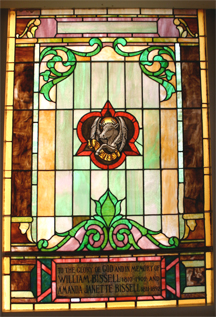
St. Patrick’s and St. Anthony’s Church (1876)

The first St. Patrick’s Church, serving the Irish-Catholic population of Hartford, was dedicated on Church Street in 1851, but was destroyed by fire in 1874. It was replaced by the current quarry-faced brownstone church, completed in 1876. A fire in 1956 gutted the interior of the church, which was restored, but the steeple was removed during the reconstruction. In 1958, St. Anthony’s Parish, dedicated in 1898, merged with St. Patrick’s Parish. St. Anthony’s had served the Italian community of Front Street, a neighborhood that had been demolished for the construction of Constitution Plaza. In 1990, the Franciscan Friars took over the leadership for the ministries of St. Patrick-St. Anthony Church and established the Franciscan Center for Urban Ministry. In 2000, new facilities for the Center were constructed on the grounds of the church.

Thomas Neary Memorial Building (1911)

The Thomas Neary Memorial Building is one of the many impressive buildings constructed in the center of Naugatuck at the turn of the nineteenth century, a period of development sponsored by John H. Whittemore. Located on the corner of Church and Maple Streets, the Neary Building is a business block of offices and shops which anchors a row of commercial buildings on Church Street, south of Naugatuck Green. Completed sometime between 1906 to 1911, the heavily ornamented Neo-Classical Revival structure was designed by the Waterbury firm of Griggs & Hunt (Wilfred Griggs designed many similarly impressive buildings in Waterbury). It was built through the efforts of William J. Neary, a lawyer, in honor of his father, Thomas J. Neary, a businessman who owned and operated a wholesale and liquor business on Water Street.

Daniel Basset House (1775)

The Daniel Basset House, north of the Green in Monroe, was built in 1775. The house has large second-floor ballroom where, according to local tradition, a ball was held on June 30, 1781, to welcome the Hussars of the French mounted Legion led by the Duc De Lauzon (pdf). Lauzun’s Legion, which was protecting the southern flank of the main French army under the Comte de Rochambeau, was camped just south of the village center of New Stratford (now Monroe). The French would soon march to fight in the Siege of Yorktown. The Basset House, located near Masuk High School, maintains much of its historic appearance, with early nineteenth-century decoration around the entrance.

William Loomis House (1795)

The William Loomis House (also known as the Deacon Warner House) in Windsor was built on the corner Broad and Elm Streets, facing Broad Street Green, in the 1790s, or perhaps as late as 1805. Horace Clark moved the house to 31 Elm Street around 1897, detaching the house’s kitchen ell, which was the earlier Deacon John Moore House, now next door to the Loomis House at 37 Elm Street. Clark sold the house to Dr. Clyde A. Clark in 1906.

Deacon John Moore House (1664)

John Moore, ordained a deacon in 1651, was one of the original settlers of Windsor, arriving in 1635 with the Dorchester group, led by the Reverends Maverick and Warham. Moore was a woodworker associated with the “Foliated Vine Group” of seventeenth-century chests. Moore’s house, built around 1664, originally stood on the east side of Broad Street Green. In the late eighteenth century, the large house of William Loomis was built on the west side of the Green and the old Deacon Moore House was moved and attached to the rear of the new house as a kitchen ell. By the end of the nineteenth century, the combined house was owned by Horace Clark, who detached the ell around 1897 and moved it to 37 Elm Street. In its new location, the Moore House originally had its gable end to the street, but was later moved to face the street. The house originally had the large center chimney typical of First Period Colonial houses.

The Williams-Salter House (1711)

The oldest surviving house in Mansfield Center is the Williams-Salter House, built around 1711. It was first the home of Rev. Eleazer Williams, Mansfield’s first settled minister and the son of Rev. John Williams, who was famously taken to Canada, along with five of his children, after the Raid on Deerfield in 1704 (Eleazer was away at school at the time). Eleazer Williams resided in the house until his death in 1742. He was succeeded as minister by Rev. Richard Salter, who married Williams’ daughter Mary in 1744 and purchased the privately-owned parsonage in 1745. Rev. Salter and his brother, John Salter, who also settled in Mansfield, were from a prominent Boston family. Richard Salter, one of the most respected ministers in Connecticut, served in Mansfield until his death, in 1787. The property also has a notable English-style barn.

The James Curtiss House (1737)

The James Curtiss House is a saltbox home on Maiden Lane in Durham. Curtiss purchased the land on which his house stands in 1722 and the house was built sometime between 1737 and 1761, when deeded half of his property to his son, Nathan Curtiss. Nathan was killed in the Revolutionary War in 1776 and his son, James, who inherited the property, was killed in an explosion at the gunpowder manufacturing mill he operated. His widow lived in the house until 1819, but his children migrated to New York and Michigan. In the 1820s, William H. Walkley bought out the shares of the various Curtiss inheritors.