Trinity Episcopal Church, Newtown (1870)

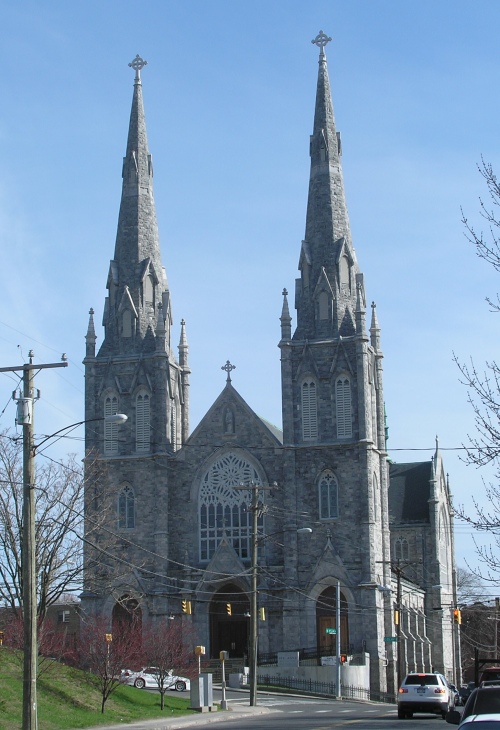
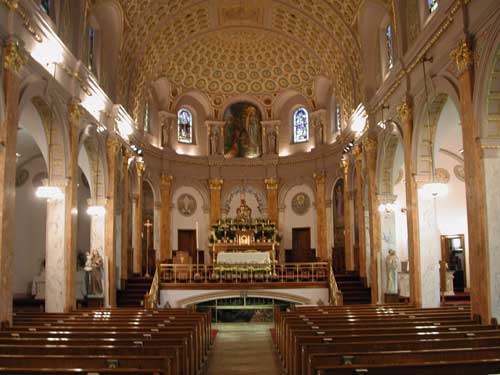
In 1732, Newtown’s Congregational minister, Rev. John Beach, converted to the Anglican Church and traveled to Scotland to be ordained. He then returned to Newtown, where the town’s Anglicans built a small church near the corner of Main Street and Glover Avenue. Its location was marked in 1907 by a memorial tablet. A larger church was built on Main Street in 1746, followed by a third building, formally named Trinity Church and consecrated in 1793 by Bishop Samuel Seabury. The current church was built in 1870. As explained in Newtown’s History and Historian, Ezra Levan Johnson (1917):

In 1866, the parish bought the homestead of Isaac Beers, just south of the old church and separated from it by a branch road connecting at the rear of the Church with the road leading to Sandy Hook. The town relinquished its right to this road. The strip of road, together with the homestead bought of Isaac Beers, made ample room for the site and building of the new Church, without disturbing the old Church building. After the completion of the stone Church, the old building was sold at auction for $100 and torn down. […] The architect was Mr. Silas Norman Beers, one of Newtown’s gifted sons. He, with Mr. Henry Sanford [a merchant] and others of the committee, gave time and strength in unstinted measure to the work, and it was a proud day in February, 1870, that saw the completion of the fourth Church edifice since the first Rector, Rev. John Beach, preached his first sermon in 1732 under the button-ball tree at the four corners below the Street.

Buck-Foreman Community Center, Portland (1852)

The Buck-Foreman Community Center in Portland houses the town’s police, parks and recreation, and youth services departments. The central section of the brownstone building dates to 1852 and was built in the Italianate style as the home of Jonathan Fuller, part-owner of the Shaler and Hall brownstone quarry. When he died in 1876, his daughter Jane inherited the house. At that time, the Town of Portland was looking for a new and more solid building to use as a town hall, as their current building, a former Episcopal church at the corner of Bartlet and High Streets, was a wooden structure built in 1790 and considered to be unsafe (part of the floor even caved in during a Republican Party caucus in 1894!). When Jane Fuller died in 1894, the town acquired the Fuller House and hired architect David Russell Brown of New Haven to remodel it in the Richardsonian Romanesque style. The wing on the south side of the building was added in 1896 as the Buck Library, donated by Horace Buck, who was originally from Portland and whose three children had died and were buried in town. A matching addition on the north side of the Town Hall was built in 1941. The building continued in use as a Town Hall until 1999.

90 Bank Street, New London (1860)

The stone Romanesque Revival block of connected buildings at 90-94 Bank Street in New London were built around 1860 (a sidewalk plaque indicates 1876). The commercial building was used by A.B. Currier, an auctioneer, around 1873 and was later home to Darrow & Comstock, ship chandlers. The New London Day newspaper began publishing on the building’s second floor in 1881. More recently, the building has housed Roberts Audio Video store, with the upper floors being used as a residence.

American Brass Company Headquarters (1913)

For much of its existence, the American Brass Company was the largest brass manufacturer in the country. The company was founded in 1893, with the consolidation of five existing brass mills in the Waterbury area. Purchased by the Anaconda Copper Company in 1922, it lost its individual name and identity in 1960. The American Brass Company’s Headquarters building in Waterbury, built in 1913, has a brass-clad entryway. The structure rounds the curved corner of Grand and Meadow Streets. Today, the building is part of the Waterbury Superior Court House complex, with the main entrance now located in a large addition, built in 1998.