Oldfield (1818)

Between 1818 and 1822, John Moseley built a house on what is now Main Street North in Southbury. The lumber for the house was said to have been personally selected by Moseley in Maine. After Moseley died in 1876 at the age of one hundred, the house passed through several owners, including Albert and Ruth Aston, who donated the land that became the First Church Green. In 1902, a building across the street, which had once served as an inn or store, was moved and attached to the rear of the house and raised from one to two stories. The house’s interior was also featured in photographs taken by Wallace Nutting during the period when he lived in Southbury. Known as Oldfield, the house has been a bed & breakfast, called Cornucopia at Oldfield, since 1997.

Southworth-Williams House (1802)

Alpheus S. Williams was a Union general in the Civil War. He was born in 1810 in Saybrook (now called Deep River). [see General Alpheus S. Williams (1911), by Joseph Greusel and Memorial Addresses on the Life and Character of Alpheus S. Williams (1880)] In 1817, his father, Ezra Williams, bought the house at the corner of Main and Elm Streets in Deep River. It had been built in 1802 by Jabez Southworth, Sr. The year before, Ezra Williams had partnered with George Read, Phineas Pratt and others to form Ezra Williams & Company to manufacture ivory combs.

Mohegan Congregational Church (1831)

On Church Lane in Uncasville near the Tantaquidgeon Museum is the Mohegan Congregational Church. In 1827, land for the church was deeded to the Mohegan Tribe by Lucy Occom Tantaquidgeon, her daughter Lucy Tantaquidgeon Teecomwas, and her granddaughter Cynthia Teecomas Hoscoat. Their friend, missionary Sarah Huntington of Norwich, raised funds and opposed the relocation of the Mohegans during the era of Indian Removal, inspiring her relative, Congressman Jabez W. Huntington, to support the Tribe’s right to remain in Connecticut. The completion in 1831 of a Christian church played an important role at the time in preventing the removal of the Mohegans from their traditional lands. More recently, proof that the church property was the only plot of land that remained continuously owned by the Tribe was a critical factor in the reinstatement of federal recognition in 1994. With new funds, the Mohegan Tribe has restored the church, which has been for so long been a center of tribal political, social, and cultural life.

Tantaquidgeon Museum (1931)

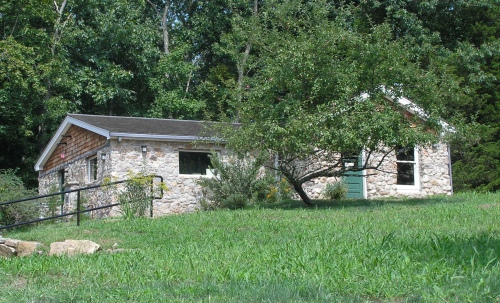
The Tantaquidgeon Museum, on the Norwich-New London Turnpike in Uncasville (in Montville), is the oldest Native American owned and operated Indian museum in America. The Museum‘s stone building was built in 1931 by three members of the Mohegan Tribe: John Tantaquidgeon, who was blind in one eye and on crutches, with his son, Chief Harold Tantaquidgeon, and daughter Gladys Tantaquidgeon. Dr. Gladys Iola Tantaquidgeon (1899-2005) was a Mohegan Medicine Woman who wrote A Study of Delaware Indian Medicine Practice and Folk Beliefs (1942), later reprinted as Folk Medicine of the Delaware and Related Algonkian Indians. She also did social and economic development work with the Bureau of Indian Affairs and the Indian Arts and Crafts Board. The Tantaquidgeon House and the Museum building were recently acquired by the Mohegan Tribe. In 2008, the Museum, which contains objects made by Mohegans and members of other Native American tribes, was reopened after renovations.

Heublein Building, Hartford (1896)

Adjacent on the north of the old Charter Oak Bank Building, on Trumbull Street in Hartford, is the Heublein Building, built in 1896. It was originally the home of G.F. Heublein and Brothers, a liquor and wine company which created the world’s first bottled cocktails in 1892 and began making A1 Steak Sauce in 1895. G.F. Heublein later built the Heublein Tower. The building in Hartford was constructed on the site of the eighteenth-century house of Dr. Norman Morrison, which was demolished to make way for the new building. Dr. Morrison (1690-1761), who was born in Scotland, settled in Hartford around 1740. He is credited with being the first man to separate the practice of medicine from pharmacy.

St. Anne’s Church, Waterbury (1906)

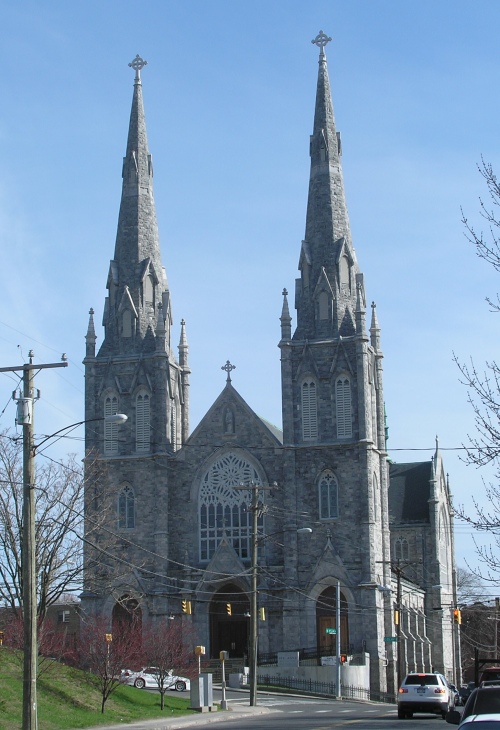
St. Anne’s Parish in Waterbury was organized in 1886 to serve the city’s French and French-Canadian Catholics. The parish’s first church was built in 1888-1889 on Dover Street. In 1906, work began on a much larger church, with the exterior being completed in one year. In 1912, the basement was finished and used for services while the rest of the interior was being worked on. It took several years to accumulate the necessary funds and there was also a delay due to the First World War, but the finished church was dedicated in 1922. The Gothic-style church has a structure of steel and brick with an exterior of granite and Vermont blue marble. The church survived fires in 1971 and 1978 and work was also undertaken in 1979 to repair the two great spires and dome. These signature features continue to impress motorists traveling through Waterbury on I-84.

UPDATE: Sadly, the condition of the two towering spires continued to deteriorate and they were removed in August, 2019.