Gates Building (1906)

Established in 1860, the New Britain National Bank constructed a building at the corner of West Main and Main Streets in 1906. It was designed in the Beaux Arts style by the firm of Davis & Brooks and was used by the bank into the 1930s. Now called the Gates Building, it was acquired by Florence Judd Gates, whose family had become wealthy making barbed wire. Used as retail and office space through the late 1980s, the Gates Building was later restored and now contains the New Britain Board of Education.

The Hemlocks (1847)

In 1847, Deacon Edward Lucas Hart built a house called “The Hemlocks” at 45 High Street in Farmington. He was the nephew of Deacon Simeon Hart, who ran the Hart School for boys in his home in Farmington. As explained in Farmington, the Village of Beautiful Homes (1906), Deacon Edward Lucas Hart

was born in East Haven, December 31, 1813, and died in this town May 15, 1876. He graduated at Yale College in 1836, and after teaching in New Haven and Berlin became associate principal in his uncle’s school in this village. He was a successful and inspiring teacher, much beloved by all who were favored by his friendship. He was for many years a director in the Farmington Savings Bank.

Further, as related in Alfred Andrews’s Genealogical History of Deacon Stephen Hart and His Descendants (1875):

He married April 26th, 1837, Nancy Champion Hooker, daughter of William G., of New Haven. […] He has a fine residence in Farmington, with a school-house on the premises, where he still continues a school for boys, especially in the winter season. Mr. Hart was chosen deacon of the Farmington Church in 1854.

In 1892, the Hemlocks was acquired by Amasa A. Redfield, a New York City lawyer who used the house as a weekend, summer and retirement home. When he died, the New York Times of October 20, 1902 stated that “Mr. Redfield was one of New York’s most prominent lawyers, and was also well known as a writer on legal subjects.” The house was then owned by his son, Robert Latimer Redfield, from 1902 to 1925.

12 Westminster Road, Canterbury (1810)

Dating to around 1810, the house at 12 Westminster Road in Canterbury has a striking Federal-style doorway. The house has been frequently surveyed: in An Architectural Monograph on Old Canterbury on the Quinebaug (White Pine Series of Architectural Monographs, Vol. IX, No. 6, 1923); in the WPA Architectural Survey (c.1935) [Canterbury historic building 028 ]; and in the Historic American Buildings Survey (1940) [the doorway]. The gambrel-roofed ell of the house is believed to be part of an earlier house on the site, the home of Rev. James Cogswell, who ran a school a school for boys there before the Revolution and once had Benedict Arnold as a student.

Sanford-Humphreys House (1793)

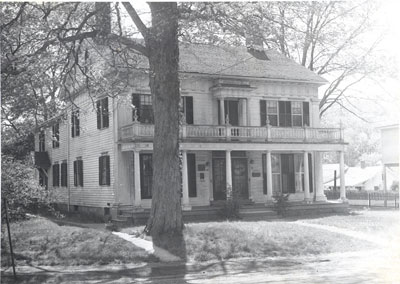
The Sanford-Humphreys House is located at the south-west corner of West and West Church Street in Seymour. It’s oldest section, to the rear, was built in the 1790s by Dr. Samuel Sanford, who became Seymour’s first physician in 1793 and established a smallpox hospital in 1797. After Dr. Sanford’s death, in 1803, the house was enlarged to its present size with the construction of what is today the main block of the structure. It was probably enlarged by General David Humphreys, who at the time was also establishing, with Captain Thomas Vose of Derby, a manufacturing business operating various mills called T. Vose & Company in Humphreysville, as Seymour was then called. In 1810, the company became known as the Humphreysville Manufacturing Company. Judge John Humphreys, the nephew of David Humphreys, later lived in the house. The authors of The History of the Old Town of Derby, Connecticut, 1642-1880 (1880) quote a resident of Seymour who was a contemporary of Humphreys as follows:

Two nephews of Colonel Humphreys represented him in the manufacturing business, and may have had considerable interest therein. The younger, William Humphreys—a fine young man as I first remember him—was the head of the counting-house, and, I think, cashier. The other, John, must have been a lawyer, for he was known as Judge Humphreys, and lived in one of the best houses in the neighborhood, a square white building that stands now on Falls hill, where the road that leads to Bungy crosses the highway. Judge Humphreys and his wife, an elegant, handsome lady, were great favorites with the Colonel, and were generally looked up to in the neighborhood as superior persons. He was one of the finest looking and most dignified men that I remember. Indeed, the whole Humphreys family were remarkable for great personal beauty, both in that and the next generation. Two of Judge John’s daughters, Mrs. Canfield and Mrs. Pease, were beautiful and elegant women.

Waterbury Y.M.C.A. (1924)

A Young Men’s Christian Association was established in Waterbury in 1858. Association activities dwindled by the late 1870s, but the organization was revived in 1883 and officially incorporated in 1889, making it the oldest YMCA in Connecticut. The YMCA‘s rented space soon became inadequate and a new building was constructed on West Main Street in 1892-1893. It occupied part of what had been the land of Philo Brown, who had a house designed by Henry Austin. Philo Brown was head of the Brown and Brothers brass company. The first YMCA building was replaced in 1924 by the current Georgian Revival structure, designed by Richard Dana. The building was expanded with a new modern wing in 1971.

Westminster Congregational Church (1770)

Faced with the long jorney from the western section of Canterbury to the Congregational church in the eastern part of town, outlying residents established the Second Congregational Church of Canterbury, called the Westminster Society, in 1769. A meetinghouse was soon built in 1769-1770, on land donated by John Parks for the Society for a community green, church and cemetery. Around 1840, the Westminster Congregational Church was significantly altered: originally facing east, it was rotated to face south and was remodeled in the Greek Revival style. During the hurricane of 1938, the church’s bell toppled out of the belfry and cracked. The church is therefore known as “the church of the broken bell.”