The New Preston Congregational Church, located at 15 Church Street in the New Preston section of the town of Washington, was built in about 1853. The New Preston Ecclesiastical Society was originally established in 1753 and its first meeting house was located southwest of the common at New Preston Hill (at the intersection of New Preston Hill, Findley, & Gunn Hill Roads). The Society decided to build a second meeting house in 1766 at the northwest corner of the common and this was replaced in 1824 by a stone church building that still exists today and is known as the Hill Church. By the mid-nineteenth century, New Preston Center, a mile to the east, had developed into an industrial center and the congregation decided (after much debate) to erect a new church there in 1853. This is the current New Preston Congregational Church, while the Hill Church is used for summer services. In 1886 the church ordered a Steere & Turner Opus #221 organ which was restored in 1969.
The Greek Revival house at 9 Depot Hill Road in the village of Cobalt in East Hampton was built in 1851, with a rear ell that was added later. The house’s original owner was James N. Tibbals, whose father, Thaddeus Tibballs, had started a successful oakum manufactory on Great Hill Pond Brook. Nearby Middle Haddam was a center of ship-building and oakum was used for caulking wooden ships. James and his brothers continued operating the business after their father’s death. The brothers also owned a store nearby. As described in the Commemorative Biographical Record of Middlesex County, Connecticut (1903):
James N. Tibbals was born in the town of Middletown, September 20, 1824. When he was but ten years old, however, the family mover across the river, and settled in the town of Chatham. His earliest educational training was obtained by walking two miles to a district school, although later he and the children received instruction at home, from Miss Melinda Hurlbut. On reaching his majority he was taken into partnership by his father, and continued to conduct the business after the latter’s death until 1899, when as has been already said, he retired. The elder Tibbals conveyed to the son four hundred dollars’ worth of real property when he reached age of twenty-one, in order that the latter might possess the property qualification then prescribed by law for voters. He first exercised the right of suffrage by casting his ballot for the Whig candidates, and since the organization of the Republican party has been one its most loyal members. Under Mr. Tibbals’ sound business management the oakum manufacture has greatly prospered. Originally not more than eight or ten hands were employed, while at present (1902), during the busy season, as many as twenty find employment, and the annual output exceeds four hundred tons. The raw material used is obtained largely from ropes and rigging of dismantled vessels, although much of it is imported, a single purchase not infrequently reaching fifty tons. Mr. Tibbals’ entire life has been passed in Middlesex county, with the exception of a year spent at Roxbury, Mass., where he engaged in business, but was forced to abandon his enterprise because of a disastrous fire. As a citizen he is broad minded and public spirited, enjoying the affectionate esteem of the community. He has served the town as a selectman and has also held various minor offices. He is a devout, consistent member of the Congregational Church, and a liberal contributor to the cause of religion. He was one of the founders of the society of that denomination between Cobalt and Middle Haddam, among original members of which were no fewer than twenty-six of the Tibbals family, and of which he was a deacon for twelve years.
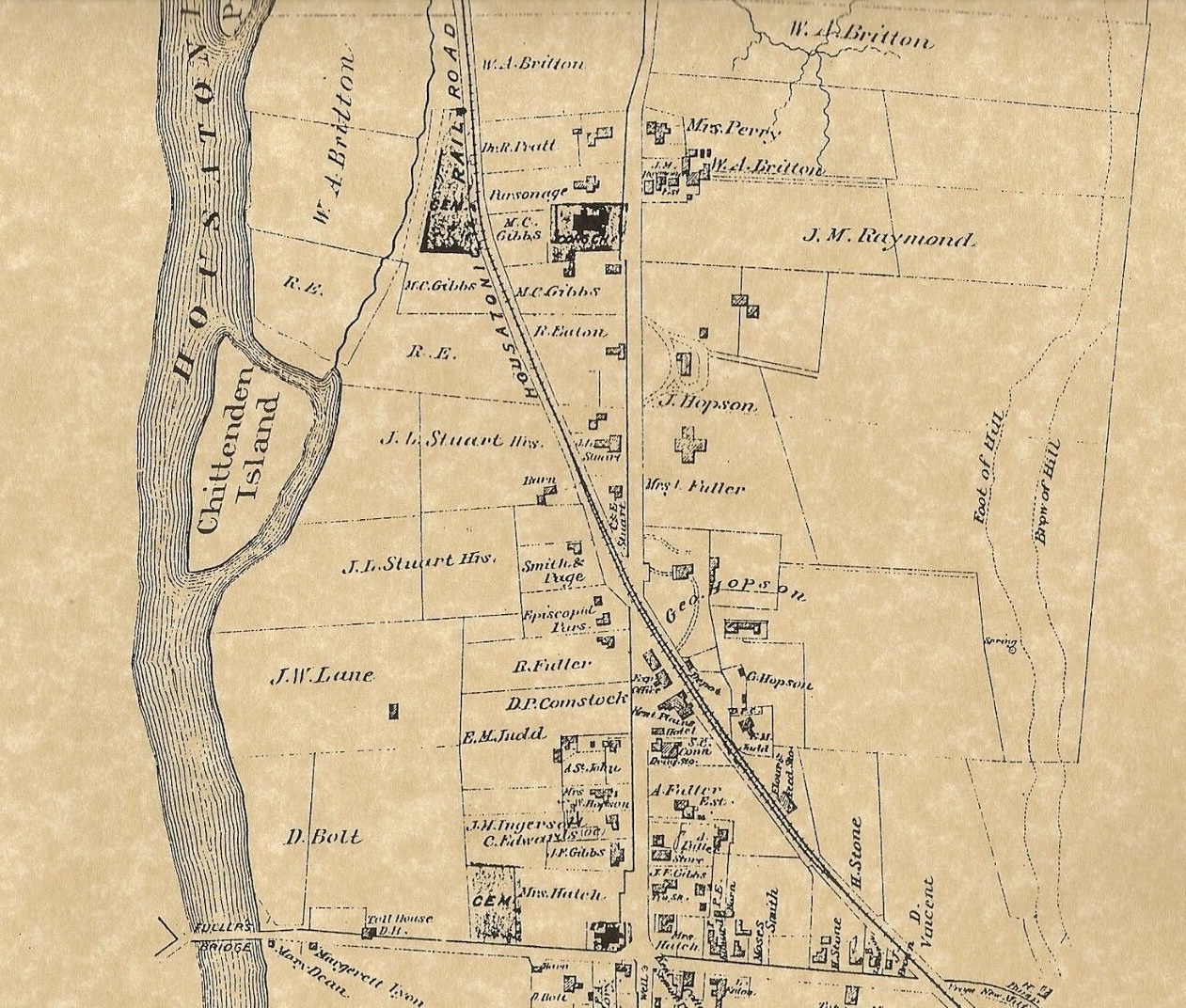
Built around 1850, the former house at 9 Maple Street in Kent is now used as offices. An example of a gable-fronted Greek Revival-style residence, in 1870 (according to the census) it was the home of Moses Smith, his wife Elvira and daughter Josie (he is also shown as the owner in the 1874 map of Kent). Smith, a wealthy businessman, was a partner in the commercial establishment of Smith & Page, which was located on North Main Street across from the railroad depot.
The Italianate-style former house at 50 North Main Street in Kent was built circa 1850. It is associated with the prominent Hopson family, who were wealthy farmers and iron merchants in Kent in the nineteenth century. It is identified as the residence of George Hopson in an 1874 map of Kent. In more recent years, the house was converted to become a branch of the New Milford Savings Bank (which became NewMil Bank in 2000) and is now a branch of Webster Bank (which acquired NewMil Bankcorp in 2006).


You must be logged in to post a comment.