Wallingford Railroad Station (1871)

Another historic Connecticut train station of the 1870s is the Wallingford Railroad Station, built in 1871 by the Hartford & New Haven Railroad on the Springfield Line. With its distinctive Mansard roof and decorative brackets, both elements of the Second Empire style, the Wallingford Station remains a prominent local landmark, located near where Hall and Quinnipiac Avenues intersect with Colony Street. Although the inside of the building has not been open as a station selling tickets since 1991, it remains an active Amtrak station. Owned by the town since 1964, the the station‘s interior was redesigned in the 1970s and the roof and exterior restored in the early 1990s. A number of businesses and organizations have been located in the station over the years. Most recently, it has housed the Wallingford Adult Education Program and the basement has been used by the New Haven Society of Model Engineers. Wallingford is also home to the Peters Rail Road Museum.

Windsor Locks Train Station (1875)

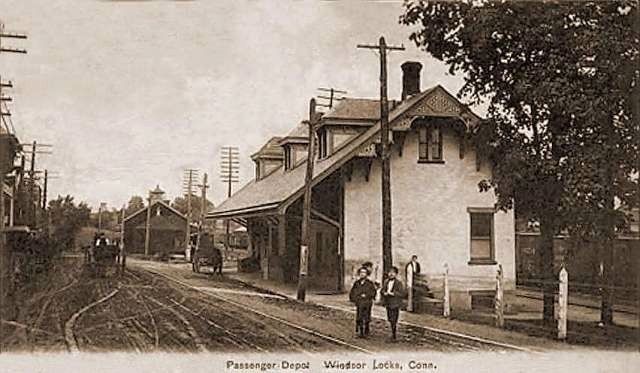
The Windsor Locks Preservation Association was formed in 2004 with a main focus of preserving the old Windsor Locks Train Station, which is currently vacant and in a deteriorating condition, having survived arson in 2000. Built in 1875, the station was originally painted cream-yellow, but a thorough cleaning in the 1940s has since left the building‘s red brick exposed. The station was closed in 1971 and saved from demolition by the The Save The Station Committee, which successfully applied to have the building placed on the National Register of Historic Places in 1975.

The Thames Club (1904)

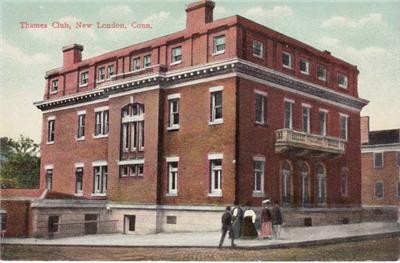
The Thames Club, Connecticut’s oldest social club and the third oldest in New England, was founded in 1869 and later acquired its first permanent home in a residence built in 1838 at the corner of State and Washington Streets in New London. After the house burned down in 1904, it was replaced by a new clubhouse at the same location, completed the following year. Unlike the house that preceded it at 290 State Street, the new Thames Club building‘s entrance was designed to face uphill to the north, instead of facing State Street. The building was designed by Ewing and Chappell of New York. Architect George Chappell was the son of A.H. Chappell, a member of the Thames Club.

Old Town Hall, Hebron (1838)

Hebron‘s Old Town Hall was built in 1838 on Hebron Green as a Methodist meeting house. The earliest Methodist Church in Hebron was erected c. 1805 on Burrows Hill and lasted until 1828, when a new schoolhouse was built that was also used by the church (which had contributed $100 towards its construction) and for town meetings. This was used until the 1838 church building was erected. The old Burrows Hill church building was taken down in 1845. The Methodist Society in Hebron broke up around 1850 and in 1863 the building was sold to the town for use as a town hall, at which time the structure was lowered to one story. It was used for town meetings until 1950 and afterwards was used by various civic organizations for meetings. Since 1971, the Old Town Hall has been owned and maintained as a museum by the Hebron Historical Society, which recently restored the building.

(more…)

First Congregational Church of Plainfield (1819)

The First Church of Christ of Plainfield was established in 1705. The Town of Quinebaug, now Plainfield, had already been incorporated in 1699, although it did not yet have an established church or meeting house. The first meeting house was begun in 1702 on Black Hill and took seven years to be finished. In 1720, the church was moved to a more central position on the turnpike and that structure lasted sixty years. In 1784, a new church, half a mile to the south, was completed, but was blown down in the September gale of 1815. A new and sturdier church, constructed of stone, was completed on the same spot in 1819 and continues today as the First Congregational Church of Plainfield.